What Is an Index Fund? A UK Guide
In short
- An index fund aims to match a market, such as the FTSE 100, rather than trying to beat it.
- It holds the companies in its index, spreading your money widely, usually for lower charges than active funds.
- ETFs can track the same indices but are bought and sold on a stock exchange, like shares.
- Compare the Ongoing Charges Figure and tracking difference, and remember index funds fall when their market falls.
- Companies in the FTSE 100
- 100
- Share of UK market value in the FTSE All-Share
- 98–99%
- Charges to add up: fund OCF and platform fee
- 2
- FSCS limit if an investment firm fails
- £85,000
On this page
- First, what is an index?
- How an index fund works
- Index funds vs actively managed funds
- Index funds and ETFs
- What index funds cost
- Tracking difference
- The risks to understand
- Which index should an index fund track?
- How do you buy an index fund?
- Are index funds good for beginners?
- What to look for in a factsheet
- Related guides
- Sources
An index fund, also called a tracker fund, is a fund that aims to match the performance of a market index, such as the FTSE 100, rather than trying to beat it. Instead of a manager choosing which companies to buy, the fund holds the companies in the index, usually in the same proportions. This guide explains how index funds work, how they differ from actively managed funds and ETFs, and what to check before you invest.
First, what is an index?
An index is a list of investments, put together by rules, that represents part of a market. Its value rises and falls with the investments in it.
The best-known UK example is the FTSE 100. According to FTSE Russell, which runs it, the FTSE 100 is made up of the 100 most highly capitalised blue-chip companies listed on the London Stock Exchange; in other words, the 100 largest by market value. A broader UK index, the FTSE All-Share, combines the FTSE 100, FTSE 250 and FTSE Small Cap indices and covers around 98–99% of the UK stock market’s value.
There are indices for almost every market: global shares, US shares, emerging markets, government bonds and more.
How an index fund works
A fund pools money from many investors and invests it together. MoneyHelper notes that many people invest through pooled funds such as unit trusts, OEICs and investment trusts.
An index fund uses that pooled money to own the investments in its chosen index. When the index rises 2%, the fund aims to rise by about 2% too, less its charges. When the index falls, the fund falls with it. You’re buying the market’s performance, good and bad, not a manager’s judgement.
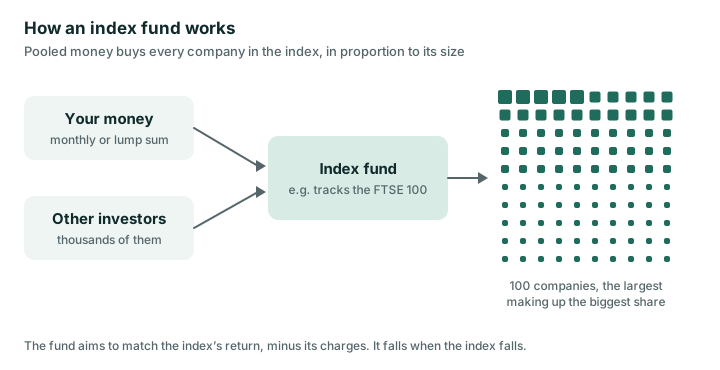
Because one fund can hold hundreds or thousands of companies, an index fund spreads your money widely. If one company does badly, it has a small effect on the whole fund. This spreading of risk is called diversification.
Index funds vs actively managed funds
| Index (tracker) fund | Actively managed fund | |
|---|---|---|
| Aim | Match an index | Beat an index or reach a goal |
| Who decides what it holds | The index rules | A fund manager and team |
| Charges | Usually lower, as there is no stock-picking team to pay | Usually higher |
| Result | Close to the market, minus charges | Depends on the manager; can be better or worse than the market |
Neither type guarantees a return. An index fund will fall when its market falls, and an active fund can underperform the market as well as beat it.
Index funds and ETFs
An exchange-traded fund (ETF) is a fund that’s listed on a stock exchange, so you buy and sell it during the day like a share, at the market price. Many ETFs track an index, so an “index ETF” and an “index fund” can track exactly the same market. Our guide to ETFs covers how they’re priced, taxed and charged.
The practical differences are in how you buy them and what you pay:
- Index funds (often structured as unit trusts or OEICs) are usually bought and sold once a day at a single price.
- ETFs trade throughout the day, and platforms sometimes charge dealing fees for them as they do for shares.
Which costs less depends on the fund’s charges and on how your platform charges for each type. Our guide to platform fees explains those differences.
What index funds cost
Every fund has running costs, which come out of the fund itself. MoneyHelper suggests checking a fund’s annual management charge and its Ongoing Charges Figure (OCF), which covers additional costs, to understand the true cost. Both are shown on the fund’s factsheet or key information document.
The platform you hold the fund on charges separately. The FCA expects platforms to set out all their costs clearly, including the total in pounds and as a percentage, before you invest.
Costs matter more than they look because they’re taken every year. In our worked example, a difference of 0.7 percentage points in yearly charges cost about £26,000 over 30 years. See how fees add up, or try it in the compound interest calculator.
Tracking difference
An index fund won’t match its index exactly. Charges come out of the fund, and the costs of buying and selling, holding cash and handling dividends all create small gaps. The gap between the fund’s return and the index’s return over a period is called the tracking difference. Funds that track the same index can have different tracking differences, so it’s worth comparing them as well as their OCFs.
The risks to understand
- Market risk. An index fund falls when its market falls, sometimes sharply, and it won’t move into cash to protect you.
- Concentration. Some indices are dominated by a small number of large companies or one sector. Check what’s actually in the index.
- Currency risk. Funds tracking overseas markets are affected by exchange rates as well as share prices.
- Not covered by FSCS for falls. FSCS protection applies if an authorised firm fails, up to £85,000 per person per firm for investments. It does not cover losses from falling prices.
Which index should an index fund track?
The index decides what you own, so it’s the biggest choice you make. Some of the most commonly tracked indices:
| Index | What it covers, according to its provider |
|---|---|
| FTSE 100 | The 100 largest companies listed on the London Stock Exchange |
| FTSE All-Share | The FTSE 100, FTSE 250 and FTSE Small Cap combined: around 98–99% of the UK market by value |
| S&P 500 | 500 leading US companies, around 80% of the US market by value |
| MSCI World | 1,249 large and mid-sized companies across 23 developed countries, around 85% of each market |
| FTSE All-World | Around 4,200 large and mid-sized companies in over 45 developed and emerging countries |
A UK index ties your money to one economy, and the FTSE 100 is weighted towards a few large companies and sectors. A global index spreads it across thousands of companies and many countries, but the US usually makes up the largest share, and returns are affected by exchange rates. Neither is right for everyone; the point is to know what you’re buying.
How do you buy an index fund?
- Choose the account. Most people use a stocks and shares ISA or a pension such as a SIPP, so growth and income aren’t taxed.
- Choose a platform. Compare its fees for holding funds, and whether it offers free regular investing. Our platform fees guide explains what to check.
- Find the fund. Search for the index you want, then compare the funds that track it on their OCF, tracking difference and size.
- Pick the unit type. Accumulation units reinvest income for you; income units pay it out.
- Invest a lump sum or set up a regular payment. Regular monthly investing means you buy at a range of prices over time.
Are index funds good for beginners?
We can’t say whether one suits you, but several features explain why they’re often where beginners start. A single fund spreads your money across many companies. You don’t need to pick shares or judge a fund manager. Charges are usually lower than for active funds. And because the fund simply follows its index, it’s easy to understand what you own and why its value changes. The trade-off is that you get the market’s falls as well as its rises, with no attempt to avoid them.
What to look for in a factsheet
- The index it tracks, and what that index contains.
- The OCF and any other charges.
- Tracking difference over several years, if published.
- Fund size, as very small funds may be more likely to close.
- Accumulation or income units. Accumulation units reinvest dividends automatically; income units pay them out to you.
Index funds are usually held inside a stocks and shares ISA or a pension, so that growth and income are sheltered from tax. Free, impartial guidance is available from MoneyHelper.
Sources
- FTSE Russell (LSEG): UK indices
- MoneyHelper: Investing for beginners
- FCA: Investment platforms costs and charges review – good and poor practice
- FSCS: Investments
- FTSE Russell (LSEG): FTSE All-World Index
- MSCI: MSCI World Index
- S&P Dow Jones Indices: S&P 500
Our guides are general information and education, not personal financial advice. If you are unsure whether an investment is right for you, speak to a regulated financial adviser. Capital at risk. Investments can fall as well as rise, and you may get back less than you put in.