Investment Platform Fees Explained (UK)
In short
- Most investors pay a platform fee and fund charges, plus dealing, currency and cash charges depending on how they invest.
- A flat fee works out cheaper than a percentage fee once your balance passes a break-even point: the flat fee divided by the percentage rate.
- In our 30-year example, total charges of 1.0% a year instead of 0.3% cost about £26,000.
- Compare the total in pounds for your own situation, not headline percentages.
- Where a £120 flat fee matches 0.25%
- £48,000
- Cost of 0.7% more in yearly charges over 30 years
- ~£26,000
- Types of charge to check
- 6
- FSCS limit if an investment firm fails
- £85,000
On this page
An investment platform is the company that holds your investments and lets you buy and sell them, often inside an ISA, a pension or a general investment account. Platforms charge in several different ways, and the total you pay can vary a lot between them for the same investments. This guide explains each type of charge, how to compare them, and why small percentages matter over long periods.
The layers of cost
Most investors pay several separate charges at once. The Financial Conduct Authority (FCA), which regulates platforms, groups them roughly into the platform’s main charges, fund charges and activity-based charges.
1. The platform (account) fee
This is what the platform charges to hold your account. It usually comes in one of two forms:
- A percentage of your balance, for example 0.25% a year, often with a lower rate on larger balances or a cap on the total.
- A flat fee, a fixed amount per month or year whatever your balance.
Some platforms charge separately for each account type, so holding an ISA and a pension with the same provider can mean two fees.
2. Fund charges
If you invest in funds, the fund’s manager takes its own charge, which is separate from the platform fee. MoneyHelper suggests checking both the annual management charge and the Ongoing Charges Figure (OCF), which includes additional running costs, to understand the true cost of a fund. You’ll find these on the fund’s factsheet or key information document.
Fund charges are taken from inside the fund, so you won’t see them as a separate deduction from your account. They are reflected in the fund’s price.
3. Dealing charges
Some platforms charge each time you buy or sell, especially for shares, ETFs and investment trusts. Others offer free or cheaper regular investing, where your money is invested on a set day each month. If you trade often, dealing charges can easily cost more than the platform fee.
4. Foreign exchange (FX) fees
Buying an investment priced in another currency, such as US shares, means converting your pounds. Platforms usually charge a percentage of the amount converted, and you pay it again when you sell and convert back.
Example: at an illustrative FX fee of 0.5%, buying and later selling £1,000 of US shares costs £10 in currency fees alone.
5. Interest on cash
Cash waiting to be invested in your account may earn less interest than the platform receives on it, and the difference is effectively a charge. In its 2022 review of platform charges, the FCA listed the “omission of a clear statement of the interest applying to any cash held” as an example of poor practice. Check what interest your platform pays on cash and how much of it the platform keeps.
6. Exit and transfer fees
Some platforms charge to transfer your investments to another provider or to close your account. The FCA’s good practice is for platforms to state clearly whether exit fees apply or not.
Flat fee or percentage fee?
Which structure costs less depends mainly on how much you have invested. Using illustrative figures (not any particular provider):
| Balance | Flat fee of £120 a year | 0.25% a year | 0.45% a year |
|---|---|---|---|
| £10,000 | £120 | £25 | £45 |
| £30,000 | £120 | £75 | £135 |
| £48,000 | £120 | £120 | £216 |
| £100,000 | £120 | £250 | £450 |
| £250,000 | £120 | £625 | £1,125 |
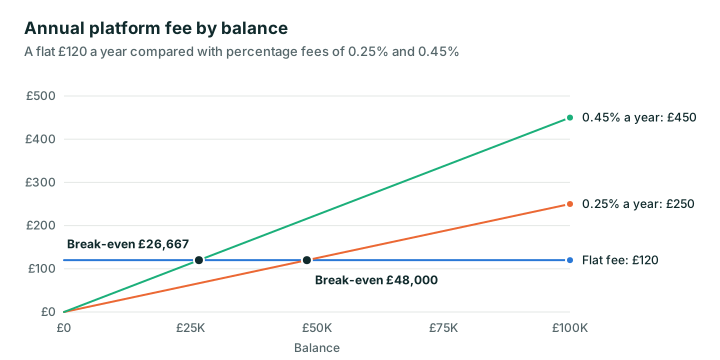
The point where the two structures cost the same is the flat fee divided by the percentage rate. A £120 flat fee matches a 0.25% fee at £48,000, and a 0.45% fee at about £26,700. Below that balance the percentage fee is cheaper; above it the flat fee is cheaper, and the gap keeps widening as your investments grow.
Remember that these are only the platform fees. Fund charges, dealing charges and FX fees come on top.
Why small percentages add up
Percentage charges are taken from your whole balance every year, whether your investments rise or fall. Money taken in fees also misses out on all the growth it would have earned in later years, so the cost compounds.
Example: you invest £10,000 and then £200 a month for 30 years, and your investments grow at a steady 5% a year before charges. You pay in £82,000 in total. The value at the end depends heavily on total annual charges:
| Total charges a year | Value after 30 years |
|---|---|
| 0% | £206,295 |
| 0.3% | £193,803 |
| 1.0% | £167,854 |
| 1.5% | £151,750 |
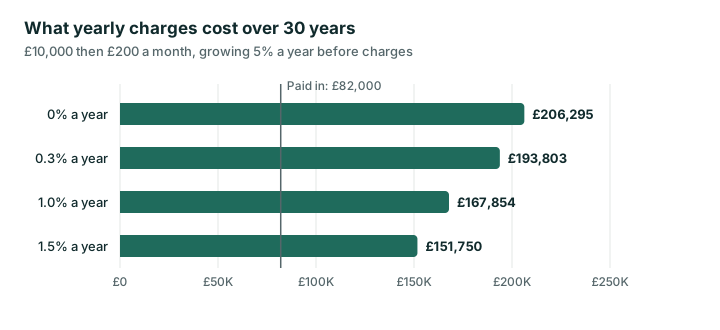
In this example, the difference between total charges of 0.3% and 1.0% a year is about £26,000. Real returns are not steady and can be negative, so treat this as an illustration of how charges compound, not a forecast. Our fee study repeats this across 162 scenarios. You can run your own numbers in our compound interest calculator.
How to compare platforms
The FCA expects platforms to show all their costs and charges clearly, and to express the total cost both as an amount in pounds and as a percentage, with a breakdown available, before you invest. When comparing:
- Work out your likely balance over the next few years, not just today, to see whether a flat or percentage fee suits you.
- List the investments you plan to hold. Funds, shares and ETFs are often charged differently on the same platform.
- Count how often you’ll trade. Regular monthly investing and occasional trades produce very different dealing costs.
- Check FX fees if you plan to buy anything priced outside the UK.
- Check cash interest and exit fees. They are easy to miss: the FCA found activity-based charges, such as FX and interest on cash, were sometimes harder to locate.
- Add it all up as pounds per year for your own situation, rather than comparing headline percentages.
Are there investment platforms with no fees?
Some platforms advertise no account fee or commission-free trading, but every platform has to make money somehow. Common ways are:
- currency exchange fees when you buy overseas shares or funds
- keeping part of the interest earned on the cash in your account
- the spread between buying and selling prices
- charges on particular services, such as transfers out or paper statements
That doesn’t make them a bad deal: for some investors they’re the cheapest option. It means you need to compare the total cost for how you’ll actually invest, not just the headline fee. One practice common in some other countries, payment for order flow, isn’t an option here. The FCA has said it’s incompatible with its rules on conflicts of interest.
Can a platform charge you for leaving?
Some platforms charge to transfer your investments elsewhere. FCA rules don’t ban platform exit fees, but since February 2021 a platform must offer to transfer funds as they are (an in-specie transfer) where the new platform offers the same fund, rather than making you sell them, and must carry out transfers efficiently and within a reasonable time. Many platforms also transfer shares and ETFs this way, but it isn’t guaranteed for every investment. Moving without selling means you stay invested throughout. Your new platform may offer to cover exit fees, so it’s worth asking.
Pensions have extra protection. If you’re 55 or over, a pension provider can’t charge you an early exit charge on a contract taken out on or after 31 March 2017, and on older contracts the charge is capped at 1% of the value.
How should a platform show you its charges?
Under the FCA’s rules, a platform must give you the total of its costs and charges both as an amount in pounds and as a percentage, with a breakdown available on request. You should see this before you invest and in regular statements afterwards. If a platform’s charges are hard to find or you can’t work out the total, that’s a reason to ask questions or look elsewhere.
Is my money safe with a platform?
Check that a platform is authorised on the FCA Financial Services Register before you use it. If an authorised investment firm fails and can’t return your investments, the Financial Services Compensation Scheme (FSCS) may be able to pay compensation of up to £85,000 per person, per firm. The FSCS does not cover losses because investments fall in value: it says it can’t accept claims for poor investment performance.
Key points
- Most investors pay a platform fee, fund charges and, depending on how they invest, dealing, FX and other charges.
- Flat fees tend to suit larger balances; percentage fees tend to suit smaller ones. Work out the break-even point for your numbers.
- Charges are taken every year and compound, so a difference of under 1% a year can cost tens of thousands of pounds over decades.
- Compare the total in pounds for your own situation, not headline rates.
Sources
- FCA: Investment platforms costs and charges review – good and poor practice
- MoneyHelper: Investing for beginners
- FSCS: Investments
- FCA: Payment for order flow, multi-firm review
- FCA: PS19/29 Investment platforms market study remedies
- FCA Handbook COBS 6.1H: platform transfers
- FCA: Cap on early exit pension charges
- FCA: Investment platforms costs and charges review, Handbook provisions
Our guides are general information and education, not personal financial advice. If you are unsure whether an investment is right for you, speak to a regulated financial adviser. Capital at risk. Investments can fall as well as rise, and you may get back less than you put in.