Inheritance Tax on Pensions from April 2027
TL;DR
- From 6 April 2027, most unused pensions count towards your estate for inheritance tax when you die.
- Pensions left to a spouse, civil partner or charity stay exempt. Death-in-service benefits and dependants' scheme pensions are excluded.
- Above the tax-free thresholds, a pension usually adds 40% of its value to the bill, more if the estate passes £2 million.
- Your executors report and pay the tax. They can ask pension schemes to hold back benefits or pay it directly.
- If you die at 75 or over, beneficiaries also pay income tax, but only on what's left after inheritance tax.
Quick answers
- DateWhen does the change start? For deaths on or after 6 April 2027.
- NoInheritance tax on pensions left to spouses? No. Pensions left to a spouse, civil partner or charity stay exempt from inheritance tax.
- NoIs death-in-service cover included? No. Death-in-service benefits from a registered pension scheme are excluded from the estate.
- LimitWhat are the tax-free thresholds? £325,000 nil-rate band, plus up to £175,000 for a home left to direct descendants. Both frozen until April 2031.
- NoWill most estates pay inheritance tax? No. HMRC expects most estates to still have no inheritance tax to pay.
- Watch outCan it be taxed twice? If death is at 75 or over, income tax applies too, but only on what's left after inheritance tax.
- Deaths on or after this date are affected
- 6 April 2027
- Inheritance tax rate above the nil-rate bands
- 40%
- Nil-rate band, frozen until April 2031
- £325,000
- Residence nil-rate band, frozen until April 2031
- £175,000
On this page
- What is changing from 6 April 2027?
- What’s in scope and what isn’t?
- How do the nil-rate bands work with a pension?
- What could the change cost? A worked example
- Who pays the tax?
- How does income tax interact after age 75?
- What could the change mean for retirement plans?
- Common questions about inheritance tax on pensions
- What to do next
- Related guides
- Sources
Until now, money left in a pension at death has usually been outside the estate for inheritance tax. That made pensions a common way to pass on wealth: many people spent ISAs and other savings first and left the pension untouched. Finance Act 2026 changes that for deaths on or after 6 April 2027. This guide explains what’s included and what isn’t, who pays, how income tax interacts with it, and what the numbers can look like. It explains the rules; it isn’t advice on what any one person should do.
What is changing from 6 April 2027?
From 6 April 2027, most unused pension funds and pension death benefits will count towards the value of a person’s estate for inheritance tax. Finance Act 2026 does this by inserting a new section 150A into the Inheritance Tax Act 1984, which treats the member as owning “notional pension property” immediately before death.
The change applies whether or not the pension scheme has discretion over who receives the money. Until now, many schemes paid death benefits at the trustees’ discretion, which kept them outside the estate. That route no longer takes pensions out of scope.
The value counted depends on the type of scheme. For defined contribution pensions, such as a SIPP or most workplace pensions, it’s broadly the money in the pot that can be used to pay death benefits. For defined benefit (final salary) schemes, it’s mainly any lump sum death benefits the scheme pays or can reasonably be expected to pay.
HMRC estimates that of around 213,000 estates with inheritable pension wealth in 2027 to 2028, about 10,500 will pay inheritance tax that previously wouldn’t have, and about 38,500 will pay more. It expects most estates to still have no inheritance tax to pay.
What’s in scope and what isn’t?
Most money that’s left in a pension and can be paid out as death benefits is in scope, but a few types of benefit are excluded and two exemptions continue. The table summarises the position under Finance Act 2026 and HMRC’s policy paper.
| Before 6 April 2027 | From 6 April 2027 | |
|---|---|---|
| Unused defined contribution pension (e.g. a SIPP) | Usually outside the estate | Usually included |
| Lump sum death benefits from a defined benefit scheme | Usually outside the estate | Usually included |
| Left to a spouse or civil partner | Exempt | Still exempt |
| Left to a registered charity | Exempt | Still exempt |
| Death-in-service benefits | Outside | Still excluded |
| Dependants’ scheme pensions from defined benefit or collective money purchase schemes | Outside | Still excluded |
| A dependant’s or nominee’s annuity bought alongside the member’s lifetime annuity | Outside | Still excluded |
The legislation describes the death-in-service exclusion as benefits payable only because the member was in employment or other work of a particular kind immediately before death.
How do the nil-rate bands work with a pension?
Inheritance tax is charged at 40% on the part of an estate above the tax-free thresholds, and from April 2027 the pension is added to the estate before those thresholds are applied. The main thresholds are:
- the nil-rate band of £325,000
- the residence nil-rate band of up to £175,000, when a home is left to children, grandchildren or other direct descendants
The residence nil-rate band is reduced by £1 for every £2 that an estate is worth over £2,000,000. Finance Act 2026 keeps both bands and that taper threshold frozen to the end of the 2030 to 2031 tax year, which is 5 April 2031. A reduced rate of 36% can apply to some assets when 10% or more of the net estate goes to charity.
Anything left to a spouse or civil partner is usually exempt, and any unused nil-rate band and residence nil-rate band can usually pass to them. That’s why a married couple or civil partners can often leave up to £1,000,000 between them before tax is due. A pension that pushes an estate over the thresholds, or further over, increases the tax.
What could the change cost? A worked example
For an estate already near or above the thresholds, adding a pension can increase the inheritance tax bill by up to 40% of the pension’s value. The example below shows how. It is an illustration with round numbers, not a forecast, and it ignores other reliefs, gifts and debts.
A single person with no transferred allowances dies after 6 April 2027. They leave a home worth £400,000 and £150,000 of savings to their children, plus an unused £200,000 defined contribution pension, also to the children. Their nil-rate band and full residence nil-rate band together come to £500,000.
| Pension outside the estate (old rules) | Pension inside the estate (from April 2027) | |
|---|---|---|
| Value of estate | £550,000 | £750,000 |
| Nil-rate bands | £500,000 | £500,000 |
| Taxable amount | £50,000 | £250,000 |
| Inheritance tax at 40% | £20,000 | £100,000 |
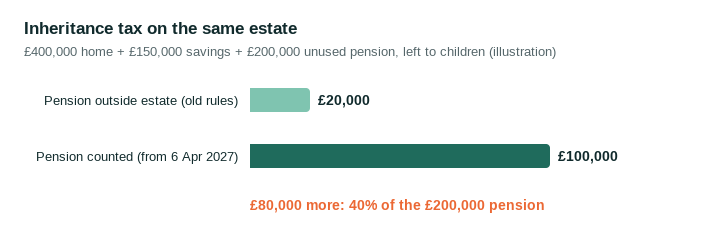
Including the pension adds £80,000 of inheritance tax, which is 40% of the £200,000 pension. Had the same estate been left to a spouse or civil partner, no inheritance tax would have been due on either version, because of the spouse exemption. If the estate were below the thresholds even with the pension included, no tax would be due either.
Who pays the tax?
The deceased person’s personal representatives, meaning the executors named in a will or the administrators if there isn’t one, are responsible for reporting and paying inheritance tax on the pension. The original proposals would have made pension schemes responsible; the government changed this after consultation. Beneficiaries who receive pension benefits can also be liable for the tax on them.
The personal representatives have to find every pension the person had, collect information from each scheme and beneficiary, and report the tax due on each scheme. Our pension checklist covers finding old pension pots and updating beneficiary details, which can make this easier for whoever deals with an estate. Inheritance tax is normally due by the end of the sixth month after the month of death, and HMRC charges interest after that.
Finance Act 2026 gives them two tools:
- Withholding. Personal representatives can tell a scheme to hold back benefits, so beneficiaries can take no more than 50% of what they’re due, for up to 15 months after the end of the month of death or until the tax is paid.
- Direct payment. Anyone liable for the tax can give the scheme a notice to pay it directly from the pension, for at least £1,000. The scheme has 35 days to pay.
Under Finance Act 2026, personal representatives aren’t liable for tax on a pension that comes to light after they’ve received clearance, unless their failure to disclose it was due to carelessness. Beneficiaries are then solely liable for tax on that pension.
How does income tax interact after age 75?
The income tax rules on inherited pensions continue alongside the new inheritance tax rules. Under the current rules, if the person dies before 75, beneficiaries can usually take the money free of income tax, provided, for lump sums, it’s within the deceased’s lump sum and death benefit allowance. There used to be a two-year time limit for this, but the government is removing it for payments made on or after 28 October 2026, with the law due in Finance Bill 2026-27. If they die at 75 or over, beneficiaries pay income tax at their own rate on what they take.
So a pension inherited from someone who died at 75 or over can face both taxes. Finance Act 2026 stops the same money being taxed twice in full: when inheritance tax on the pension is paid by the beneficiary, or by the personal representatives and passed on to them, the beneficiary gets a deduction from their taxable pension income equal to the inheritance tax paid. When the scheme pays the tax directly from the pot, the beneficiary simply receives less, so income tax applies only to what they actually get.
The table follows £10,000 of pension that bears inheritance tax at 40%, drawn by a beneficiary whose marginal income tax rate stays the same throughout. It is a simplified illustration using the England, Wales and Northern Ireland rates.
| Beneficiary’s income tax rate | Inheritance tax | Taxable after deduction | Income tax | Kept from £10,000 | Kept before April 2027 (income tax only) |
|---|---|---|---|---|---|
| 20% | £4,000 | £6,000 | £1,200 | £4,800 | £8,000 |
| 40% | £4,000 | £6,000 | £2,400 | £3,600 | £6,000 |
| 45% | £4,000 | £6,000 | £2,700 | £3,300 | £5,500 |
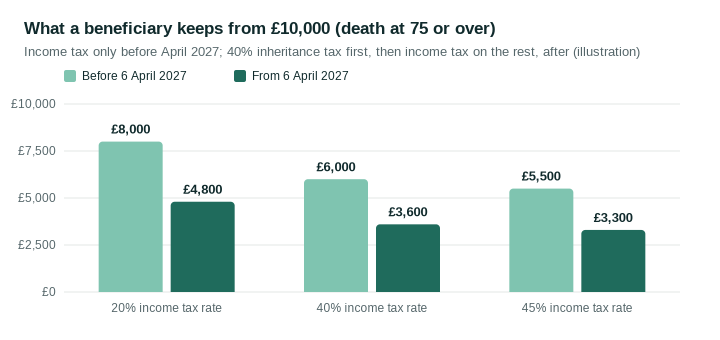
If the person died before 75, the beneficiary would keep £6,000 of the same £10,000 in this illustration, because only inheritance tax applies. In practice, drawing a large sum in one tax year can push a beneficiary into a higher income tax band.
What could the change mean for retirement plans?
The change doesn’t affect tax relief on pension contributions or the income tax rules on a person’s own withdrawals. What it changes is the inheritance tax position of money left in a pension at death, which may affect how some people think about using their savings in retirement.
Leaving a pension untouched and spending ISAs and other savings first used to be a common way to pass money on, because the pension sat outside the estate. For estates above the thresholds, that difference largely disappears from 6 April 2027. Income tax still applies on top to a pension inherited from someone who died at 75 or over.
Some people are reviewing who they’ve nominated to receive their pension, since pensions left to a spouse or civil partner remain exempt. Others are looking at drawing more from their pension in life, which is taxed as income, and the separate inheritance tax rules on gifts, including the seven-year rule. The pension drawdown calculator shows how different withdrawal amounts could affect how long a pot lasts, and our guides to pension drawdown and ISA or pension explain the related rules.
These are complex decisions with large sums involved. Pension Wise from MoneyHelper offers free, impartial guidance backed by the government to people aged 50 or over with a defined contribution pension, and a regulated financial adviser or estate planning specialist can look at a whole situation.
Common questions about inheritance tax on pensions
Is my pension still exempt if I leave it to my husband, wife or civil partner?
Yes. Finance Act 2026 keeps the spouse and civil partner exemption for pension death benefits passing to them. No inheritance tax is due on that part on the first death. What the survivor still owns when they die is then assessed in their own estate, which can include any of their own unused pension.
Does inheritance tax apply to a final salary pension?
Mostly not to the pension itself. Dependants’ scheme pensions from defined benefit schemes are excluded. But lump sum death benefits that a defined benefit scheme pays, or can reasonably be expected to pay, are counted in the estate from 6 April 2027, unless they go to a spouse, civil partner or charity.
Is death-in-service cover affected?
No. Death-in-service benefits from a registered pension scheme are excluded from the estate, whether or not the scheme pays them at its discretion. The legislation defines them as amounts payable only because the member was in employment or other work of a particular kind just before death.
When does the change start?
It applies to deaths on or after 6 April 2027. Section 71 of Finance Act 2026 sets the start date. Deaths before that date are dealt with under the old rules, where pensions paid at a scheme’s discretion were usually outside the estate.
Who tells the pension scheme about the inheritance tax?
The personal representatives. They gather the information from every scheme, work out the tax due on each and report it to HMRC. They can ask a scheme to hold back up to half the benefits for up to 15 months, or ask it to pay at least £1,000 of the tax directly within 35 days.
Can the same pension be taxed twice?
It can face both inheritance tax and income tax if the person died at 75 or over. But income tax is only charged on the amount left after inheritance tax: Finance Act 2026 gives the beneficiary a deduction for inheritance tax that’s been paid on the pension.
Sources
- HMRC: Removing the pensions tax two-year rule (policy paper, 28 October 2026)
- GOV.UK: Inheritance Tax residence nil rate band (taper above £2 million)
- legislation.gov.uk: Finance Act 2026, section 66 (tax to be charged on certain pension interests)
- legislation.gov.uk: Finance Act 2026, section 67 (liability for tax on pension interests)
- legislation.gov.uk: Finance Act 2026, section 68 (withholding of benefits and payment of tax by pension scheme administrator)
- legislation.gov.uk: Finance Act 2026, section 69 (connected amendments to IHTA 1984)
- legislation.gov.uk: Finance Act 2026, section 70 (connected amendments to income tax rules)
- legislation.gov.uk: Finance Act 2026, section 71 (commencement: deaths on or after 6 April 2027)
- legislation.gov.uk: Finance Act 2026, section 72 (rate bands frozen to 2030-31)
- HMRC policy paper: Inheritance Tax on unused pension funds and death benefits (26 November 2025)
- HMRC policy paper: Inheritance Tax on unused pension funds and death benefits (21 July 2025)
- GOV.UK: Inheritance Tax
- GOV.UK: Inheritance Tax thresholds and interest rates
- GOV.UK: Inheritance Tax residence nil rate band
- GOV.UK: Paying Inheritance Tax
- GOV.UK: Tax on a private pension you inherit
- GOV.UK: Income Tax rates and Personal Allowances
- MoneyHelper: Pension Wise
Our guides are general information and education, not personal financial advice. If you are unsure whether an investment is right for you, speak to a regulated financial adviser. Capital at risk. Investments can fall as well as rise, and you may get back less than you put in.