ISA or Pension: Which Should Come First?
TL;DR
- A pension gets tax relief going in, and a quarter usually comes out tax-free. An ISA gets no relief, but everything comes out tax-free.
- In our example, for the same cost a pension ends up worth more, unless your retirement tax rate is higher than your relief.
- Employer contributions and salary sacrifice add to a pension's lead. An ISA has neither.
- ISA money can be used any time. Pensions are locked until 55, rising to 57 on 6 April 2028.
- From 6 April 2027, unused pensions usually count for inheritance tax, as ISAs already do.
Quick answers
- YesCan I pay into both in one year? Yes. ISAs take £20,000; pensions get relief on up to 100% of earnings, within a £60,000 allowance.
- DependsWhen can I get the money? ISA money any time. Pension money from 55, rising to 57 on 6 April 2028.
- Watch outIs pension money taxed when taken out? Usually 25% is tax-free, up to £268,275 in total. The rest is taxed as income.
- NoDo ISA withdrawals count as income? No. They don't use up your Personal Allowance or push you into a higher tax band.
- DependsWhere does a Lifetime ISA fit? A 25% bonus on up to £4,000 a year, for a first home or from 60. Open it before 40.
- NoCan I move an ISA into a pension? Not directly. You can withdraw and pay into a pension, getting tax relief within your allowance limits.
- ISA allowance, 2026/27
- £20,000
- Pension annual allowance, 2026/27
- £60,000
- Usual tax-free part of a pension
- 25%
- Earliest usual pension access age from 6 April 2028
- 57
On this page
- What’s the difference between an ISA and a pension?
- Which gives you more for the same cost?
- How does the tax-free lump sum change the sums?
- How do employer contributions change the comparison?
- When can you get at the money?
- Where does the Lifetime ISA fit?
- Why might an ISA still be chosen?
- How does the 2027 inheritance tax change affect the choice?
- How do people typically order their saving?
- Common questions about ISAs and pensions
- What to do next
- Related guides
- Sources
ISAs and pensions both let your investments grow free of UK income tax and capital gains tax. The difference is when the tax break happens and when you can get at the money. A pension gives you tax relief on what you pay in, but locks the money away and taxes most of it on the way out. An ISA gives no relief on the way in, but you can take the money out whenever you like, tax-free. This guide sets out how the two compare, with worked examples, and where the Lifetime ISA fits.
What’s the difference between an ISA and a pension?
The main difference is timing: a pension gives you the tax break when you pay in, while an ISA gives it when you take money out. With a pension, the government adds tax relief at your income tax rate, and your employer may pay in too. When you take the money, usually a quarter is tax-free and the rest is taxed as income. With an ISA, you pay in from taxed income, but there’s no tax on growth or withdrawals.
| Pension | Stocks and shares ISA | Lifetime ISA | |
|---|---|---|---|
| Tax relief on payments | Yes, at your income tax rate | No | 25% government bonus |
| Employer contributions | Often, in a workplace pension | No | No |
| Yearly limit | £60,000, with relief on up to 100% of your earnings (£3,600 with no earnings; less for very high earners) | £20,000 across all ISAs | £4,000, within the £20,000 |
| Tax when you take money out | 25% usually tax-free (up to £268,275 in total), the rest taxed as income | None | None, for a first home or from 60 |
| When you can access it | From 55, rising to 57 on 6 April 2028 | Any time | First home, from 60, or with a 25% charge |
| Inheritance tax | Usually included from 6 April 2027 | Included | Included |
Which gives you more for the same cost?
For people saving for retirement, a pension usually turns the same cost to take-home pay into more spendable money than an ISA, because tax relief goes in at your current rate and a quarter usually comes out tax-free. The table below uses the same code as our ISA vs pension calculator: £2,400 a year from take-home pay for 25 years, growing 5% a year before 0.5% charges, for a 30-year-old in England using relief at source. The pension figure is after tax at the stated rate on three-quarters of the pot.
| Situation | Paid into pension each year | Pension, after tax | Stocks and shares ISA | Lifetime ISA |
|---|---|---|---|---|
| Basic rate now, basic rate in retirement | £3,000 | £118,323 | £111,363 | £122,065 |
| Higher rate now, basic rate in retirement | £4,000 | £157,764 | £111,363 | £122,065 |
| Higher rate now, higher rate in retirement | £4,000 | £129,923 | £111,363 | £122,065 |
| Basic rate now, higher rate in retirement | £3,000 | £97,442 | £111,363 | £122,065 |
An illustration, not a forecast. Values are after 25 years. Lifetime ISA payments stop at 50, so that column gets 20 years of payments rather than 25, and values are shown before the minimum pension age or 60, when neither a pension nor a Lifetime ISA could yet be used. Real returns vary, and investments can fall as well as rise. Employer contributions aren’t included.
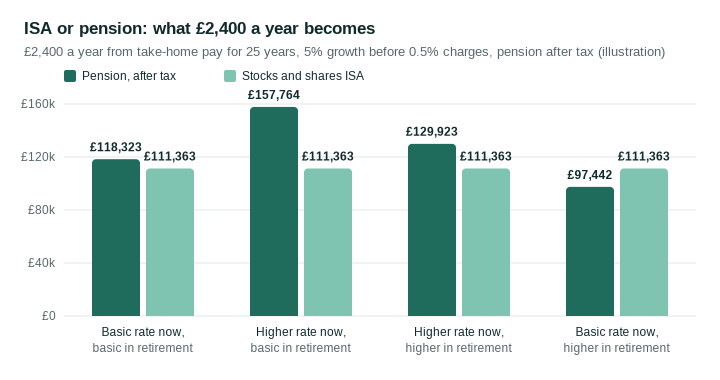
Example: a basic-rate taxpayer who gives up £2,400 of take-home pay a year for 25 years ends up with about £118,323 from the pension after tax, against £111,363 in a stocks and shares ISA. If the same person paid higher rate in retirement, the pension would come to £97,442, less than the ISA.
A basic-rate taxpayer’s £2,400 becomes £3,000 in the pension. A higher-rate taxpayer who claims the extra relief gets £4,000 for the same cost. The pension’s lead shrinks, and can reverse, if you pay a higher rate in retirement than the relief you got going in, as the last row shows. The model also taxes all the taxable part at one rate. Some pension income can fall within your Personal Allowance (£12,570 in 2026/27), though for someone getting the full State Pension, most of the allowance is already used.
How does the tax-free lump sum change the sums?
The tax-free part is a big reason pensions come out ahead: usually 25% of what you take is free of income tax. You can take it as one lump sum when you start drawing your pension, or as a quarter of each withdrawal. There’s a lifetime cap, the lump sum allowance, of £268,275 across all your pensions unless you have a protected amount.
In the basic-rate example above, three-quarters of the pot is taxed at 20%, so each £1 in the pension is worth 85p to spend. The ISA has no relief going in, but every £1 is worth £1. That’s why the pension wins when relief going in is at least as high as tax coming out: £3,000 at 85p beats £2,400 at £1.
Our guide to the tax-free lump sum explains the options, and the pension drawdown calculator shows how withdrawals are taxed.
How do employer contributions change the comparison?
Employer contributions usually decide the question for people in a workplace pension, because an ISA has nothing to match them. Your employer must pay at least 3% of qualifying earnings if you’re auto-enrolled, and many pay more. Some match extra contributions you make, up to a limit, which works like an immediate return on every extra pound you pay. If you leave the scheme, that money stops.
Salary sacrifice widens the gap, because it saves National Insurance as well as income tax. Using the same model, a basic-rate taxpayer giving up £2,400 of take-home pay through salary sacrifice gets £3,333 into the pension, against £3,000 through relief at source. From April 2029, only the first £2,000 a year sacrificed will be free of National Insurance.
Our take-home pay calculator shows what different contribution methods do to your pay, and our workplace pensions guide explains matching and salary sacrifice.
When can you get at the money?
An ISA can be used at any time, but a pension normally can’t be touched until the minimum pension age. That’s 55 now, rising to 57 on 6 April 2028 under the Finance Act 2022, unless you have a protected earlier pension age. A Lifetime ISA can be used without a charge for a first home, from age 60, or if you’re terminally ill with less than 12 months to live.
This matters because many goals come well before retirement: a house deposit, a career break, school fees or simply a buffer against the unexpected. Money for anything needed before 57 isn’t usually held in a pension. Once you can access a pension, though, the rules are flexible: you can take lump sums, draw an income or buy an annuity.
Having money in both can help later on. ISA withdrawals don’t count as income, so they don’t use up your Personal Allowance or push you into a higher tax band. Many people use ISA money to top up pension income in years when extra pension withdrawals would be taxed at a higher rate.
Where does the Lifetime ISA fit?
A Lifetime ISA can be a third option for people aged 18 to 39, because it adds a 25% bonus on up to £4,000 a year, the same boost as basic-rate pension relief. You must open it before 40 and can pay in until you’re 50. The government has consulted on a First Time Buyer ISA to be offered in place of the Lifetime ISA, so it may not stay open to new savers; our Lifetime ISA guide has the latest. It’s mainly for a first home costing £450,000 or less, but it can also be used from 60, tax-free.
In the worked example, the Lifetime ISA comes to £122,065, more than the basic-rate pension’s £118,323, even though payments stop at 50, because nothing is taxed on the way out. But it has limits a pension doesn’t. There are no employer contributions, it falls well behind a pension for higher-rate taxpayers, and it can’t be used until 60 rather than 57. Taking money out for anything else before 60 costs a 25% charge on the whole amount, which takes back more than the bonus.
The government plans a new First Time Buyer ISA to be offered in place of the Lifetime ISA, and its consultation describes it as a product for buying a home. Our Lifetime ISA guide covers the rules and the proposals.
Why might an ISA still be chosen?
An ISA’s strength is flexibility, which matters for any money that might be needed before pension age. Some situations where people often lean towards an ISA:
- Access. You can use ISA money at any time for a house deposit, a career break or an emergency.
- Goals before retirement. Anything needed before you can access a pension fits more naturally in an ISA.
- Tax in retirement. If you expect to pay a higher rate in retirement than you get relief at now, the pension’s advantage shrinks or reverses.
- Limits. Once you’ve used the pension annual allowance, or if you’ve already taken taxable money flexibly from a pension and the £10,000 money purchase annual allowance applies, an ISA can take the rest.
The £20,000 ISA allowance is shared across all your ISAs and doesn’t carry forward. Our ISAs explained guide covers the different types.
How does the 2027 inheritance tax change affect the choice?
From 6 April 2027, most unused pension funds and death benefits will usually count towards your estate for inheritance tax, as ISAs already do. Until then, pensions usually fall outside your estate, which made them a popular way to pass money on. HMRC says pensions left to a spouse or civil partner, or to charity, stay exempt, and death-in-service benefits from registered pension schemes are excluded.
For people saving for their own retirement, this doesn’t change the tax relief going in or the tax-free cash coming out. What it changes is the case for leaving a pension untouched to pass on, and for spending ISAs first to keep the pension for heirs. Income tax rules on inherited pensions also continue: if the person dies at 75 or over, beneficiaries usually pay income tax on what they take.
Our guide to inheritance tax on pensions explains the change and who it affects.
How do people typically order their saving?
There’s no single right answer, but a common sequence works from short-term security to long-term growth. Many people work through something like this:
- An emergency fund in cash. MoneyHelper suggests three to six months’ essential outgoings in an instant-access account.
- Pay off expensive debt, such as credit cards.
- Take any employer pension match in full.
- Save for nearer goals in an ISA, or a Lifetime ISA for a first home.
- Split long-term saving between pension and ISA, depending on tax rate now and later, and how much flexibility matters.
Example (illustration): Sam, 30, earns £45,000, pays 5% into a workplace pension that the employer matches up to 6%, and has £3,000 in emergency savings. Raising the contribution to 6% brings another 1% from the employer for a small cost after tax relief. After that, Sam saves for a house deposit in a Lifetime ISA and puts anything left into a stocks and shares ISA for flexibility.
Common questions about ISAs and pensions
Can I pay into an ISA and a pension in the same year?
Yes. The limits are separate. In 2026/27 you can put up to £20,000 into ISAs and, separately, get tax relief on pension contributions up to 100% of your earnings, within the £60,000 annual allowance. Many people use both: a pension for retirement and an ISA for goals before then.
Is a pension better than an ISA for a higher-rate taxpayer?
In the worked example, yes, if they pay basic rate in retirement: £157,764 from the pension against £111,363 from the ISA for the same cost. Even paying higher rate in retirement, the pension comes to £129,923, thanks to the tax-free quarter. Higher-rate relief has to be claimed if the scheme uses relief at source.
Can I move money from an ISA into a pension?
Yes, by withdrawing from the ISA and paying it into a pension, where it gets tax relief like any other contribution, within your limits. There’s no direct transfer between the two. Withdrawing from an ISA uses up that tax-free space for good unless the ISA is flexible and you replace the money in the same tax year.
Does the Lifetime ISA count towards my £20,000 ISA allowance?
Yes. Anything you pay into a Lifetime ISA, up to £4,000 a year, counts towards the overall £20,000 ISA allowance. The government bonus doesn’t. So someone paying £4,000 into a Lifetime ISA can put up to £16,000 into other ISAs in the same tax year.
What happens if I need my pension money before 57?
Normally you can’t take it. From 6 April 2028 the minimum age is 57, unless you have a protected pension age; before that, it’s 55. GOV.UK lists narrow exceptions, such as ill health, or some schemes joined before 6 April 2006 that allow an earlier age. Firms offering to release a pension early may be arranging an unauthorised payment, which GOV.UK says can be taxed at up to 55%.
If you’re unsure, MoneyHelper’s free guidance service can explain the options, and a regulated financial adviser can look at your whole situation.
Sources
- GOV.UK: Tax on your private pension contributions, tax relief
- GOV.UK: Tax when you get a pension
- GOV.UK: Individual Savings Accounts
- GOV.UK: Lifetime ISA
- GOV.UK: Who can open a Lifetime ISA
- GOV.UK: Withdrawing money from your Lifetime ISA
- HM Treasury: First Time Buyer ISA consultation (June 2026)
- GOV.UK: Workplace pensions, what you, your employer and the government pay
- HM Treasury: Changes to salary sacrifice for pensions from April 2029
- HMRC: Pension schemes rates and allowances
- HMRC: Inheritance Tax on unused pension funds and death benefits
- Finance Act 2022, section 10: normal minimum pension age
- GOV.UK: Early retirement, personal and workplace pensions
- GOV.UK: Tax on a pension you've inherited
- GOV.UK: How ISAs work
- MoneyHelper: Emergency savings, how much is enough?
Our guides are general information and education, not personal financial advice. If you are unsure whether an investment is right for you, speak to a regulated financial adviser. Capital at risk. Investments can fall as well as rise, and you may get back less than you put in.