How to Check Your Pension: A Checklist
TL;DR
- Many people start by listing every pension they've had. The free Pension Tracing Service finds contact details for lost schemes.
- Check your State Pension forecast and National Insurance record on GOV.UK. Gaps can usually be filled for the past six tax years.
- Each annual statement shows your pot's value, what's going in, the charges and an estimate of your retirement income.
- Auto-enrolment default funds can't charge over 0.75% a year. Stakeholder pensions have their own cap. Others may have no cap.
- Each scheme keeps a form saying who you'd like to get your pension if you die. It only helps if kept up to date.
Quick answers
- YesHow do I find a lost pension? The free Pension Tracing Service finds the scheme's contact details. The scheme itself tells you what it's worth.
- DependsCan I fill National Insurance gaps? Usually for the past six tax years, by 5 April each year. Not every gap raises your State Pension.
- LimitWhat's the minimum workplace contribution? 8% of qualifying earnings in total, with at least 3% from your employer.
- DependsIs there a cap on charges? 0.75% on auto-enrolment default funds; stakeholder pensions 1.5% for 10 years, then 1%. Others may not be capped.
- Watch outIs combining old pots always a good idea? Not always. Check for exit fees and lost guarantees. Final salary transfers over £30,000 need regulated advice by law.
- YesIs there free help? Pension Wise gives free guidance if you're 50 or over with a defined contribution pension.
- Minimum total auto-enrolment contribution, at least 3% from the employer
- 8%
- Charge cap on auto-enrolment default funds, a year
- 0.75%
- How far back you can usually fill National Insurance gaps
- 6 years
- Defined benefit transfers above this need regulated advice by law
- £30,000
On this page
- Why check your pension?
- Step 1: How do you find all your pensions?
- Step 2: How do you check your State Pension?
- Step 3: What should you look for on your pension statement?
- Step 4: Are the right contributions going in?
- Step 5: How is your pension invested?
- Step 6: How much is your pension costing you?
- Step 7: Have you told each scheme who should get your pension?
- Step 8: Should you combine your old pensions?
- How do you spot a pension scam?
- Where can you get free help?
- Your pension check-up checklist
- What to do next
- Related guides
- Sources
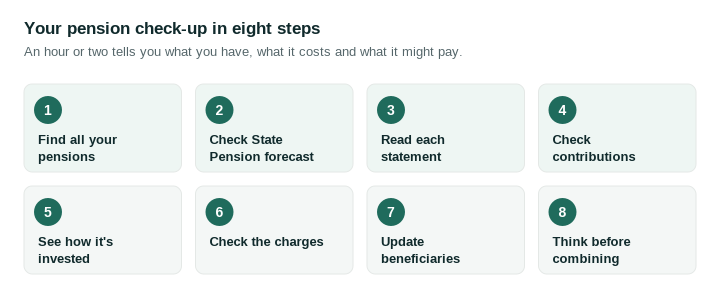
Most people end up with several pensions: one from each employer they’ve worked for, perhaps a personal pension or SIPP, and the State Pension. A pension check-up takes an hour or two and tells you what you have, what it’s costing and what it might pay. This guide works through the checks in order, with official tools for each. There’s a short checklist at the end.
Why check your pension?
Because pensions are easy to lose track of. Every time you change jobs, you may leave a pot behind with a scheme you no longer hear from, especially if you move house and don’t update your address. Small differences also add up over decades: a higher charge, a contribution set below what your employer would match, or an out-of-date beneficiary form can each make a real difference later.
A check-up also tells you whether you’re broadly on track. Once you know what your pensions are worth and what’s going in, you can put the numbers into our pension calculator to see what they could grow to, and our retirement calculator to compare that with what you might need. Our guide to how much pension people need at each age puts those numbers in context. None of these checks commits you to changing anything.
Step 1: How do you find all your pensions?
Start with a list of every employer you’ve worked for, and any pensions you set up yourself. Old payslips, P60s and pension letters will show the scheme names. Then check your emails and paperwork for any you may have forgotten.
If you can’t find details for an old scheme, the government’s free Pension Tracing Service can find contact details for workplace and personal pension schemes. You need the name of the employer or the pension provider. It won’t tell you whether you have a pension there or what it’s worth, so you’ll need to contact the scheme itself with your National Insurance number and dates of employment.
Pensions dashboards will eventually show most of your pensions in one place online. The legal deadline for schemes in scope to connect to the system was 31 October 2026, but dashboards aren’t open to the public yet. Not every pension will appear: workplace schemes with fewer than 100 relevant members aren’t currently in scope, and some schemes could apply to defer. In June 2026, the Money and Pensions Service said it expected the MoneyHelper dashboard to be available in the 2027/28 financial year.
Step 2: How do you check your State Pension?
Use GOV.UK’s Check your State Pension forecast service. It shows when you can get your State Pension, how much you might get, and whether you can increase it. The full new State Pension is £241.30 a week in 2026/27. You usually need 35 qualifying years of National Insurance to get the full amount, and at least 10 to get anything.
Then check your National Insurance record for gaps. Years spent working, claiming certain benefits or caring for children can all count. If there are gaps, you can usually pay voluntary contributions to fill them for the past six tax years, with a deadline of 5 April each year. Class 3 contributions cost £18.40 a week in 2026/27. The special extension that let people fill gaps back to April 2006 ended on 5 April 2025.
Paying isn’t always worthwhile: some gaps won’t increase your State Pension, for example if you’ll reach the full amount anyway. The forecast service tells you whether paying would make a difference before you pay anything. Our State Pension guide explains how it’s worked out.
Step 3: What should you look for on your pension statement?
Each workplace or personal pension sends an annual statement, and most now let you see the same information online. Look for:
- the current value of your pot, and how it’s changed over the year
- what’s been paid in, by you, your employer and tax relief
- the charges you’ve paid, in pounds or as a percentage
- a projection: an estimate of the income your pot might give at retirement, usually in today’s money
- your selected retirement age, which the projection is based on
Check the retirement age is realistic. Many schemes use a default age that may not match your plans. From 6 April 2028, the normal minimum age for taking money from a personal or workplace pension rises from 55 to 57, unless you have a protected earlier pension age.
Projections are estimates based on assumptions about growth and inflation. They’re useful for spotting a shortfall early, but they aren’t promises.
Step 4: Are the right contributions going in?
If you’re an employee, check your payslip against your scheme’s rules. Under auto-enrolment, the minimum total contribution is 8% of qualifying earnings, of which at least 3% must come from your employer. In 2026/27, qualifying earnings are the part of your pay between £6,240 and £50,270, and you’re automatically enrolled if you earn over £10,000 and are aged between 22 and State Pension age.
Many employers pay more than the minimum, and some will match extra contributions you make, up to a limit. If your employer matches and you pay less than the most they’ll match, you don’t get all the employer money on offer. HR or the scheme booklet will have the details. Some employers also offer salary sacrifice, which can save National Insurance; our take-home pay calculator shows the effect.
There are limits on tax-relieved saving. Total contributions from you, your employer and tax relief count towards an annual allowance of £60,000. If you’ve already taken taxable money from a defined contribution pension, a lower money purchase annual allowance of £10,000 usually applies.
Step 5: How is your pension invested?
Most people in workplace pensions are in the scheme’s default fund, chosen by the scheme for members who don’t make a choice. That’s fine for many people, but it’s worth knowing what it holds and how much risk it takes. Your scheme’s website or fund factsheet will show the mix of shares, bonds and other assets.
Some default funds gradually move into lower-risk investments as your selected retirement age approaches, sometimes called lifestyling. That’s another reason to check the retirement age on your statement: if it’s earlier than you plan to retire, your money may be moved out of growth investments too soon.
If you’d like more control, most schemes offer a range of other funds. Our guides to diversification and risk and reading a fund factsheet explain what to compare.
Step 6: How much is your pension costing you?
Charges are taken every year, so small differences compound over decades. Default funds in auto-enrolment workplace schemes are covered by a charge cap: charges paid by members can’t be more than 0.75% a year.
Older workplace pensions, personal pensions, SIPPs and funds you pick yourself outside the default aren’t covered by the 0.75% cap, and some older policies charge more or have exit fees. Your annual statement or the scheme’s charges document will show what you pay. Our platform fee calculator shows what different SIPP providers would cost on your balance, and our fee study shows how much charges add up to over 30 years.
Step 7: Have you told each scheme who should get your pension?
If you die, most pension schemes decide who receives your pension, guided by an expression of wish form, sometimes called a nomination form. MoneyHelper notes the trustees usually have the final say, but they take your wishes into account. Many people filled in a form when they joined and never updated it, so it may still name an ex-partner, or no one.
Check each scheme has an up-to-date form, particularly after marriage, divorce, a new partner or the birth of a child. It usually takes a few minutes online.
From 6 April 2027, most unused pension savings will also count towards your estate for inheritance tax. Our guide to inheritance tax on pensions explains the change.
Step 8: Should you combine your old pensions?
Bringing old pots together can make them easier to track and may lower your charges. But check before you move anything:
- Exit fees on the old pension.
- Valuable guarantees or benefits you’d lose, such as a guaranteed annuity rate or a protected pension age. Older policies are the most likely to have these.
- Defined benefit (final salary) pensions, which pay a guaranteed income. Transferring one usually means giving that guarantee up, and if it’s worth more than £30,000, you must by law take advice from a regulated financial adviser first.
New rules are coming for very small pots. The Pension Schemes Act 2026 lets small, inactive workplace pots of £1,000 or less in default funds be combined automatically, but it isn’t in force yet. The government’s July 2026 roadmap indicates consolidation will begin around 2030. Our guide to SIPPs explains how transfers into a self-invested pension work.
How do you spot a pension scam?
Pension scams often start with an unexpected call, email or social media message. The FCA’s warning signs include:
- promises of guaranteed or unusually high returns
- pressure to decide quickly
- unusual, high-risk or unregulated investments
- complicated structures, with several firms, some overseas, each taking a fee
Never transfer a pension because of a cold call. Check any firm on the FCA register and the FCA’s Warning List before you deal with it.
Where can you get free help?
If you’re 50 or over and have a defined contribution pension, Pension Wise from MoneyHelper offers a free, impartial appointment about your options for taking your money. MoneyHelper also offers free general pension guidance for any age. For a personal recommendation, for example on a transfer, you’d need a regulated financial adviser.
Your pension check-up checklist
- List every employer and pension you’ve had, and trace any missing schemes.
- Check your State Pension forecast and National Insurance record for gaps.
- Find each pension’s latest statement or log in online.
- Note each pot’s value, charges and selected retirement age.
- Check your contributions, and whether your employer would match more.
- Look at how each pension is invested and the risk it takes.
- Update your expression of wish form for each scheme.
- If you’re thinking of combining pots, check for exit fees and guarantees first.
- Put your total into our pension calculator to see where you stand.
Sources
- MoneyHelper: Stakeholder pensions (charge cap)
- GOV.UK: Find pension contact details (Pension Tracing Service)
- GOV.UK: New Pension Tracing Service website launched
- GOV.UK: Check your State Pension forecast
- GOV.UK: Check your National Insurance record
- GOV.UK: Your State Pension explained
- GOV.UK: Voluntary National Insurance, how and when to pay
- GOV.UK: Voluntary National Insurance, rates
- GOV.UK: Deadline for voluntary National Insurance contributions extended to April 2025
- The Pensions Regulator: When your scheme needs to connect with dashboards
- Money and Pensions Service: Pensions Dashboards Programme progress update report, June 2026
- DWP: Pensions dashboards guidance on connection, the staged timetable
- Pensions Dashboards Programme: Delivery timeline
- GOV.UK: Workplace pensions, joining a workplace pension
- DWP: Review of the automatic enrolment earnings trigger and qualifying earnings band for 2026/27
- The Pensions Regulator: Making contributions to your pension scheme
- The Pensions Regulator: What to look for in a pension scheme (charge cap)
- HMRC Pensions Tax Manual PTM051100: Annual allowance
- HMRC Pensions Tax Manual PTM056510: Money purchase annual allowance
- HMRC Pensions Tax Manual PTM028000: Pension age
- GOV.UK: Inheritance Tax on unused pension funds and death benefits
- MoneyHelper: What happens to my pension when I die?
- FCA: Pension transfer advice, what to expect
- The Pensions Regulator: Pension Schemes Act 2026
- GOV.UK: Workplace pensions, an updated roadmap (July 2026)
- FCA: Pension scams
- FCA: Warning List of unauthorised firms
- MoneyHelper: Pension Wise
Our guides are general information and education, not personal financial advice. If you are unsure whether an investment is right for you, speak to a regulated financial adviser. Capital at risk. Investments can fall as well as rise, and you may get back less than you put in.