Pensions · · 5 min read
New Default Pensions: What the Plans Mean
TL;DR
- The government wants workplace pensions to offer a ready-made retirement income, called a default pension, to around 17 million private sector workers.
- About 46% of pots accessed for the first time in 2025/26 were fully emptied, and ministers want more people to have lifelong income.
- Nothing changes yet. You could still choose something else, and no default pension would start paying until you ask for it.
- The consultation closes on 21 December 2026. The government's roadmap has the first schemes complying between July and September 2029.
What it means for you
- No changeWorkplace pension savers today Nothing changes yet. These are proposals, and the consultation runs until 21 December 2026.
- DependsFuture workplace pension retirees Your scheme would offer a default pension. You could turn it down and choose something else.
- DependsPots of £10,000 or less After tax-free cash, lifelong income protection would not be required, under a limit that could still change.
- No changeTaking only tax-free cash Under the proposal, taking only this and staying invested would not trigger a default pension offer.
- No changeIndividual SIPPs Not currently included, though the government is asking whether they should be.
On this page
- What has the government announced?
- Why does the government want default pensions?
- How would a default pension work?
- What could a default pension be made of?
- Does the size of your pot matter?
- Who is covered, and who isn’t?
- When would this happen?
- What does it mean for your pension now?
- Common questions
- Sources
What has the government announced?
On 3 November 2026 the Department for Work and Pensions (DWP) published its plans for Guided Retirement. Under them, workplace pension schemes would have to offer savers approaching retirement a default pension: a ready-made way of turning their pot into an income.
The government says around 17 million private sector workers now saving into a pension would get this option. The legal power comes from the Pension Schemes Act 2026. The details will sit in regulations and, for contract-based schemes, FCA rules. These are still only proposals. The DWP is consulting alongside HM Treasury, the FCA and The Pensions Regulator. GOV.UK’s consultation page gives a closing time of 11:59pm on 21 December 2026, while the consultation document itself says 22 December.
Why does the government want default pensions?
Automatic enrolment got people saving. The DWP says nine in 10 eligible private sector workers now save into a pension, up from four in 10 in 2012. Spending that money is harder. In a defined contribution pension, you build up a pot, and at retirement you decide what to do with it.
The DWP says around 46% of first-time pension pot accesses in 2025/26 involved withdrawing the whole pot. The aim of the plans is to give people an income for life without asking them to make complex decisions themselves.
How would a default pension work?
Your scheme would design a default for groups of savers, then present it when you come to use your pot. The proposals say:
- You’d be allocated, not locked in. You’d stay allocated to the default until you chose something else.
- Nothing pays out on its own. Payments would start only once you asked for them and confirmed your bank details. If you made no contact, your money would stay invested.
- You could say no. Your scheme could then look at whether one of its other options suits you, but it wouldn’t have to.
- There’d be time to change your mind. The government proposes a cooling-off period of at least 30 days.
- Big steps get extra care. Before payment for anything irreversible, such as an annuity, providers would have to do their best to engage you.
- Moving provider needs your consent. Your scheme could send you to another provider for your default pension, but only if you agreed.
What could a default pension be made of?
A default pension must normally protect you against longevity risk, the risk of living longer than your money lasts. The consultation says “a drawdown strategy alone cannot deliver this”. Drawdown means leaving your pot invested and taking money out as you go.
The options it discusses include:
- annuities, which pay a guaranteed income, possibly combined with a period of flexible withdrawals first
- bulk annuities bought by the scheme
- Retirement Collective Pension Schemes (RCPS), which are run by trustees and pay a target income that aims to at least keep pace with inflation.
The government published draft RCPS regulations alongside the plans, and that consultation closes on 15 December 2026. Under the proposals, default pensions couldn’t be designed in a way that requires you to buy your own individual annuity.
Does the size of your pot matter?
Yes. The government proposes that lifelong income protection would apply only above an initial limit of £10,000. That’s measured after any tax-free cash you’ve taken, and it combines all your relevant pots with the same provider. The limit isn’t final: the consultation notes that some feedback suggested £30,000.
Example: someone has pots of £6,000 and £8,000 with one provider. Together that’s £14,000. They take £3,000 as tax-free cash, leaving £11,000, which is above the £10,000 limit. Someone with one £12,000 pot who takes the same £3,000 is left with £9,000, which is below it. Their provider wouldn’t have to build in lifelong protection, though the government expects providers to consider it if that pot is the person’s only pension wealth.
Who is covered, and who isn’t?
The proposals cover workplace defined contribution pensions. That means trust-based schemes whose members are mainly defined contribution savers, and the whole contract-based workplace market, including group personal pensions.
Some things are left out or treated differently under the proposals:
- Tax-free cash only. If you only want your tax-free lump sum and leave the rest invested, your provider generally wouldn’t have to present a default pension at that point.
- Small deferred pots. Pots of £1,000 or less from an old job that meet the small pot consolidation rules would be excluded.
- Individual SIPPs. These aren’t in the proposals for now, but the government is asking whether they should be. Our SIPP guide explains how they work.
When would this happen?
Not soon. The government’s roadmap, updated in July 2026, sets out these planned steps. The government calls these its best estimate, so they may change, and the consultation has its own chapter on timing.
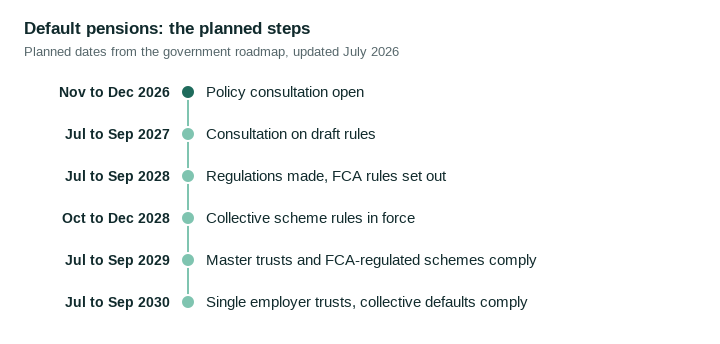
The DWP says it will publish its response alongside a further consultation on draft regulations and on FCA rules. Anyone can respond to the current consultation through the DWP’s consultation page.
What does it mean for your pension now?
Today’s rules still apply, and your options at retirement haven’t changed. To see where you stand, our guide to checking your pension walks through what to look for, and the retirement calculator shows how a pot might turn into an income. This post explains the proposals and isn’t personal advice. The value of investments can fall as well as rise.
Common questions
Will I be forced into a default pension?
No. The government says savers will stay free to choose something else. Under the proposals you would be allocated to a default, but payments would start only once you asked for them and confirmed your bank details. If you did nothing, your money would stay invested.
When does Guided Retirement start?
Not yet. The government's roadmap, updated in July 2026, has regulations made between July and September 2028. Master trusts and FCA-regulated workplace schemes would comply between July and September 2029, and single employer trusts and schemes with collective default pensions between July and September 2030. The government calls these dates best estimates.
Does Guided Retirement apply to my SIPP?
It depends on the type. Workplace SIPPs are in scope, apart from what the consultation calls 'accidental' workplace SIPPs. The government isn't currently proposing to include individual SIPPs, but it is asking for views on whether it should.
Sources
- DWP: New plans "resurrect" genuine pensions for millions of private sector workers (3 November 2026)
- DWP: Guided retirement policy consultation, response page (closes 21 December 2026)
- DWP: Guided retirement policy consultation, full document
- DWP: Workplace pensions, an updated roadmap (updated 14 July 2026)
- DWP: The Pension Schemes (Retirement Collective Money Purchase Schemes) (Amendment) Regulations 2027, consultation
Our guides are general information and education, not personal financial advice. If you are unsure whether an investment is right for you, speak to a regulated financial adviser. Capital at risk. Investments can fall as well as rise, and you may get back less than you put in.