Annuities Explained: Types, Tax and Choices
TL;DR
- An annuity swaps some or all of your pension for a guaranteed income, for life or for a fixed number of years.
- A level income usually pays more at the start. A rising income starts lower but keeps up better with rising prices.
- Joint life, a guarantee period or value protection can pay out after you die, but each lowers the starting income.
- Rates vary between providers, and you can buy from any of them. Health conditions or smoking can mean a higher income.
- It's taxed as income, with no National Insurance. After cooling-off, usually 30 days, a lifetime annuity can't be cancelled.
Quick answers
- Watch outCan I cancel an annuity? Only in the cooling-off period, usually 30 days. After that it can't be cancelled or cashed in.
- Watch outIs annuity income taxed? Yes, as income, usually through PAYE, added to your State Pension and other income.
- YesIs it protected if the provider fails? Yes. The FSCS protects annuities at 100%, with no cap, for providers failing since 3 July 2015.
- NoMust I buy from my own provider? No. You can buy from any provider. Some older pensions have a guaranteed annuity rate you could lose by moving.
- NoDo I have to buy one? No. Drawdown, cash lump sums or a mix are other ways to take a pension.
- DependsDoes the income stop when I die? With a basic single-life annuity, yes. Joint life, a guarantee or value protection can pay out after.
- FSCS protection for annuities if the provider fails
- 100%
- Usual cooling-off period after buying
- 30 days
- Guarantee period paying out after death
- Up to 30 years
- Typical length of a fixed-term annuity
- 1 to 40 years
On this page
- What is an annuity?
- What types of annuity are there?
- Level or escalating income?
- What happens to an annuity when you die?
- What is an enhanced annuity?
- How much income does an annuity pay?
- What is the open market option?
- How is annuity income taxed?
- Is your annuity protected if the provider fails?
- Annuity or drawdown?
- Common questions about annuities
- Where to get help
- What to do next
- Related guides
- Sources
An annuity is a way of turning pension savings into a guaranteed income. You hand over some or all of your pot to an insurance company, and in return it pays you a set income, either for the rest of your life or for a fixed number of years. Unlike drawdown, the income doesn’t depend on how investments perform and can’t run out. The trade-off is that the decision is usually permanent, and with a basic lifetime annuity, nothing is left to pass on when you die. This guide explains the types of annuity, the options, how they’re taxed and how they compare with drawdown.
What is an annuity?
An annuity is an insurance product that pays you a guaranteed income in exchange for a lump sum from your pension. GOV.UK describes it as “a product that gives you a guaranteed income”, and you can buy one from the minimum pension age, currently 55 and rising to 57 on 6 April 2028.
Before you buy, you can usually take up to 25% of the pension as a tax-free lump sum, capped by the lump sum allowance. MoneyHelper notes this is optional, and you can take less. Our guide to the tax-free lump sum explains the rules.
You don’t have to use your whole pot. Some people buy an annuity with part of it and keep the rest invested, or buy one later. If you have several pensions, each can be treated differently: an annuity from one, drawdown from another.
The provider takes on two risks you would otherwise carry: that investments do badly, and that you live longer than expected. That’s why the income is guaranteed, and also why it’s lower than you might hope to draw from an invested pot in a good year.
What types of annuity are there?
There are two main types: lifetime and fixed-term.
A lifetime annuity pays an income for as long as you live. It’s the traditional choice and the one most people mean by “annuity”. Once it’s set up, MoneyHelper says it can’t be cancelled after the cooling-off period, which is usually 30 days.
A fixed-term annuity pays a guaranteed income for an agreed period, which MoneyHelper says can be anywhere from 1 to 40 years. At the end you get a maturity amount, agreed when you buy. You can spend it, move it into drawdown or use it to buy another annuity. A higher maturity amount means a lower income during the term. Some people use a fixed-term annuity to keep their options open, for example to buy a lifetime annuity later when they’re older or their health has changed, which may give a higher rate.
How a fixed-term annuity is set up matters for tax. If it’s bought from a flexi-access drawdown fund, HMRC calls it a short-term annuity, and its first payment triggers the money purchase annual allowance (below). It’s worth asking the provider how a particular product works.
Level or escalating income?
A level annuity pays the same amount every year. An escalating annuity rises each year, either by a set rate such as 3% or 5%, or in line with inflation, sometimes with a cap.
The catch is the starting income. MoneyHelper says level annuities usually pay more at the start. With an escalating annuity, you accept a lower income now in exchange for one that keeps pace with rising prices later.
Illustration: the figures here are invented to show the mechanics. They are not quotes or typical rates. Suppose the same pot buys either a level income of £6,000 a year or one starting at £4,500 and rising 3% a year. The rising income overtakes the level one in year 11. It takes until year 20 for the total received to catch up, because of the lower payments early on.
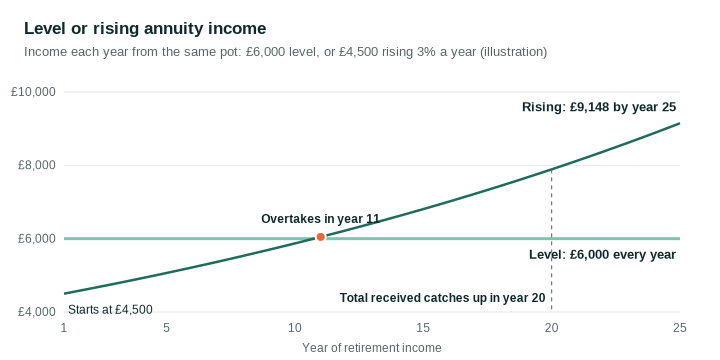
By year 25, the rising income in this illustration would be about £9,148 a year, against £6,000 from the level one.
So the choice is partly a bet on how long you’ll live. A level annuity pays more in the early years, but its buying power falls with inflation. At 3% inflation, prices roughly double in 24 years. Our inflation calculator shows the effect on any amount.
What happens to an annuity when you die?
With a basic single-life annuity, the income stops when you die, even if that’s soon after you buy it. Three options can change that, each in return for a lower starting income:
- Joint life: a portion of your income continues to a partner or dependant for the rest of their life after you die. You choose the portion when you buy.
- Guarantee period: if you die early, the income carries on to your beneficiaries until the end of the period. MoneyHelper says this can be up to 30 years.
- Value protection: if the annuity has paid out less than it cost when you die, your beneficiaries get the difference as a lump sum. MoneyHelper’s example is an annuity costing £50,000 that has paid £30,000, leaving £20,000 for the beneficiary.
How much tax beneficiaries pay depends on your age when you die and the type of payment. GOV.UK’s guide to tax on a pension you inherit sets out the rules.
What is an enhanced annuity?
An enhanced annuity, sometimes called an impaired life annuity, pays a higher income to people whose health or lifestyle means they’re expected to live less long. MoneyHelper lists examples such as medical conditions, smoking and being overweight.
The logic is simple: if the provider expects to pay you for fewer years, it can afford to pay more each year.
To be considered, you answer health and lifestyle questions when you ask for quotes. Providers assess health and lifestyle in their own way, so the extra income for the same condition can vary.
For the same reason, the health and lifestyle details given when asking for quotes can change the income offered, so giving them in full can make a difference.
How much income does an annuity pay?
It depends on the size of the pot and the rate the provider offers. MoneyHelper’s own arithmetic is that a £100,000 pot at a rate of 5% pays £5,000 a year, and at 6% pays £6,000.
The rate itself depends on:
- your age: the older you are, the higher the rate, because the income is expected to be paid for fewer years
- your health and lifestyle, as with enhanced annuities
- where you live
- interest rates and market conditions when you buy (our guide to gilts and bonds explains how interest rates and bond yields work)
- the options you choose: escalation, joint life and guarantees all lower the starting income
Rates change often and vary between providers, so we don’t quote them. MoneyHelper’s free Compare annuities tool shows live quotes from providers on the market. It’s backed by the government and receives no commission.
What is the open market option?
It’s your right to buy an annuity from any provider, not just the one that holds your pension. GOV.UK says plainly: “You do not have to buy your annuity from your pension provider.” MoneyHelper advises comparing providers, including your existing one, rather than accepting the first offer.
The difference can be significant, especially for anyone who qualifies for an enhanced annuity, which their existing provider may not offer.
One exception is worth checking first. Some older pensions come with a guaranteed annuity rate, a promise to convert the pot into income at a set rate that may be much higher than today’s. MoneyHelper suggests looking in your paperwork for terms like “retirement annuity contract”, “section 226 policy”, “with-profits” or “guarantee”, or asking the provider. Transferring away can mean losing it.
Annuity brokers and regulated financial advisers can also search the market on your behalf. It’s worth asking how they’re paid.
How is annuity income taxed?
Annuity income from a pension is taxed as income, just like a salary. MoneyHelper says it counts towards your income for the year, and the provider usually takes off tax through PAYE using your tax code before paying you. GOV.UK notes you may have a different tax code for each pension.
Your annuity is added to your other income for the year, including the State Pension. In 2026/27, the first £12,570 of total income is covered by the Personal Allowance in England, Wales and Northern Ireland, and the next slice is taxed at 20%.
Example: someone receives an annuity of £8,000 a year (an illustrative figure) plus the full new State Pension of £12,548. Their total income is £20,548, and their income tax for the year is about £1,596. Because the State Pension is paid without tax taken off, HMRC usually collects the tax on it through the annuity’s tax code.
Our take-home pay calculator shows the tax on other levels of income. Scotland has its own income tax bands.
Buying a standard lifetime annuity doesn’t trigger the money purchase annual allowance, so you can keep paying into pensions with full relief. Among annuities, HMRC’s triggers are lifetime annuities that can go down other than in set circumstances, and short-term annuities bought from drawdown.
Is your annuity protected if the provider fails?
Yes. The Financial Services Compensation Scheme (FSCS) protects annuities as long-term insurance. For a provider that failed on or after 3 July 2015, the FSCS says claims are protected at 100%, meaning it repays eligible claims in full. Before that date, cover was 90%.
Unlike the FSCS limits on cash savings and investments, there’s no cap. It only covers the provider failing, not poor value or a decision you later regret.
Annuity or drawdown?
Neither is better in general. They make opposite trade-offs, and many people use both: an annuity to cover essential bills alongside the State Pension, and drawdown for the rest.
| Lifetime annuity | Drawdown | |
|---|---|---|
| Income | Guaranteed, fixed or rising | Flexible; you choose how much and when |
| Investment risk | Carried by the provider | Carried by you |
| Can the money run out? | No | Yes, if you take too much or markets fall |
| Living longer than expected | Provider’s risk | Your risk |
| Changing your mind | Not after the cooling-off period | You can change withdrawals or buy an annuity later |
| On death | Stops, unless you add joint life, a guarantee or value protection | Remaining pot can pass to beneficiaries; from 6 April 2027 it usually counts for inheritance tax |
| Ongoing decisions | None | Investment choices and withdrawal reviews |
| Charges | Built into the rate offered | Platform and fund charges, paid from the pot |
Timing can also be split. Some people use drawdown in their 60s and buy an annuity later, when their age and health may give a higher rate. Our pension drawdown calculator shows how long a pot could last at different withdrawal levels, which can be compared with annuity quotes. For more on the inheritance tax change, see our guide to inheritance tax on pensions.
Common questions about annuities
Can you cancel an annuity once you’ve bought it?
Only during the cooling-off period, which MoneyHelper says is usually 30 days. After that, an annuity can’t be cancelled or cashed in, and the terms you chose, such as level or escalating income, are fixed. That’s why many people compare quotes with and without each option before deciding.
Can you buy an annuity with only part of your pension?
Yes. You can use part of a pot to buy an annuity and keep the rest in drawdown, or buy one now and another later. If you have several pensions, you can buy an annuity with one and leave the others invested. Your provider’s options may vary.
Do you have to buy an annuity at retirement?
No. GOV.UK lists several ways to take a defined contribution pension: cash lump sums, drawdown, an annuity, or a combination. An annuity is one option among them, and it can be bought later in retirement, or not at all.
Are annuity rates higher when interest rates are high?
MoneyHelper lists current interest rates and market conditions among the factors behind the rate a provider offers, so rates do change as interest rates move. Your age, health and the options you choose matter too, and rates vary between providers at any one time.
Does an annuity affect the State Pension?
No. The State Pension is paid on the same basis whatever private pension income you have. But the two are added together for income tax, so a larger annuity usually means more of your State Pension is effectively taxed.
Where to get help
If you’re 50 or over with a defined contribution pension, Pension Wise from MoneyHelper offers free, impartial guidance on your options, including annuities, online or with a specialist. MoneyHelper’s Compare annuities tool shows quotes from providers on the market. For a personal recommendation, you need a regulated financial adviser. See the glossary for any unfamiliar terms.
Sources
- FSCS: Pensions and annuities protection
- MoneyHelper: Guaranteed retirement income (annuities) explained
- MoneyHelper: Compare annuities
- MoneyHelper: Pension Wise
- GOV.UK: Personal pensions, how you can take your pension
- GOV.UK: Tax on your private pension, lump sum allowance
- GOV.UK: Tax on pension income, how your tax is paid
- GOV.UK: Tax on a private pension you inherit
- GOV.UK: Income Tax rates and Personal Allowances
- HMRC Pensions Tax Manual PTM056520: money purchase annual allowance trigger events
- FSCS: Insurance protection
- HMRC: Inheritance Tax on unused pension funds and death benefits
Our guides are general information and education, not personal financial advice. If you are unsure whether an investment is right for you, speak to a regulated financial adviser. Capital at risk. Investments can fall as well as rise, and you may get back less than you put in.