Savings and Rates · · 6 min read
Interest Rates Rise to 4%: What It Means
TL;DR
- The Bank of England raised interest rates from 3.75% to 4% on 5 November 2026, the first rise since August 2023.
- It wants to stop high energy prices pushing up other prices. Inflation is 3.5%; the next decision is 17 December.
What it means for you
- Goes upTracker mortgages Your rate rises by 0.25 points: about £14.50 more a month for every £100,000 borrowed.
- Likely upStandard variable rate mortgages Your lender decides, but will likely pass the rise on.
- No changeFixed-rate mortgages Same payments until your deal ends. Your next fixed deal may cost more.
- Likely upEasy-access savings Rates may rise, but banks often pass on only part of a rise, slowly. Fixed rates stay the same.
- Likely downBonds and bond funds Prices usually fall when interest rates rise.
- Goes upLate tax payments HMRC interest on late tax rises from 7.75% to 8% a year from 24 November.
On this page
- What did the Bank of England decide?
- Why did interest rates go up?
- What happens to my mortgage?
- What does a higher Bank Rate mean for cash savings?
- Does more interest mean more tax on savings?
- What happens to HMRC interest on late tax?
- What does it mean for bonds, shares and pensions?
- What happens next?
- Common questions
- Sources
What did the Bank of England decide?
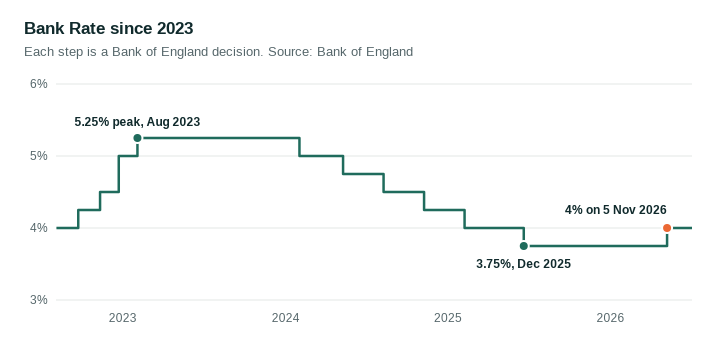
On Thursday 5 November 2026 the Bank of England’s Monetary Policy Committee (MPC) raised Bank Rate by 0.25 percentage points, from 3.75% to 4%. Bank Rate is the interest rate the Bank pays on money that banks hold with it. It feeds through to the rates banks charge on loans and pay on savings.
It’s the first increase since August 2023, when Bank Rate reached 5.25%. The Bank’s own records show it was then cut step by step from August 2024 to 3.75% in December 2025, where it stayed until this decision.
Why did interest rates go up?
The Bank’s job is to keep inflation at its 2% target. Inflation, measured by the Consumer Prices Index (CPI), was 3.5% in the 12 months to September 2026, up from 3.1% in August, according to the ONS.
The Bank says it raised rates to limit how far rising energy costs spread into other prices. Conflict in the Middle East has disrupted the supply and transport of energy. The ONS says transport, particularly motor fuel, made the largest upward contribution: fuel prices were 29.8% higher than a year earlier. The Bank expects inflation to reach about 5% by mid-2027.
Higher interest rates make borrowing more expensive and saving more rewarding. That tends to cool spending and, over time, slow price rises. It works with a delay of a year or more, which is why the Bank acts before inflation peaks.
What happens to my mortgage?
It depends on the type of mortgage you have.
- Tracker mortgage. Your rate follows Bank Rate plus a set margin, so it goes up by the same 0.25 percentage points. MoneyHelper says payments on a tracker are likely to change straight away.
- Standard variable rate (SVR). Your lender sets this rate and can change it at any time. MoneyHelper says lenders will likely pass on a rise, but they don’t have to follow Bank Rate decisions.
- Fixed rate. Your payments stay the same until the fixed period ends. After that, a new deal may cost more than it would have before the rise.
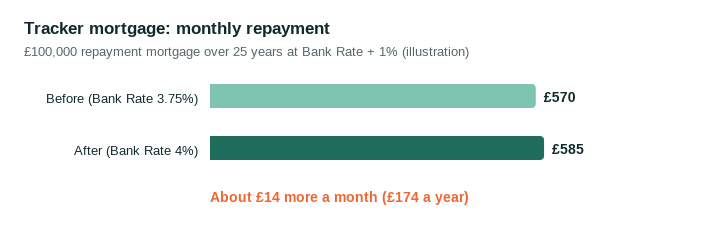
Example: a £100,000 repayment mortgage over 25 years on a tracker at Bank Rate + 1%. At a 3.75% Bank Rate it costs about £570 a month. At 4% it costs about £585: roughly £14.47 more a month, or £173.67 a year. Owe £200,000 on the same terms? Double it: about £28.95 more a month.
What does a higher Bank Rate mean for cash savings?
Variable-rate accounts may pay more, but there’s no rule that they must. Each bank or building society decides. When the FCA reviewed the market in 2023, it found the nine biggest providers had passed on only 28% of base rate rises to easy-access accounts on average, and slowly. Fixed-rate accounts don’t change: you keep the agreed rate until the term ends.
What matters for your spending power is the rate after inflation, often called the real return. With inflation at 3.5%, an account paying an illustrative 4% a year leaves you about 0.5% a year better off in real terms, before any tax. If the Bank’s forecast of 5% inflation comes true, the same account would fall behind rising prices.
Does more interest mean more tax on savings?
It can. Outside an ISA, interest above your Personal Savings Allowance is taxed: £1,000 a year for basic-rate taxpayers, £500 for higher-rate taxpayers and nothing for additional-rate taxpayers.
Example: £50,000 outside an ISA at an illustrative 4% a year earns £2,000 of interest.
- A basic-rate taxpayer pays £200 tax in 2026/27: 20% on the £1,000 above their £1,000 allowance.
- A higher-rate taxpayer pays £600: 40% on the £1,500 above their £500 allowance.
- From 6 April 2027, savings tax rates rise to 24%, 44% and 49%, so the same higher-rate taxpayer would pay £660.
Interest in a cash ISA is tax-free. At the Budget on 28 October 2026, the government said the cash ISA limit will stay £20,000 for all savers over 18 from April 2027. Our guide to stocks and shares ISAs vs cash ISAs compares the two, and the Budget 2026 guide covers the savings tax change.
What happens to HMRC interest on late tax?
HMRC’s interest rates are set by regulations and linked to Bank Rate. Late payment interest is Bank Rate plus 4%, so it rises from 7.75% to 8% a year from 24 November 2026. It applies to tax paid after its due date, including Income Tax, Capital Gains Tax and National Insurance through Self Assessment. Repayment interest, which HMRC pays when you’ve overpaid, is Bank Rate minus 1%, so it rises from 2.75% to 3%.
Example: £1,000 of tax paid a month late costs about £6.67 in interest at the new rate, against £6.46 before. For every £10,000 paid a year late, that’s £800 rather than £775.
Interest is separate from any late payment penalty. The next Self Assessment payment deadline is 31 January 2027.
What does it mean for bonds, shares and pensions?
Bonds. Gilts (UK government bonds) and other bonds pay a fixed amount of interest. When new bonds start paying more, existing ones with lower payments become less valuable. So their prices usually fall as interest rates rise. Bond funds can therefore drop in value, though new money into them buys at higher yields. Our gilts guide explains yields and prices.
Shares. There’s no reliable rule for how share prices react to a single rate decision. Higher rates raise companies’ borrowing costs, but markets often price in a move before it happens. We don’t make predictions. Many long-term investors focus on spreading their money widely rather than on individual rate decisions; our diversification guide explains how that works.
Pensions. Your pension’s value moves with the investments inside it. If you’re near retirement and thinking about an annuity, the income providers offer changes over time; our annuities guide explains what affects it.
What happens next?
The Bank of England’s next decision is due on 17 December 2026. We’ll explain any change on the blog. To see how different interest rates and inflation add up over time, try the compound interest calculator and the inflation calculator.
Common questions
Will my savings rate go up because Bank Rate rose?
Not automatically. Banks and building societies set their own savings rates. Many variable rates follow Bank Rate up, often after a delay, but some don't change. Fixed-rate accounts keep the rate you signed up for until the end of the term.
Do Premium Bonds change when Bank Rate changes?
Not automatically. NS&I sets the Premium Bonds prize fund rate, which is variable and can change at any time. Check the current rate on the NS&I website.
Does HMRC charge more interest on late tax when Bank Rate rises?
Yes. HMRC's late payment interest is set by regulations at Bank Rate plus 4%. After the rise to 4%, HMRC says the rate goes from 7.75% to 8% from 24 November 2026. Interest HMRC pays on overpaid tax, set at Bank Rate minus 1%, rises from 2.75% to 3%.
When is the next Bank of England decision?
The Bank of England says its next Bank Rate announcement is due on 17 December 2026.
Sources
- Bank of England: Interest rates and Bank Rate, our latest decision (5 November 2026)
- Bank of England: Official Bank Rate history
- ONS: Consumer price inflation, UK, September 2026
- HM Treasury: Budget 2026 overview of tax legislation and rates (sections 1.1 and 2.5)
- MoneyHelper: How will interest rates affect my mortgage?
- MoneyHelper: How to prepare for an interest rate rise
- FCA: Cash savings market review 2023 (how banks pass on base rate rises)
- NS&I: Premium Bonds
- GOV.UK: Tax on savings interest
- HMRC: Interest rates update (6 November 2026)
- HMRC: Interest rates for late and early payments
- GOV.UK: Self Assessment tax returns, deadlines
- GOV.UK: Estimate your penalty for late Self Assessment tax returns and payments
- UK Debt Management Office: About gilts
Our guides are general information and education, not personal financial advice. If you are unsure whether an investment is right for you, speak to a regulated financial adviser. Capital at risk. Investments can fall as well as rise, and you may get back less than you put in.