Accumulation vs Income Funds Explained
TL;DR
- Accumulation units (accumulating ETFs) reinvest a fund's income for you. Income units (distributing ETFs) pay it out as cash.
- Both hold the same investments. Accumulation units usually cost more per unit because reinvested income builds up inside each one.
- In an ISA or pension, neither creates a tax bill. Outside them, reinvested income is taxed as if it had been paid out.
- Reinvested income is added to your cost for Capital Gains Tax, so it isn't taxed twice.
- Switching between the accumulation and income classes of the same fund usually isn't a sale for Capital Gains Tax.
Quick answers
- NoDo accumulation units pay dividends? No cash is paid. The income is reinvested inside each unit, raising its value.
- DependsIs one type better than the other? Neither is better in itself. Same investments, same total return before tax and charges; only income handling differs.
- Watch outIs reinvested income taxed outside an ISA? Yes. HMRC taxes it as if it had been paid out, even though you received no cash.
- Tax-freeAny tax inside an ISA or pension? No. Neither type creates any tax to pay or report inside an ISA or pension.
- NoIs switching classes a sale for tax? Usually not within one fund. Moving between sub-funds, or between ETF versions, is a disposal outside ISAs and pensions.
- Dividend allowance, 2026/27: applies to paid-out and reinvested income alike
- £500
- £20,000 after 20 years with a 3% yield reinvested (illustration, not a forecast)
- £53,066
- Same £20,000 with the 3% yield taken as cash: £29,719 left plus £14,578 paid out (illustration)
- £44,297
- Share of a fund in interest-paying investments needed for interest distributions
- 60%
On this page
- What is the difference between accumulation and income units?
- Why do accumulation units have a higher price?
- Are accumulating and distributing ETFs the same thing?
- How are accumulation units taxed outside an ISA or pension?
- What is equalisation?
- What is excess reportable income on offshore funds?
- Does the choice matter inside an ISA or pension?
- How do people typically use each type?
- Worked example: reinvesting vs taking a 3% yield over 20 years
- Can you switch between accumulation and income units?
- Common questions about accumulation and income funds
- What to do next
- Related guides
- Sources
Most funds and ETFs come in two versions that hold exactly the same investments and differ only in what happens to the income. Accumulation units, called accumulating shares in ETFs, reinvest dividends and interest inside the fund. Income units, called distributing shares in ETFs, pay that money out to you as cash. Fund names usually show which is which, with “Acc” or “Inc” (or “Dist”) at the end.
The choice doesn’t change what the fund invests in, its risk or its charges. It changes how your return arrives, how the unit price behaves, and the paperwork if you hold the fund outside an ISA or pension. This guide explains how each works, how they’re taxed, how people typically use them, and what happens if you switch.
What is the difference between accumulation and income units?
Accumulation units keep a fund’s income invested; income units hand it to you. Funds collect dividends from the shares they own and interest from the bonds they hold. Every so often, on dates set by the fund, that income is shared out among investors.
With income units, your share is paid in cash into your account. You can withdraw it, leave it as cash or use it to buy more units.
With accumulation units, the income stays in the fund. HMRC’s Investment Funds Manual describes it as retained in the fund and reinvested for the investor rather than paid out, and notes that no new units are issued. Instead, each accumulation unit becomes worth more. You end up with the same number of units, each with a higher value.
So two people who invest the same amount in the same fund on the same day, one in each class, own the same underlying investments. After each income date, the income-unit holder has cash plus units, and the accumulation-unit holder has units that are worth more. Before charges and tax, the total is the same. What differs is whether the income is reinvested automatically or arrives as cash.
Why do accumulation units have a higher price?
Accumulation units usually cost more per unit because years of reinvested income have built up inside each one. Both classes start at a launch price. From then on, an income unit’s price reflects the value of the fund’s investments, and drops back each time income is set aside to be paid out. An accumulation unit’s price reflects the same investments plus all the income kept in it since launch.
Over time the gap widens. A fund launched many years ago can have an accumulation unit priced at two or three times its income unit, even though the two are tracking the same investments. That doesn’t make the accumulation unit expensive or the income unit cheap. You simply get fewer accumulation units for the same money.
This matters when comparing performance. An income unit’s price chart shows growth in price only, leaving out the income paid out. An accumulation unit’s chart shows the total return: price growth plus reinvested income. Comparing an income unit’s price chart with an accumulation unit’s understates the income version. Factsheets often show total return figures for exactly this reason; our guide to reading a fund factsheet shows where to look.
Are accumulating and distributing ETFs the same thing?
Yes, they work the same way under different names. With unit trusts and OEICs (open-ended investment companies), the classes are called accumulation and income units or shares. With ETFs, which trade on a stock exchange, the usual terms are accumulating and distributing.
A distributing ETF pays income into your account on its distribution dates. An accumulating ETF keeps the income in the fund, so the value of each ETF share rises to reflect it. As with funds, the holdings are the same; only the handling of income differs.
One practical difference is how you move between the two. A fund’s accumulation and income classes are usually two classes of the same fund, and some fund managers can convert one into the other. An ETF’s two versions are generally separate share classes listed under different tickers, so moving between them normally means selling one on the exchange and buying the other. Outside an ISA or pension, that sale is a disposal for Capital Gains Tax. Our ETF guide and ETF vs index fund comparison cover the other differences.
How are accumulation units taxed outside an ISA or pension?
Outside an ISA or pension, reinvested income is taxed exactly as if it had been paid to you. HMRC’s Investment Funds Manual says amounts reinvested in accumulation units are taxed as income in the same way as if they had been distributed. HMRC gives two reasons: so tax doesn’t distort the choice between classes, and so investors can’t put off income tax by accumulating for years.
The type of income depends on the fund. UK-authorised share funds usually pay dividend distributions, which HMRC treats in the same way as any other UK company dividend. In 2026/27 the first £500 of dividends is covered by the dividend allowance, and the rest is taxed at 10.75%, 35.75% or 39.35%.
A fund can pay interest distributions instead only if more than 60% of its investments are interest-paying throughout the distribution period, which is typical of bond funds. Interest distributions are taxed as savings income: the Personal Savings Allowance covers £1,000 for basic-rate taxpayers and £500 for higher-rate taxpayers, then tax is 20%, 40% or 45%. From the 2027/28 tax year, savings rates rise to 24%, 44% and 49%.
Illustration: someone holds £40,000 in a share fund in a general account, and it produces a 3% yield: £1,200 of dividend income in a year. Whether they hold accumulation or income units, £500 is covered by the allowance and £700 is taxable. That’s £75.25 at the basic rate or £250.25 at the higher rate, assuming no other dividends. With accumulation units, it’s paid from other money, because no cash was received.
Reinvested income is added to your cost
The other side of being taxed on income you didn’t receive is that it isn’t taxed again when you sell. HMRC’s Capital Gains Manual says the reinvested amount counts as allowable expenditure for Capital Gains Tax where it has been subject to income tax. In practice, each year’s reinvested income is added to what your units cost you, which reduces the gain when you sell. Keeping a record of these amounts each year makes the eventual calculation much easier. Our guide to tax on investments covers Capital Gains Tax in full, and the dividend and capital gains tax calculator estimates both.
What is equalisation?
Equalisation is a part of your first distribution that’s a refund of your own money, not income. When you buy into a fund partway through a distribution period, the price you pay includes the income the fund has already earned in that period. When the fund next distributes, you receive a share of that income, but part of it is simply the money you paid for it coming back.
HMRC’s Capital Gains Manual says this equalisation payment is shown on the statement for the first distribution period after you bought, and that it is not income. So it isn’t taxed as a dividend or interest. Because it returns part of your purchase price, it’s deducted from the cost of your units when you later work out your gain.
Equalisation only affects the first distribution after a purchase. It’s mainly a record-keeping point for people holding funds in a general account: HMRC expects the distribution statement, or tax voucher, for that period to show the amount returned.
What is excess reportable income on offshore funds?
HMRC calls it excess reported income.
Excess reportable income is the income an overseas reporting fund has earned but not paid out, and UK investors are taxed on it. Many ETFs and some funds sold in the UK are based abroad, often in Ireland or Luxembourg. For these, HMRC’s reporting fund rules apply, and an accumulating offshore fund that keeps its income still has to report it.
HMRC’s helpsheet HS265 says UK investors are taxed on their full share of a reporting fund’s reportable income, even if it hasn’t been distributed. The difference between the income reported and the income actually paid to you is the excess. It’s treated as received on the fund distribution date, which is six months after the end of the fund’s reporting period. It counts as interest if the fund is a company with more than 60% in interest-bearing assets, and otherwise usually as a dividend; other fund structures follow their own rules.
To avoid double taxation, HS265 says excess reportable income arising while you held the units can be deducted when working out your capital gain. Reporting funds publish their reports, and HMRC keeps a list of approved offshore reporting funds, updated monthly. None of this applies inside an ISA or pension.
Does the choice matter inside an ISA or pension?
Not for tax: inside a stocks and shares ISA or a pension, neither accumulation nor income units create any tax to pay or report. There’s no dividend tax, no tax on interest and no Capital Gains Tax inside these wrappers, so the record-keeping in the sections above falls away. You can pay up to £20,000 into ISAs in 2026/27.
What remains is a practical choice. Inside an ISA, income from income units is paid as cash into the ISA. That cash stays inside the ISA unless you withdraw it. It doesn’t grow unless you reinvest it, and some platforms charge to buy more units. Accumulation units avoid that step.
In a pension, income stays inside the pension either way until you take money out. The same choice applies: reinvest automatically, or let cash build up and use it later. Some people in pension drawdown hold income units so that the income gathers as cash, ready to be withdrawn. Our guides to stocks and shares ISAs and SIPPs explain each wrapper.
How do people typically use each type?
Many people building wealth over the long term hold accumulation units, while many people living off their investments hold income units. The logic is about what the income is for.
While building wealth, many investors don’t need the income. Accumulation units reinvest it automatically and promptly, with no cash sitting idle and no dealing charges for buying more. Over long periods, reinvested income can make up a large share of total return, as the worked example below shows.
When drawing an income, people often want regular cash without selling anything. Income units deliver the fund’s natural yield: the dividends and interest it actually receives. Some people find this simpler than selling units, because the number of units they own stays the same. The trade-off is that the amount varies: dividends can be cut, so income from income units isn’t fixed.
Neither approach changes the total return before tax and charges. Someone holding accumulation units can sell some units to raise cash, and someone holding income units can reinvest the payments. Our pension drawdown calculator shows how withdrawals affect a pot over time.
Worked example: reinvesting vs taking a 3% yield over 20 years
Reinvesting the income ends up with a larger total because the income itself keeps growing. Here’s £20,000 invested in one fund for 20 years, held two ways. This is an illustration, not a forecast: it assumes the fund’s price grows a steady 2% a year and it yields a steady 3% a year, so the total return is 5% a year. Charges and tax are left out. It uses the same growth model as our compound interest calculator.
| Accumulation (income reinvested) | Income (yield taken as cash) | |
|---|---|---|
| Value of holding after 20 years | £53,066 | £29,719 |
| Income paid out over 20 years | None (reinvested) | £14,578 |
| Total | £53,066 | £44,297 |
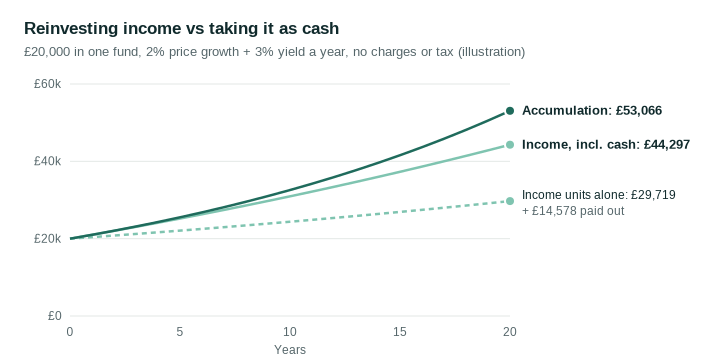
With income units, the cash paid out starts at £600 in the first year and rises to £874 in year 20, because it’s 3% of a holding that’s growing at 2% a year. Add it all up and the income route is £8,769 behind the accumulation route after 20 years. That gap is the growth that the reinvested income would have earned. If the income had been spent, that’s the cost of having had it to spend.
The accumulation holding would also produce more income if someone then switched to taking it: 3% of £53,066 is about £1,592 a year, against £874 for the income holding in year 20. Real returns and yields vary from year to year, and investments can fall in value.
Can you switch between accumulation and income units?
Yes. Switching between the accumulation and income classes of the same fund is usually not a disposal for Capital Gains Tax. HMRC’s Capital Gains Manual says that where an investor switches between classes of share in the same OEIC, the share reorganisation rules in section 127 of the Taxation of Chargeable Gains Act 1992 can apply. The same applies to switching between unit classes in an authorised unit trust.
Under those rules, the switch isn’t treated as a disposal. The new units are treated as if they were bought when, and for what, you paid for the original ones, so any gain carries over to the new holding until you eventually sell.
Two cases are different. Switching between different sub-funds of an umbrella OEIC is a disposal, according to HMRC’s manual, even if they’re run by the same manager. And for ETFs, moving between versions normally means selling one and buying the other on the exchange, which is a disposal outside an ISA or pension. Inside an ISA or pension, switching has no tax effect at all. Whether a conversion is possible, and how it’s done, depends on the fund manager and platform.
Common questions about accumulation and income funds
Do accumulation units pay dividends?
No cash is paid, but the income is still there. The dividends and interest the fund receives are reinvested within each accumulation unit, raising its value. Outside an ISA or pension, HMRC treats that reinvested amount as income for tax, in the same way as if it had been paid to you.
Is an accumulation fund better than an income fund?
Neither is better in itself. They hold the same investments and, before tax and charges, give the same total return. The difference is whether income is reinvested automatically or paid as cash. Many people building savings choose accumulation for convenience; many people drawing an income choose income units.
Why is the accumulation unit price so much higher?
Because every distribution since the fund launched has been kept inside each accumulation unit, while income units paid theirs out. The higher price doesn’t mean better value or worse value: you buy fewer accumulation units for the same money, and each is worth more.
How do I find out how much income was reinvested for my tax return?
Fund managers issue a statement, or tax voucher, for each distribution period showing the income paid or reinvested and any equalisation. Offshore reporting funds publish their reports, which show the reportable income per unit. Outside an ISA or pension, these figures are needed for both income tax and the Capital Gains Tax cost.
Do I pay tax on accumulation units in an ISA?
No. Income and gains inside a stocks and shares ISA are free of UK tax, whether the units are accumulation or income. There’s nothing to report to HMRC. The same applies inside a pension, although pension withdrawals beyond any tax-free part are taxed as income when taken.
Can a fund pay out interest instead of dividends?
Yes, if more than 60% of its investments are interest-paying throughout the distribution period, which typically means a bond fund. Its distributions, paid out or reinvested, are then taxed as savings income rather than dividends. Our guide to gilts and bonds explains bond funds.
Sources
- HMRC Investment Funds Manual IFM03120: accumulation units
- HMRC Investment Funds Manual IFM03350: taxation of investors within the charge to income tax, distributions
- HMRC Investment Funds Manual IFM02224: interest distributions, qualifying investments test
- HMRC Capital Gains Manual CG57707: unit trusts, accumulation units
- HMRC Capital Gains Manual CG57705: unit trusts, dividend equalisation payments
- HMRC Capital Gains Manual CG57755: OEICs, shareholders, share classes
- HMRC Capital Gains Manual CG57760: OEICs, umbrella OEICs
- HMRC Capital Gains Manual CG51700: share reorganisations
- HMRC: Offshore funds (Self Assessment helpsheet HS265)
- HMRC: Approved offshore reporting funds
- GOV.UK: Tax on dividends
- GOV.UK: Tax on savings interest, how much is tax-free
- Finance Act 2026, section 5: savings rates
Our guides are general information and education, not personal financial advice. If you are unsure whether an investment is right for you, speak to a regulated financial adviser. Capital at risk. Investments can fall as well as rise, and you may get back less than you put in.