ETF vs Index Fund: What's the Difference?
TL;DR
- An index fund and an index ETF can track the same index. The main differences are how they're bought, sold and charged.
- ETFs trade on a stock exchange during the day at the market price. Index funds deal at the next price the fund calculates.
- ETFs often carry dealing charges and a spread. Funds are often cheaper for small, regular amounts.
- Usually neither carries the 0.5% stamp duty on most UK shares: qualifying ETFs are exempt, and so are funds bought from the manager.
- Outside an ISA or pension, an overseas fund or ETF without HMRC reporting fund status has gains taxed as income.
Quick answers
- NoDo they hold different investments? Not if they track the same index. Returns before charges should be very close.
- DependsWhich is cheaper? Depends on your platform's charges and balance. In our example, the flat-fee ETF route costs less above £40,000.
- NoIs there stamp duty? Not on qualifying ETFs, or on funds bought from the manager. Most UK shares carry 0.5%.
- Watch outDo ETF dealing charges hurt small amounts? They can. A £5 charge on a £100 monthly purchase is 5% of each payment.
- YesCan I hold both in an ISA? Yes, mainstream ETFs and index funds can go in a stocks and shares ISA or SIPP.
- LimitIs my money protected? FSCS may pay up to £85,000 per person, per firm, if a firm fails. Not for falls in value.
- Stamp duty on qualifying ETFs and on funds bought from the manager
- 0%
- Where £140 a year of flat costs matches a 0.35% fee (illustrative)
- £40,000
- Date the ETF stamp duty exemption came into force
- 28 April 2014
- FSCS limit if an investment firm fails
- £85,000
On this page
- What is the difference between an ETF and an index fund?
- How do ETFs and index funds compare side by side?
- How are ETFs and index funds priced?
- What does each cost to hold and to trade?
- What is the spread, and does it apply to index funds?
- Which works out cheaper? A worked example
- Do you pay stamp duty on ETFs or index funds?
- How do minimums and regular investing differ?
- What is reporting fund status, and why does it matter?
- Accumulation or income: does it work the same way?
- Can you hold ETFs and index funds in an ISA or SIPP?
- What do people weigh up when choosing between them?
- Common questions about ETFs and index funds
- What to do next
- Related guides
- Sources
An ETF (exchange-traded fund) and an index fund can do exactly the same job: track a market index such as the FTSE 100 or a global share index, for a low yearly charge. The difference is in the wrapper around that job. An ETF is listed on a stock exchange and trades like a share. An index fund, in the UK usually a unit trust or OEIC, is bought from and sold back to the fund manager at a price worked out once a day or so. This guide compares how each is priced, dealt, charged and taxed, with a worked cost example.
What is the difference between an ETF and an index fund?
The main difference is how you buy and sell them, not what they hold. An index fund that tracks the FTSE All-World and an ETF that tracks the same index own much the same companies in much the same proportions. Their returns, before charges, should be very close.
An index fund is usually structured as a unit trust or an OEIC (open-ended investment company). When you invest, the fund manager creates new units for you; when you sell, it cancels them. The deal happens at a price the fund calculates after your order is placed.
An ETF is a fund with shares listed on a stock exchange. The FCA defines it as a fund with at least one class of units or shares traded throughout the day on a trading venue, with at least one market maker acting to keep its price close to the value of what it holds. You buy from and sell to other investors through the exchange, at the live market price.
Most practical differences flow from that: when the price is set, how platforms charge, the spread, and how easy it is to invest small amounts regularly. Our guides to ETFs and index funds explain each in more depth.
How do ETFs and index funds compare side by side?
The table below summarises the differences that matter most to UK investors. Neither column is better in itself; which costs less depends on how and how much you invest.
| ETF | Index fund (unit trust or OEIC) | |
|---|---|---|
| How it’s bought | On a stock exchange, through a platform or broker | From the fund manager, usually through a platform |
| When the price is set | Continuously during trading hours | At the fund’s next valuation point after your order (forward pricing) |
| Price you get | Live market price, which can differ slightly from the fund’s value | The fund’s own unit price |
| Ongoing charge (OCF) | Yes | Yes |
| Spread | Yes: buying and selling prices differ | Usually none visible, as you deal at the fund’s price |
| Dealing charges on platforms | Common, as for shares | Less common, often free |
| Regular investing | Available on some platforms | Widely available, often free |
| Stamp duty on purchase | None on qualifying ETFs | None when bought from the manager |
| Minimum investment | One share, or a fraction on some platforms | Set by the fund or platform |
| Accumulation or income versions | Both exist (often called accumulating and distributing) | Both exist |
| ISA and SIPP | Yes, for mainstream ETFs | Yes, for authorised and recognised funds |
How are ETFs and index funds priced?
ETFs are priced continuously by the market; index funds are forward priced, which means you don’t know the exact price until after you’ve dealt. FCA rules for authorised UK funds say that, apart from some money market funds, all deals in units must be at a forward price. The FCA defines that as a price calculated at the valuation point after the fund manager agrees to sell or buy back the units.
In practice, if you place an order for an index fund in the morning, you’ll get the price set at the fund’s next valuation point, which may be later that day or the next day. FCA rules require most authorised funds to have at least two regular valuation points a month, and many value daily. Funds the FCA classes as higher volatility funds must value at least once every business day.
An ETF, by contrast, trades whenever its exchange is open. You see a price, place an order and usually deal at or near that price within seconds. That lets you know exactly what you paid. It also lets you trade during the day, which matters to some investors and not at all to many long-term ones. An ETF’s market price can sit slightly above or below the value of its holdings, called the net asset value (NAV). Market makers keep the gap small for large ETFs, but it can widen in fast-moving markets.
What does each cost to hold and to trade?
Both carry an ongoing charge; the bigger cost differences usually come from how your platform charges for each. The ongoing charges figure (OCF) is the yearly cost of running the fund, taken from inside it. MoneyHelper describes it as covering the annual management charge and the other expenses of running the fund. Index funds and index ETFs both tend to have low OCFs, and you’ll find the figure on the factsheet.
On top of the OCF:
- Platform fee. Some platforms charge a percentage of your balance; others charge a flat amount. Some percentage-fee platforms cap the fee on shares and ETFs but not on funds.
- Dealing charges. MoneyHelper notes that dealing charges usually apply when you invest directly. Many platforms charge a fixed fee per ETF trade, as they do for shares. Fund deals are often free.
- The spread on ETFs, explained in the next section.
- Currency fees if an ETF is priced in another currency.
The FCA expects platforms to show the total of their costs and charges, in pounds and as a percentage, before you invest. Our platform fees guide explains each charge, and our platform fee calculator compares them for your own habits.
What is the spread, and does it apply to index funds?
The spread is the gap between the price you pay to buy an ETF and the price you get when you sell it, and it’s a cost every time you trade. At any moment an ETF has two prices on the exchange: a higher offer price for buyers and a lower bid price for sellers. If an ETF’s offer price is £10.02 and its bid price is £10.00, the spread is 2p, or about 0.2%. If you bought and immediately sold, you’d lose that 2p per share before any dealing charges.
Spreads are usually narrow for large, heavily traded ETFs that track major indices, and wider for ETFs tracking niche markets or less frequently traded assets. They can also widen when markets are volatile.
When you buy an index fund from the fund manager, you deal at the fund’s own price, so there’s no spread in the same sense. That doesn’t mean trading is free: the fund itself pays costs when it buys and sells investments, and those costs are borne by everyone in the fund. Funds that track the same index can therefore differ slightly in their tracking difference, the gap between the fund’s return and the index’s.
Which works out cheaper? A worked example
Whether an ETF or a fund is cheaper usually comes down to the platform’s charging structure and your balance, not the investment itself. Here’s the same index investment held two ways for 20 years. The charges are clearly hypothetical, chosen to show the effect, not the prices of any provider. Growth is an assumed steady 5% a year before charges, which is an illustration, not a forecast. The calculation uses the same growth model as our compound interest calculator.
- Route A, index fund: a fund with a 0.15% OCF on a platform charging 0.35% a year of the balance. No dealing charges.
- Route B, ETF: an ETF with the same 0.15% OCF, on a platform charging a flat £120 a year, plus 4 trades a year at £5 each. That’s £140 a year of fixed costs, taken at the end of each year.
| Starting balance | Route A after 20 years | Route B after 20 years | Difference |
|---|---|---|---|
| £10,000 | £24,002 | £21,195 | Route A ahead by £2,807 |
| £100,000 | £240,020 | £252,929 | Route B ahead by £12,909 |
The break-even point is the fixed costs divided by the percentage fee: £140 ÷ 0.35% = £40,000. Below that balance the percentage-fee route costs less each year; above it the flat-fee route does, and the gap grows as the balance grows. With frequent small purchases, dealing charges would push the break-even point higher. Spreads and currency fees are left out to keep the example simple.
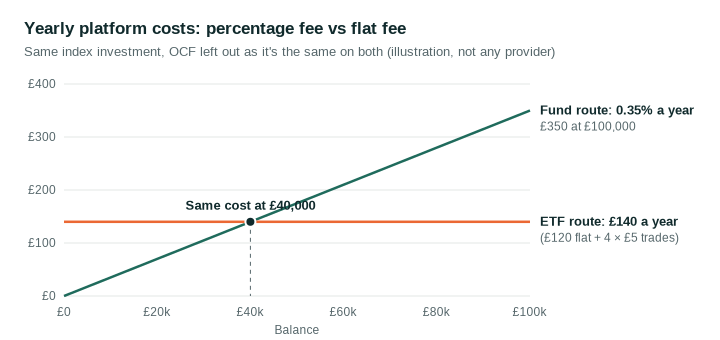
Example: in a single year, the 0.35% fee costs £35 on £10,000, against £140 of flat costs. On £100,000 it costs £350, against the same £140.
Do you pay stamp duty on ETFs or index funds?
Usually neither attracts the 0.5% stamp duty that applies to most UK share purchases. GOV.UK says you normally pay 0.5% Stamp Duty Reserve Tax when you buy shares electronically in a UK company. Two exemptions matter here.
For ETFs, regulations in force since 28 April 2014 exempt transfers of units in qualifying ETFs from both Stamp Duty Reserve Tax and Stamp Duty, as HMRC’s Stamp Taxes on Shares Manual explains. Many ETFs sold in the UK are domiciled abroad, often in Ireland or Luxembourg. GOV.UK says you don’t normally pay stamp duty on foreign shares bought outside the UK, and UK stamp duty on foreign companies generally applies only where they keep a UK share register.
For index funds, GOV.UK lists buying units in a unit trust or shares in an OEIC from the fund manager as exempt. Because you buy fund units directly from the manager, there’s normally no stamp duty to pay.
So stamp duty rarely decides between the two. It’s more relevant when comparing either one with buying individual UK shares, or with investment trusts, which are companies whose shares do attract the charge.
How do minimums and regular investing differ?
Funds are usually easier for small, regular amounts; ETFs are usually bought one share at a time. With an index fund you invest a sum of money, say £50 or £500, and the fund issues units to match, including fractions of a unit. Some fund managers and platforms set a minimum lump sum or monthly amount.
With an ETF you buy whole shares at the market price, so the minimum is the price of one share. Some platforms let you buy fractional shares, which removes that limit.
The bigger difference is cost. Many platforms offer free or cheap regular investing into funds on a set day each month. Some offer the same for ETFs, but where a fixed dealing charge applies to each purchase, it takes a large bite out of small amounts. A £5 charge on a £100 monthly purchase is 5% of each payment. On a £1,000 purchase it’s 0.5%.
Regular investing means you buy at a range of prices over time. Our guide to lump sum vs drip-feeding explains the trade-off, and the savings goal calculator shows what a monthly amount could grow to.
What is reporting fund status, and why does it matter?
Reporting fund status is an HMRC status for overseas funds that decides whether a gain on selling is taxed as a capital gain or as income. It matters only outside an ISA or pension, and it applies to overseas ETFs and overseas index funds alike. UK-authorised unit trusts and OEICs aren’t offshore funds, so the rules don’t apply to them.
HMRC’s helpsheet HS265 sets out the two outcomes:
- Reporting fund. A gain when you sell is a capital gain, so Capital Gains Tax applies. The first £3,000 of gains in 2026/27 is covered by the annual exempt amount.
- Non-reporting fund. A gain is normally an offshore income gain, taxed as income, usually at higher rates and without the annual exempt amount.
Reporting funds also report income that hasn’t been paid out, and HMRC says UK investors are taxed on their full share of reportable income even if it hasn’t been distributed. HMRC publishes a list of approved offshore reporting funds, updated monthly, and most fund documents state the status too. Our guide to tax on investments covers the wider rules.
Accumulation or income: does it work the same way?
Yes: both ETFs and index funds commonly come in a version that reinvests income and a version that pays it out. With funds they’re called accumulation and income units. With ETFs they’re usually called accumulating and distributing. The investments inside are the same; only what happens to dividends and interest differs.
Our guide to accumulation and income funds covers the difference, and the tax, in detail.
Accumulation versions add income to the value of your holding, so you see it as a higher price rather than a payment. Income versions pay it into your account as cash, which you can withdraw or reinvest.
Inside an ISA or pension, the choice has no tax effect. Outside them, choosing accumulation doesn’t avoid tax. HMRC’s Investment Funds Manual says amounts reinvested are taxed as income in the same way as if they had been distributed. That means you may owe tax on income you never received in cash, and it needs recording so it isn’t taxed again when you sell.
Can you hold ETFs and index funds in an ISA or SIPP?
Yes, both are among the most common holdings in stocks and shares ISAs and self-invested personal pensions (SIPPs). HMRC’s rules for ISA managers allow shares officially listed on a recognised stock exchange, units in UK-authorised funds (UK UCITS and certain other retail funds), and overseas funds recognised by the FCA. That covers mainstream ETFs and index funds.
Inside an ISA or SIPP, several of the differences in this guide fall away. There’s no Capital Gains Tax, so reporting fund status doesn’t matter. There’s no dividend tax, so accumulation units create no tax bill. What’s left is cost: the OCF, the platform fee, dealing charges and spreads. Those are the same whether the account is an ISA, a SIPP or a general account, although some platforms charge differently for each account type.
You can pay up to £20,000 into ISAs in 2026/27. Our stocks and shares ISA guide and SIPPs guide explain how each wrapper works.
What do people weigh up when choosing between them?
People typically decide on cost and convenience rather than on the investment itself, since both can track the same index. The factors that usually decide it are:
- How they invest. Small monthly amounts often suit funds where regular investing is free; larger, occasional lump sums can suit ETFs.
- Their platform’s charges. On a flat-fee platform, ETFs can be cheaper for large balances. On a percentage-fee platform, some cap the fee on ETFs but not on funds.
- What’s available. Some indices and themes are only available as ETFs; some platforms offer a wider range of one or the other.
- Whether intraday dealing matters. For long-term investors it often doesn’t; for others, knowing the exact price on the spot is useful.
Whichever wrapper is used, the FSCS can pay up to £85,000 per person, per firm, if an authorised investment firm fails and can’t return what it holds for you. It doesn’t cover falls in value.
Common questions about ETFs and index funds
Is an ETF riskier than an index fund?
Not because of the structure. An ETF and an index fund that track the same index carry the same market risk: both fall when that market falls. Specialised ETFs, such as leveraged or inverse products, are much riskier, but they aren’t typical index trackers. Our ETF guide covers those risks.
Do ETFs and index funds pay the same dividends?
Broadly, yes, if they track the same index, since both receive dividends from the same companies. Small differences come from charges, timing and how often each pays out. Accumulation and accumulating versions reinvest dividends instead of paying them.
Can you switch from an index fund to an ETF tracking the same index?
Yes, by selling one and buying the other. Inside an ISA or pension there’s no tax on the sale. In a general account, selling can create a capital gain. You’d be out of the market briefly between the two deals, and the ETF purchase may carry a dealing charge and spread.
Why might the same index have a fund and an ETF with different charges?
Fund managers price each product separately, and platforms may negotiate cheaper share classes of funds. Tracking methods and fund size also affect costs. Comparing the OCF and the tracking difference over several years, both shown on the factsheet, gives a fuller picture. Our guide to reading a fund factsheet shows where to find them.
Are ETFs or index funds better for beginners?
Neither is better in general. Index funds are often simpler for regular monthly saving, since you invest a set amount and there’s usually no dealing charge. ETFs can suit people investing larger lump sums on low-cost or flat-fee platforms. Our investing for beginners guide covers what to sort out first.
Sources
- FCA Handbook glossary: exchange traded fund
- FCA Handbook glossary: forward price
- FCA Handbook COLL 6.3: Valuation and pricing
- MoneyHelper: Popular investments at a glance
- FCA: Investment platforms costs and charges review – good and poor practice
- GOV.UK: Tax when you buy shares
- HMRC Stamp Taxes on Shares Manual: Exchange traded funds (STSM101065)
- The Stamp Duty and SDRT (Exchange Traded Funds) (Exemption) Regulations 2014
- HMRC: Offshore funds (Self Assessment helpsheet HS265)
- HMRC: Approved offshore reporting funds
- HMRC Investment Funds Manual IFM03120: accumulation units
- HMRC: Stocks and shares ISA investments (guidance for ISA managers)
- FSCS: Investments
Our guides are general information and education, not personal financial advice. If you are unsure whether an investment is right for you, speak to a regulated financial adviser. Capital at risk. Investments can fall as well as rise, and you may get back less than you put in.