Premium Bonds, Savings or Investing?
TL;DR
- Premium Bonds pay no interest. Each £1 bond goes into a monthly prize draw, and prizes are tax-free.
- The prize fund rate is 4.35% from the September 2026 draw. It's an average: most holders get less in a typical year.
- Each £1 bond has a 1 in 21,000 chance of a prize each month, so small holdings can go months without winning.
- Savings pay a known rate, protected up to £120,000 per person, per banking licence. Interest above your allowance is taxed.
- Investing usually suits money not needed for at least five years, because its value can fall.
Quick answers
- Tax-freeAre prizes taxed? No. Prizes are free of UK income tax and capital gains tax, whatever your tax band.
- NoIs 4.35% what I'll get? No. It's the average across all bonds. Most holders get less in a typical year; a few get more.
- Watch outCan I lose money in Premium Bonds? Not in pounds: NS&I is backed by HM Treasury. But small or no prizes lose buying power to inflation.
- LimitHow much can I hold? From £25 up to £50,000 per person. Bonds can't be held jointly.
- DateWhen do new bonds enter the draw? After a whole calendar month: bonds bought in November first go into the January draw.
- DependsDoes my tax band matter? Yes. Taxed interest is worth less to higher and additional-rate taxpayers; prizes are tax-free for everyone.
- Premium Bonds prize fund rate, from the September 2026 draw
- 4.35%
- Odds of each £1 bond winning a prize each month
- 21,000 to 1
- Maximum Premium Bonds holding
- £50,000
- FSCS deposit protection per person, per banking licence
- £120,000
On this page
- How do Premium Bonds work?
- What does the 4.35% prize fund rate mean?
- How likely is a Premium Bonds win?
- How are savings accounts different?
- How does tax change the comparison?
- How does investing compare?
- How do they compare side by side?
- How do people typically use each?
- Why does inflation matter?
- Common questions about Premium Bonds
- What to do next
- Related guides
- Sources
Premium Bonds, savings accounts and investments are three different homes for spare money. Premium Bonds swap interest for the chance of a tax-free prize. Savings accounts pay interest that can be counted on. Investments aim for higher growth over the long term but can fall in value. Which one fits usually comes down to when the money will be needed and how much tax would be paid on interest. This guide explains how each works, what the 4.35% prize fund rate really means, and how tax changes the comparison for basic, higher and additional-rate taxpayers.
How do Premium Bonds work?
Premium Bonds are a savings product from NS&I (National Savings and Investments) that pay prizes in a monthly draw instead of interest. NS&I is backed by HM Treasury, so the money put in is fully secure. Each £1 held is a separate bond with its own number, and each eligible bond has one chance in each monthly draw.
Anyone aged 16 or over can buy bonds, from £25 up to a maximum holding of £50,000. Bonds can also be bought for children under 16. Prizes range from £25 to £1 million, and every draw has at least one £1 million prize. Winning numbers are generated by ERNIE (Electronic Random Number Indicator Equipment), and the Government Actuary’s Department checks the results before they are published.
New bonds have to be held for a whole calendar month before they enter a draw, so bonds bought in November first go into the January draw. Bonds can be cashed in at any time without a penalty, but they can’t be held jointly or sold to someone else. Prizes are free of UK income tax and capital gains tax.
What does the 4.35% prize fund rate mean?
The prize fund rate is the total value of a year’s prizes as a percentage of all eligible bonds, so it’s an average return, not a rate any one holder is promised. From the September 2026 draw it is 4.35%, up from 3.80%, and the odds of each £1 bond winning shortened from 22,000 to 1 to 21,000 to 1.
NS&I sets one twelfth of the annual rate aside as each month’s prize fund and divides it into prizes of fixed sizes. NS&I’s estimate for the September 2026 draw was about 6.5 million prizes worth about £497 million. Around 80% of that money was in £25, £50 and £100 prizes; the rest went on far fewer larger prizes, including two of £1 million.
Because a slice of the fund pays for rare big prizes, most holders tend to receive less than the headline rate in a typical year, while a few receive much more. The rate also moves. In 2026 alone it went from 3.60% to 3.30% (April draw), then to 3.80% (July draw) and 4.35% (September draw). HM Treasury and NS&I can change the rate, the odds and the prize values at any time.
How likely is a Premium Bonds win?
At odds of 21,000 to 1, each £1 bond has a 1 in 21,000 chance of a prize in each monthly draw. That works out at about 0.6 prizes a year on average for every £1,000 held, so smaller holdings can go many months without winning anything.
Some illustrations, using the published odds and assuming the holding stays the same all year:
| Holding | Chance of at least one prize in a given month | Average number of prizes a year |
|---|---|---|
| £1,000 | 4.7% | 0.6 |
| £10,000 | 37.9% | 5.7 |
| £50,000 | 90.8% | 28.6 |
These are averages, not forecasts. Draws are random, so any holder can have a run of months with no prize or win several in one year. Larger holdings tend to land closer to the average over time, because they get more chances each month, but even the maximum £50,000 holding has no guaranteed return. Most of those prizes will be £25, £50 or £100, so the number of prizes says little about the amount won. NS&I’s prize checker shows what a particular holding has won.
How are savings accounts different?
A savings account pays a set rate of interest, so the return is known in advance. Easy-access accounts allow withdrawals at any time. Fixed-rate bonds and notice accounts usually pay more in return for tying money up for a set period or needing notice before a withdrawal.
Money in a UK bank or building society is protected by the Financial Services Compensation Scheme (FSCS) up to £120,000 per person, per banking licence, if the bank fails. That limit rose from £85,000 on 1 December 2025. Brands that share a banking licence count as one bank, so money spread across them shares a single £120,000 limit.
Interest counts as income. Most people can earn some interest tax-free through the Personal Savings Allowance: £1,000 a year for basic-rate taxpayers, £500 for higher-rate taxpayers and £0 for additional-rate taxpayers. People whose other taxable income is low may also get the starting rate for savings, worth up to £5,000 of tax-free interest. Interest in a cash ISA is tax-free and doesn’t use either allowance. The ISA allowance is £20,000 in 2026/27.
How does tax change the comparison?
Tax matters because Premium Bonds prizes are tax-free while savings interest above the allowances is taxed at the saver’s income tax rate. The same headline rate is therefore worth less after tax to higher and additional-rate taxpayers.
The worked example below holds £20,000 in a savings account paying an illustrative 4.35% a year, the same as the prize fund rate, so the two compare like for like. It assumes no other savings interest that year and uses the 2026/27 rates. It is an illustration, not a forecast or a real account’s rate.
| Taxpayer | Interest | Tax-free allowance | Tax on interest | Interest after tax | After-tax return | Gross rate that matches 4.35% tax-free* |
|---|---|---|---|---|---|---|
| Basic rate (20%) | £870 | £1,000 | £0 | £870 | 4.35% | 5.44% |
| Higher rate (40%) | £870 | £500 | £148 | £722 | 3.61% | 7.25% |
| Additional rate (45%) | £870 | £0 | £391.50 | £478.50 | 2.39% | 7.91% |
*Once the Personal Savings Allowance is used up, interest is taxed in full at the saver’s rate. The last column is 4.35% divided by (1 minus that rate).
For a basic-rate taxpayer with no other interest, the allowance covers the whole £870, so the after-tax return matches the prize fund rate. For a higher-rate taxpayer, £148 of tax brings it down to 3.61%. An additional-rate taxpayer has no allowance and keeps 2.39%.
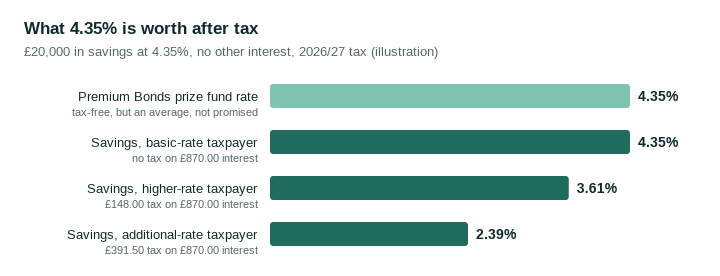
The comparison has two sides. Savings interest is certain, while the 4.35% prize rate is an average that most holders don’t reach. Many people compare the after-tax interest they’d actually get with the prize fund rate, knowing their own Premium Bonds return could be lower or higher. From 6 April 2027 the savings rates of income tax rise to 24%, 44% and 49% (Finance Act 2026, as changed at Budget 2026), which would reduce the after-tax figures for interest above the allowances.
How does investing compare?
Investing in funds, shares or bonds aims for growth above inflation over the long term, but values go up and down and could end up below what was put in. MoneyHelper suggests investing for at least five years, so there’s time to ride out falls.
Investments are usually held in a stocks and shares ISA or a pension, where growth and income aren’t taxed (pension withdrawals are mostly taxed as income). Outside those, dividends and gains can be taxed; our guide to tax on investments explains the allowances.
Safety works differently too. The FSCS may pay up to £85,000 per person, per firm if an authorised investment firm fails and can’t return investments, but it doesn’t cover falls in value. That’s the main trade-off against cash and Premium Bonds: the possibility of higher long-term returns, in exchange for the risk of losses and no guaranteed outcome. The cash vs investing calculator compares the two over different time frames in today’s money.
How do they compare side by side?
The three options differ mainly on how predictable the return is, how it’s taxed and what protects the money. Some people also look at gilts, which are UK government bonds that can be bought directly or through a fund, as another low-risk option alongside these three.
| Premium Bonds | Savings account | Investing | |
|---|---|---|---|
| Return | Prize draw, 4.35% average | Fixed or variable interest | Varies, can be negative |
| Predictable? | No | Yes | No |
| Tax | Prizes tax-free | Taxable above allowances, unless in a cash ISA | No tax on growth in an ISA or pension (pension withdrawals are mostly taxed as income) |
| Safety of what’s put in | 100% backed by HM Treasury | FSCS up to £120,000 per banking licence | Can fall in value; FSCS up to £85,000 only if a firm fails |
| Access | Cash in at any time | Depends on the account | Can sell at any time, but possibly at a loss |
| Typically used for | Security, spare cash above tax-free allowances | Emergency fund, short-term goals | Goals 5+ years away |
How do people typically use each?
Many people use more than one, matching each to when the money will be needed. These are common patterns, not recommendations:
- Emergency fund: an easy-access savings account or cash ISA, because the money needs to be there and earning a known amount.
- Money for the next few years, such as a house deposit or a wedding: savings or a cash ISA, or a Lifetime ISA for a first home.
- Spare cash above the Personal Savings Allowance, for higher or additional-rate taxpayers: some people hold Premium Bonds, because tax-free prizes compare better with taxed interest. Others compare them with cash ISA rates, which are also tax-free.
- Long-term money that won’t be needed for at least five years: investing, usually through a stocks and shares ISA or pension, has historically been more likely to beat inflation than cash, though past returns don’t guarantee future ones.
Before moving savings into investments, many people check their debts and emergency fund first. Our guide Should I invest my savings? covers those checks.
Why does inflation matter?
Inflation matters because money earning less than prices rise loses buying power, even when its value in pounds goes up. The Bank of England’s target is 2% inflation a year, but actual inflation can be well above or below that.
This applies to all three options. A Premium Bonds holding that wins nothing for a year has fallen in real terms by that year’s inflation. A savings account paying less than inflation after tax also loses ground. Investments have historically had a better chance of beating inflation over long periods, at the cost of short-term ups and downs. Our inflation calculator shows what rising prices do to a sum over time.
Common questions about Premium Bonds
Are Premium Bonds prizes taxable?
No. Premium Bonds prizes are free of UK income tax and capital gains tax, whatever the size of the prize and whatever the holder’s tax band. That’s the main reason the comparison with taxed savings interest looks different for higher and additional-rate taxpayers, as the worked example above shows.
Can I lose money in Premium Bonds?
The amount put in can’t fall in pounds: NS&I is backed by HM Treasury and bonds can be cashed in at face value. The risk is that prizes over a period are small or nothing, so the holding loses buying power to inflation and earns less than an interest-paying account would have.
What is the maximum Premium Bonds holding?
The maximum holding is £50,000 per person, and the minimum purchase is £25. Bonds can’t be held jointly, so a couple can hold up to £50,000 each.
When do new Premium Bonds go into the draw?
New bonds need to be held for a whole calendar month before they’re eligible. A purchase in November first enters the January draw. Bonds bought by reinvesting prizes enter the following month’s draw. Bonds must still be held on the first day of the draw month.
Does the prize fund rate change?
Yes. NS&I and HM Treasury change it from time to time, along with the odds. In 2026 it moved from 3.60% to 3.30%, then 3.80%, then 4.35% from the September draw. NS&I announces changes on its website and in notices in The Gazette.
Is the Premium Bonds rate the same as interest?
No. Interest is paid to every saver at the stated rate. The prize fund rate is the average across all bonds, and the money is paid out unevenly as prizes. Most holders get less than the average in a typical year, and a few get much more.
Sources
- NS&I: Boost for Premium Bonds, plus improved rates on four other NS&I savings products (18 August 2026)
- NS&I: Improved rates for Premium Bonds and four other NS&I savings accounts (14 May 2026)
- NS&I: NS&I reduces prize fund rate and lengthens odds for Premium Bonds (24 February 2026)
- The Gazette: National Savings notice of Premium Bonds changes from the 1 September 2026 draw
- NS&I: Premium Bonds
- NS&I: Premium Bonds brochure and terms
- GOV.UK: Tax on savings interest, how much is tax-free
- GOV.UK: Income Tax, changes to tax rates for property, savings and dividend income
- legislation.gov.uk: Finance Act 2026, section 5 (savings rates of income tax for 2027-28)
- GOV.UK: Individual Savings Accounts
- FSCS: Deposit protection limit
- FSCS: Investments
- MoneyHelper: A beginner's guide to investing
- Bank of England: Inflation and the 2% target
Our guides are general information and education, not personal financial advice. If you are unsure whether an investment is right for you, speak to a regulated financial adviser. Capital at risk. Investments can fall as well as rise, and you may get back less than you put in.