Should I Invest My Savings? UK Guide
TL;DR
- MoneyHelper's general rule is to deal with expensive debts and build an emergency fund before investing.
- MoneyHelper suggests an emergency fund of three to six months' essential outgoings, in instant-access savings.
- Investing usually suits money not needed for at least five years, because values can fall and need time to recover.
- Cash can't fall with markets, but it loses buying power if it earns less than inflation.
- In the FCA's 2024 survey, 61% of people with over £10,000 to invest held at least three-quarters of it in cash.
Quick answers
- LimitHow much cash do people keep first? MoneyHelper suggests three to six months' essential outgoings in instant-access savings.
- DependsPay off debt before investing? Expensive debts like credit cards usually first, MoneyHelper says. Many don't treat a mortgage the same way.
- LimitHow long before investing makes sense? MoneyHelper suggests investing only money you won't need for at least five years.
- Watch outIs cash risk-free? Not quite. Its value in pounds doesn't fall, but inflation can shrink what it buys.
- NoDoes investing always beat cash? No. At 3% growth a year, our 10-year example ends behind cash in today's money.
- LimitIs my money protected? Per person: savings to £120,000 per banking licence; investments to £85,000 per firm, if a firm fails.
- Of people with £10,000+ to invest who held at least three-quarters in cash (FCA, 2024)
- 61%
- Essential outgoings MoneyHelper suggests keeping as an emergency fund
- 3 to 6 months
- Minimum time frame MoneyHelper suggests for investing
- 5 years
- FSCS protection for savings, per person, per banking licence
- £120,000
On this page
- How many people keep their savings in cash?
- What should you sort out before investing?
- How much cash should you keep?
- When does investing make sense for savings?
- What does keeping money in cash cost over time?
- Worked example: £10,000 in cash or invested
- How do people move savings into investments?
- Is your money protected?
- Where can you get help with the decision?
- What to do next
- Related guides
- Sources
Many people in the UK have savings sitting in cash and wonder whether they should be investing some of it. There’s no single right answer, because it depends on your debts, your safety net and when you’ll need the money. This guide sets out the checks many people make, how much cash is usually kept back, and what leaving money in cash, or investing it, could mean over different time frames.
How many people keep their savings in cash?
A lot. The FCA’s Financial Lives survey, the regulator’s large study of how UK adults use financial services, found that in 2024 61% of people with more than £10,000 in investible assets held at least three-quarters of it in cash. For some of them, that’s exactly right: the money is an emergency fund, or it’s earmarked for a house deposit in two years. Cash is simple, its value in pounds doesn’t fall, and deposits are protected by the FSCS up to £120,000 per person, per banking licence.
The FCA has also been concerned that some people miss out by holding cash they won’t need for many years. That concern is one reason it introduced targeted support from 6 April 2026. Under these rules, authorised firms such as banks, platforms and pension providers can offer ready-made suggestions to groups of customers in similar situations, for example people with large cash balances and no investments. Targeted support isn’t personal financial advice, and you don’t have to act on it.
What should you sort out before investing?
MoneyHelper, the free government-backed guidance service, gives a general order that many people follow. Our guide to what to do with your money covers the full order, including budgeting and free top-ups such as Help to Save; the short version is:
- Deal with expensive debts. MoneyHelper’s general rule is to pay off expensive debts, such as credit cards, store cards, Buy Now Pay Later and short-term loans, before you save or invest. Paying off debt saves you its interest rate with certainty, and investment returns are never certain. Priority debts, such as council tax, court fines and child maintenance, come before everything else.
- Build an emergency fund. This is money kept in cash for unexpected costs, such as a boiler repair or a gap between jobs, so you don’t have to borrow or sell investments at a bad time.
- Then think about investing money you can leave alone for years.
Many people don’t treat a mortgage or a student loan as “expensive” debt in the same way. Overpaying a mortgage and investing are both reasonable uses of spare money, and many people do a bit of each.
How much cash should you keep?
MoneyHelper suggests aiming for three to six months’ essential outgoings in an instant-access savings account. Essential outgoings are the bills you must pay: rent or mortgage, council tax, energy, food, transport and minimum debt repayments. For someone whose essentials cost £1,800 a month, that’s roughly £5,400 to £10,800.
If you’re building up to that figure, our savings goal calculator works out how much to put aside each month to reach it within a set number of years; for cash, set the growth rate to your savings rate.
Some people keep towards the top of that range, or more, for example if their income is irregular, they’re self-employed or they’re the only earner in the household.
On top of the emergency fund, money you’ll need for a known goal in the next few years, such as a wedding, a car or a house deposit, usually stays in cash or a cash ISA, so a market fall can’t eat into it just before you need it. Only the money left after that is usually considered for investing.
When does investing make sense for savings?
MoneyHelper suggests starting to think about investing if you won’t need the money for at least five years. The reason is that investment values go up and down, sometimes sharply. Over a short time frame, a fall could leave you with less than you put in, with no time to wait for a recovery. Over a longer one, there’s more time for growth to make up for falls, although that isn’t guaranteed.
So a common approach is to split savings by time frame:
- Needed within a year or two: cash, a cash ISA or Premium Bonds.
- Two to five years away: usually cash, or a fixed-rate account; some people use lower-risk investments.
- Five or more years away: investing, usually through a stocks and shares ISA or a pension.
Our guide to Premium Bonds, savings or investing compares the three main homes for money in more detail.
What does keeping money in cash cost over time?
Cash can’t fall with the markets, but it has a quieter risk: inflation. If your savings earn less than prices rise, the money buys less each year, even though the balance in pounds goes up. The Bank of England’s target for inflation is 2% a year. Even at that rate, prices double in about 35 years.
The figure that matters is the real return: what your money earns after inflation. Savings paying 3.5% while inflation runs at 2% give a real return of roughly 1.5% a year. Over a decade, that leaves £10,000 worth about £11,572 in today’s money.
Tax matters too. Interest above your Personal Savings Allowance, which is £1,000 a year for basic-rate taxpayers and £500 for higher-rate taxpayers in 2026/27, is taxed as income: 20% at the basic rate now, rising to 24% from 6 April 2027 after the Budget on 28 October 2026. Interest in a cash ISA is tax-free. Our inflation calculator shows whether your own savings are keeping up.
Worked example: £10,000 in cash or invested
Here’s £10,000 left in savings earning 3.5% a year, compared with the same money invested and growing 5% a year before charges of 0.5% a year. Inflation is 2% a year. Values are in today’s money, so they show what the money would buy. These are illustrations with steady rates, not forecasts.
| Years | Savings | Invested | A fall of this size would wipe out the lead |
|---|---|---|---|
| 1 | £10,147 | £10,243 | 0.9% |
| 3 | £10,448 | £10,746 | 2.8% |
| 5 | £10,757 | £11,274 | 4.6% |
| 10 | £11,572 | £12,709 | 9.0% |
| 20 | £13,391 | £16,153 | 17.1% |
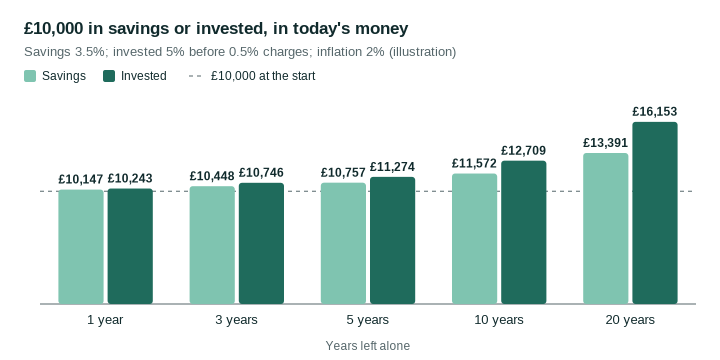
Two things stand out. First, over one year the invested money is only about £96 ahead in today’s money, so a fall of just 0.9% would leave it behind cash. That’s why short-term money usually stays in cash. Second, the gap widens with time: after 20 years it is about £2,762 ahead, and it would take a fall of around 17% to erase it.
The result depends heavily on the growth assumption. Over 10 years, at 3% growth the invested money would be worth about £10,486 in today’s money, less than the £11,572 in savings. At 7% it would be about £15,349. Nobody knows which is more likely, so it’s worth testing a range in our cash vs investing calculator.
How do people move savings into investments?
People who decide to invest some of their savings usually make three choices:
- The account. A stocks and shares ISA lets up to £20,000 a year grow free of tax in 2026/27; a pension adds tax relief but locks money away until later life. Our guide to ISAs or pensions compares them.
- How to put the money in. Some invest a lump sum at once; others drip-feed it monthly to spread the timing risk. Our guide to lump sums and drip-feeding sets out what the research shows.
- What to invest in. Many beginners use low-cost, diversified funds, such as index funds or ready-made portfolios, rather than picking individual shares. Our guide to diversification and risk explains why.
Charges matter because they’re taken every year whatever happens to your investments. Our platform fee calculator shows what different platforms would cost on your balance.
Is your money protected?
Protection works differently for savings and investments:
- Savings in a UK bank or building society are protected by the Financial Services Compensation Scheme (FSCS) up to £120,000 per person, per banking licence, if the bank fails.
- Investments held with an authorised investment firm are protected up to £85,000 per person, per firm, if the firm fails and can’t return your money or investments.
The FSCS never covers investments falling in value. That’s the risk you take for the chance of higher growth. Before using any firm, check it’s on the FCA register.
Where can you get help with the decision?
MoneyHelper offers free, impartial guidance on saving, investing and debt. If your bank or platform offers targeted support, it can help you see what people in a similar situation tend to do. For a recommendation based on your own circumstances, you need a regulated financial adviser, who will charge a fee.
If you’re new to investing, our beginner course takes you through the basics in order, starting with how investing works.
Sources
- FCA: More people have bank accounts but one in ten have no cash savings, FCA survey reveals (Financial Lives 2024, 16 May 2025)
- FCA PS25/22: Supporting consumers' pensions and investment decisions, rules for targeted support
- MoneyHelper: What's the difference between saving and investing?
- MoneyHelper: How to save for an emergency
- MoneyHelper: Should you pay off debt, save, or invest first?
- MoneyHelper: A beginner's guide to investing
- Bank of England: Inflation and the 2% target
- FSCS: Deposit protection limit
- FSCS: Investments
- GOV.UK: Tax on savings interest
- GOV.UK: Individual Savings Accounts
- HM Treasury: Budget 2026 overview of tax legislation and rates, Annex A: rates and allowances
Our guides are general information and education, not personal financial advice. If you are unsure whether an investment is right for you, speak to a regulated financial adviser. Capital at risk. Investments can fall as well as rise, and you may get back less than you put in.