Transferring Investments Between Platforms
TL;DR
- Investments can move to a new platform as they are (an in-specie transfer) or be sold and moved as cash.
- In specie keeps you invested throughout. A cash transfer leaves your money out of the market until it's reinvested.
- Since February 2021, platforms must offer in-specie transfers of funds that the new platform also offers.
- ISA and pension transfers must be arranged provider to provider. Withdrawing the money yourself loses the tax wrapper.
- GOV.UK says ISA transfers should take up to 15 working days between cash ISAs and 30 calendar days for others.
Quick answers
- DependsWill I be out of the market? Not with an in-specie transfer. With a cash transfer, yes, from the sale until you reinvest.
- Watch outCan a platform charge me to leave? Yes. Exit fees aren't banned, but the Consumer Duty bars unreasonable barriers to switching.
- NoDoes an ISA transfer use my allowance? No. A transfer isn't a new payment, as long as the new provider arranges it.
- DateHow long does an ISA transfer take? Up to 15 working days cash to cash; up to 30 calendar days for other ISA transfers.
- DependsCan moving a general account trigger tax? A cash transfer sells everything, which can create Capital Gains Tax. In specie isn't a sale.
- DependsDo I need advice to move a pension? Only if it has safeguarded benefits worth over £30,000, such as a defined benefit pension or guaranteed annuity rate.
- Maximum for a stocks and shares ISA transfer (GOV.UK)
- 30 calendar days
- Defined benefit pension value above which advice is required
- £30,000
- Cap on early exit charges on older personal pensions, from 55
- 1%
- FSCS limit if an investment firm fails
- £85,000
On this page
- What does transferring investments between platforms mean?
- What is the difference between an in-specie and a cash transfer?
- What do FCA rules say about in-specie transfers?
- What is a unit-class conversion?
- Will you be out of the market during a transfer?
- Can a platform charge you to leave?
- How does an ISA transfer keep its tax-free status?
- How do you transfer a SIPP or other pension?
- What should you check before moving a pension?
- What about a general investment account?
- How long does a platform transfer take?
- Are your investments protected during a transfer?
- How do people typically go about a transfer?
- Common questions about transferring investments
- What to do next
- Related guides
- Sources
Transferring investments means moving your holdings, or their cash value, from one investment platform to another without closing the account type they sit in. It applies to stocks and shares ISAs, self-invested personal pensions (SIPPs) and general investment accounts (GIAs). People move to cut charges, to bring scattered accounts together, or for a wider range of investments. This guide explains the two ways a transfer can happen, what the FCA’s rules say, what it can cost, how long it takes and what to check before starting.
What does transferring investments between platforms mean?
A platform transfer moves an account, or part of one, from one provider to another, keeping the same type of account. A stocks and shares ISA stays an ISA, a SIPP stays a pension and a GIA stays a GIA. The new platform, called the receiving platform, usually starts the process. The old one, the ceding platform, then sends your investments or their cash value across.
This is different from closing an account and opening a new one yourself. For ISAs and pensions that difference matters a great deal, because taking money out of the wrapper and paying it in elsewhere is treated as a withdrawal and a new payment, not a transfer. For a GIA there’s no tax wrapper to lose, but how the move is made can still decide whether you owe Capital Gains Tax.
The FCA, the UK’s financial regulator, has set specific rules for platform switching since February 2021. They sit in the part of its rulebook called COBS 6.1H. They cover what platforms must offer when you move, not what they may charge. Unfamiliar terms are explained in our glossary.
What is the difference between an in-specie and a cash transfer?
An in-specie transfer moves your investments as they are, while a cash transfer sells them and moves the money. In specie means “in kind”. It’s also called re-registration, because the FCA defines it as moving fund units by re-registering who owns them, without the fund manager cashing them in. On the day the transfer completes, you hold the same funds, shares or ETFs on the new platform, in the same quantities.
In a cash transfer, the old platform sells everything, sends the proceeds, and you choose new investments once the money arrives. That’s simpler for the platforms, and some holdings can only move this way, for example a fund the new platform doesn’t offer.
The two routes differ in four practical ways:
- Market exposure. In specie keeps you invested throughout. Cash leaves you out of the market for a period.
- Dealing costs. Selling and rebuying can mean dealing charges and spreads twice.
- Tax in a GIA. Selling is a disposal for Capital Gains Tax. Re-registering isn’t a sale.
- Speed. Cash transfers are often quicker, because only money changes hands.
What do FCA rules say about in-specie transfers?
Since 1 February 2021, the FCA has required platforms to offer an in-specie transfer of fund units, as long as the receiving platform offers the same fund and nothing outside either firm’s control stops it. The rules, introduced in policy statement PS19/29, came out of the FCA’s investment platforms market study, which found that barriers to switching were harming competition.
Under COBS 6.1H, a platform must:
- offer the option of an in-specie transfer of units in a fund available on both platforms
- offer to convert your units into a cheaper discounted unit class where one is available to you
- give you enough information, in good time, to choose between the options
- take all reasonable steps to carry out your transfer instructions efficiently and within a reasonable time
- contact you at the earliest opportunity if it needs further instructions
The rules apply to units in funds such as unit trusts and OEICs. They don’t guarantee in-specie transfers of shares, ETFs or investment trusts, although many platforms move those as they are too. The rules set no fixed number of days. Asking the receiving platform which holdings it can accept in specie, before starting, avoids surprises.
What is a unit-class conversion?
A unit-class conversion swaps your holding in a fund for a different version of the same fund, usually one with a lower charge. Most funds come in several share classes (also called unit classes). They hold the same investments but carry different charges, and some classes are available only through certain platforms. If the receiving platform has negotiated a discounted class, keeping your old class means paying more for the same fund.
COBS 6.1H tackles this in two ways. If you choose an in-specie transfer and a conversion is needed, the ceding platform must ask the fund manager to carry it out. If you choose a discounted class the receiving platform offers, that platform must ask the fund manager and take other reasonable steps to make it happen. Both duties apply only where the platform is entitled to make the request.
Converting doesn’t mean selling. HMRC’s Capital Gains Manual says the share reorganisation rules can apply when an investor switches between classes of share in the same OEIC, so a conversion doesn’t usually count as a sale for Capital Gains Tax.
Will you be out of the market during a transfer?
With an in-specie transfer you stay invested; with a cash transfer you’re out of the market from the sale until the money is reinvested. While your holdings are being re-registered, you may not be able to buy or sell them. But they keep rising and falling with markets, so you share in whatever happens.
In a cash transfer, the money isn’t invested while it’s moving. If markets rise in that period you miss the gain, and if they fall you avoid the loss. Nobody can know in advance which. For a stocks and shares ISA, GOV.UK says a transfer other than cash ISA to cash ISA should take no longer than 30 calendar days, so the gap could be up to a month, plus the time it takes you to reinvest.
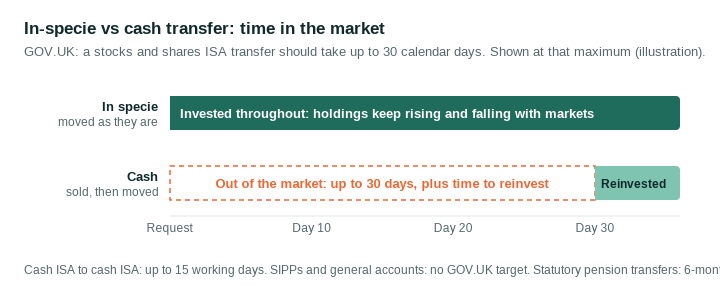
The gap also depends on the order of events. Some platforms sell on the day they receive the request; others wait until the receiving platform is ready. Many people ask both platforms how long the money will sit as cash, and invest it promptly once it arrives. Our guide to lump sum vs drip-feeding covers the separate question of how to reinvest a large sum.
Can a platform charge you to leave?
Yes, FCA rules don’t ban platform exit fees, but they must not create unreasonable barriers to switching. The FCA planned to consult on restricting exit fees after its market study. In November 2020 it dropped that work. It said there had been a “marked shift in the market away from exit fees”, welcomed platforms phasing them out, and said it would watch closely and could consult on new rules if harm re-emerged.
Two other rules apply. Under the Consumer Duty, a firm must make sure retail customers don’t face unreasonable barriers, including unreasonable additional costs, when they switch products or transfer to a new provider (PRIN 2A.6.2R). And the FCA’s good practice for platforms includes stating clearly whether exit fees apply or not.
Fees to look for include:
- a charge per holding or per account for transferring out
- a charge to close the account
- dealing charges, if holdings are sold for a cash transfer
Some receiving platforms offer to cover exit fees, so it’s worth asking. Our platform fee calculator works out the yearly cost on each platform, which shows how much a move could save each year compared with any exit fee.
How does an ISA transfer keep its tax-free status?
An ISA transfer keeps its tax-free status as long as the new provider arranges it; if you withdraw the money yourself, it stops being an ISA. GOV.UK’s guidance is to contact the ISA provider you want to move to and fill in its transfer form. If you withdraw the money without doing this, you can’t reinvest that part of your tax-free allowance.
Transferred money isn’t a new payment, so it doesn’t use any of the £20,000 allowance for 2026/27. You can move all or part of an ISA, including money paid in during earlier years, and still pay in your full allowance with either provider.
Your holdings keep their ISA status throughout, whether they move in specie or as cash. A stocks and shares ISA can be moved in specie under the same FCA rules as any other platform account, so the choice between in-specie and cash applies here too.
Our guide on how to transfer an ISA covers the details, including Lifetime ISAs, Junior ISAs, fixed-rate penalties on cash ISAs and the rule change from April 2027 on moving stocks and shares ISAs into cash ISAs.
How do you transfer a SIPP or other pension?
A pension transfer works like an ISA transfer: the receiving pension provider requests it, and the money moves directly between schemes. Taking money out of a pension yourself is a withdrawal, normally taxed, not a transfer. Moving a SIPP from one platform to another, or moving an old workplace pension into a SIPP, can be done in specie or as cash, depending on what both providers accept.
The cost of leaving is capped for many older personal pensions. Since 31 March 2017, if you’re 55 or over, the FCA caps early exit charges on existing contract-based personal pensions at 1% of their value. Pensions taken out after the cap started can’t have an early exit charge at all once you reach that age.
Pension schemes also run checks on transfers to protect against scams. Since 30 November 2021, trustees must check every statutory transfer for warning signs. Some, such as unsolicited contact or pressure to transfer, stop it. Others, such as unclear charges or overseas investments, mean you must attend a MoneyHelper pensions safeguarding session before it can go ahead.
What should you check before moving a pension?
Before moving a pension, check whether it has guarantees or special rights that you’d lose by leaving. GOV.UK warns that a transfer could mean losing:
- a right to take your pension at a certain age
- fixed or enhanced protection
- a tax-free lump sum of more than 25% of your pot
Some older policies also offer a guaranteed annuity rate, a promised rate for turning your pot into an income that can be far higher than rates available today. Your current provider can confirm which of these apply.
Defined benefit (final salary) pensions are different. They pay a guaranteed income, and MoneyHelper notes that those guaranteed benefits can’t be got back once you transfer out. If a defined benefit pension is worth more than £30,000, you must get regulated financial advice before transferring it to a defined contribution scheme such as a SIPP. You usually pay for that advice unless your employer has offered you an incentive to transfer.
Our pension check-up guide explains how to find these details on your statements, and our SIPPs guide covers what happens once a pension has moved.
What about a general investment account?
A general investment account has no tax wrapper, so the main risk in moving one is selling when you don’t need to. GOV.UK says you may have to pay Capital Gains Tax if you make a profit when you sell shares or units outside an ISA. A cash transfer sells everything, so it can crystallise gains: turn them from paper profits into taxable ones. Gains above the £3,000 annual exempt amount in 2026/27 are taxed.
An in-specie transfer avoids that. Platforms usually hold your investments through a nominee company, but HMRC treats you, not the nominee, as the owner. Re-registering holdings from one nominee to another doesn’t change who owns them, so it isn’t a sale.
If the new platform can’t hold some of your investments, those may have to be sold, and that sale counts for Capital Gains Tax in the usual way. Our general investment account guide explains how gains are worked out, and our dividend and capital gains tax calculator estimates the tax.
How long does a platform transfer take?
ISA transfers have set maximum timescales, but other platform transfers only have to happen within a reasonable time. According to GOV.UK, ISA transfers should take no longer than:
| Type of ISA transfer | Maximum time |
|---|---|
| Cash ISA to cash ISA | 15 working days |
| Other transfers, including stocks and shares ISAs | 30 calendar days |
For SIPPs and general investment accounts, the FCA’s switching rules require platforms to act efficiently and within a reasonable time, but set no fixed deadline. In-specie transfers can take longer than cash, because each holding has to be re-registered and some fund managers are slower than others. A transfer involving many holdings, or a fund that needs a unit-class conversion, often takes the longest.
If an ISA transfer runs late, GOV.UK says to contact your provider first. If you’re unhappy with its response, you can complain to the Financial Ombudsman Service, which is free to use.
Are your investments protected during a transfer?
Your investments don’t lose regulatory protection while they move between two authorised firms. The FSCS (Financial Services Compensation Scheme) can pay up to £85,000 per person, per firm, if an authorised investment firm fails and there’s a shortfall in the money or assets it holds for you. That applies to the ceding and receiving platforms alike.
The FSCS doesn’t cover falls in value. It says it can’t accept claims for poor investment performance, so a market fall during a transfer isn’t something it protects against.
One practical point: the FSCS limit applies per firm, not per account. If you consolidate several accounts on one platform, the £85,000 limit covers your total holding with that firm, not each account. That’s worth knowing when moving large sums. You can check that both firms are authorised on the FCA Financial Services Register.
How do people typically go about a transfer?
The usual sequence is the same for ISAs, SIPPs and general accounts. Many people:
- List what they hold and on which accounts, including any cash.
- Check the old platform’s charges for leaving, and the pension’s terms for guarantees or exit charges.
- Ask the new platform which holdings it can accept in specie, which share classes it offers, and whether it covers exit fees.
- Open the matching account with the new platform and complete its transfer form. They don’t withdraw money or close the old account themselves.
- Confirm the method (in specie or cash) for each holding.
- Check everything arrived, then close the old account if it’s empty and no fees continue.
Our platform fees guide explains how to compare what you’d pay on the new platform.
Common questions about transferring investments
Does transferring an ISA use this year’s allowance?
No. A transfer isn’t a new payment, so it doesn’t count towards the £20,000 allowance. You can transfer an ISA and still pay your full allowance in during the same tax year, with the old provider or the new one. This only holds if the new provider arranges the transfer.
Can you transfer only part of your investments?
Usually, yes. GOV.UK says you can transfer all or part of your ISA savings, including money paid in during earlier years. Platforms often allow partial transfers of SIPPs and general accounts too, for example moving some holdings and leaving others. Each platform sets its own rules on this, so check with both.
Can you buy or sell during an in-specie transfer?
Usually not. Holdings being re-registered are typically frozen until the transfer completes, so you can’t trade them on either platform for that time. Their value still moves with the market. Some people who expect to sell soon do so before starting, bearing in mind that selling outside an ISA or pension can trigger Capital Gains Tax.
What happens to cash in the account?
Cash held in the account is normally sent across as part of the transfer. It keeps its ISA or pension status if it’s moving between ISAs or between pensions. Check whether any cash is earning interest on the old platform, and whether dividends paid during the transfer will follow automatically.
Can you transfer a workplace pension while you still work there?
Sometimes. Some workplace schemes allow transfers out while you’re still a member and contributing; others don’t. You’d also lose your employer’s contributions to that scheme if you stopped paying in. Your scheme administrator can tell you its rules, and our workplace pensions guide explains how employer contributions work.
Do you need advice to transfer a pension?
Only in some cases. You must get regulated advice before transferring a defined benefit pension worth more than £30,000. For most other transfers, such as moving a SIPP or a personal pension, advice isn’t compulsory, though free, impartial guidance is available: Pension Wise, from MoneyHelper, offers appointments if you’re 50 or over and have a defined contribution pension.
Sources
- DWP: Pension benefits with a guarantee and the advice requirement
- Pension Schemes Act 1993, section 99 (time limit for statutory transfers)
- FCA Handbook COBS 6.1H: Platform switching
- FCA: PS19/29 Making transfers simpler, feedback to CP19/12 and final rules
- FCA: Statement on certain FCA work in light of coronavirus and changing market conditions (13 November 2020)
- FCA Handbook PRIN 2A.6: Consumer Duty, consumer support outcome
- FCA: Investment platforms costs and charges review – good and poor practice
- FCA: Cap on early exit pension charges
- GOV.UK: Transferring your ISA
- GOV.UK: Transferring your pension to a UK pension scheme
- MoneyHelper: Transferring your defined benefit pension
- The Pensions Regulator and DWP: Joint statement on transfer regulations
- GOV.UK: Tax when you sell shares
- HMRC Capital Gains Manual CG34300: nominees and bare trustees
- HMRC Capital Gains Manual CG57755: OEICs, share classes
- FSCS: Investments
- MoneyHelper: Pension Wise
Our guides are general information and education, not personal financial advice. If you are unsure whether an investment is right for you, speak to a regulated financial adviser. Capital at risk. Investments can fall as well as rise, and you may get back less than you put in.