Lump Sum or Drip-Feed Your Investments?
TL;DR
- In UK shares from 1986 to 2022, investing a lump sum at once beat a three-month drip-feed 68.1% of the time.
- That's mainly because prices rose more often than they fell, so money waiting in cash usually missed out.
- Drip-feeding won about one time in three. It narrows the range of outcomes, which is why some people choose it.
- Investing monthly from pay isn't really drip-feeding a lump sum: it's investing money as it's earned.
- Time invested, charges and diversification usually matter more than how a lump sum goes in.
Quick answers
- DependsDoes a lump sum usually do better? Usually, in the past. In UK shares it beat a three-month drip-feed 68.1% of the time.
- DependsDoes drip-feeding reduce risk? It reduces the risk of a badly timed start, not the risk of the investments themselves.
- DependsHow long did the study drip-feed over? Three to six months. The average cost of waiting grew with the length.
- Watch outCan a lump sum fall straight away? Yes. Money invested just before a crash can fall sharply and take years to recover.
- NoDoes interest on waiting cash close the gap? It narrows it. For an all-shares portfolio, a lump sum still beat a three-month drip-feed 65% of the time.
- NoIs investing monthly from pay drip-feeding? Not really. It's investing money as it's earned, with no lump sum waiting in cash.
- How often a lump sum beat a three-month drip-feed in UK shares, 1986 to 2022
- 68.1%
- How often a lump sum beat a six-month drip-feed in UK shares, same period
- 69.5%
- Minimum time frame the FCA suggests for investing
- 5+ years
- FSCS protection for cash waiting in a bank, per person, per bank
- £120,000
On this page
- Is it better to invest a lump sum or drip-feed it?
- Why has a lump sum usually come out ahead?
- How does pound-cost averaging work?
- What does waiting cost in a worked example?
- Why do some people still choose to drip-feed?
- How do people usually set up a drip-feed?
- Is investing monthly from your pay the same as drip-feeding?
- What matters more than lump sum or drip-feed?
- Common questions about lump sums and drip-feeding
- What to do next
- Related guides
- Sources
If you have a lump sum to invest, perhaps from an inheritance, a bonus or savings you’ve built up, you can put it all in at once, or drip-feed it into the market in smaller amounts over several months. Drip-feeding a lump sum is also called pound-cost averaging. It feels safer, because it avoids putting everything in just before a fall. The research suggests investing all at once has usually ended with more money, but not always, and the gap is often modest. This guide explains what the evidence shows, how pound-cost averaging works in numbers, and why some people still phase money in. It explains how things work; it isn’t advice about what anyone should do.
Is it better to invest a lump sum or drip-feed it?
Historically, investing a lump sum straight away has ended with more money about two times in three, but drip-feeding has won about one time in three. A 2023 research paper by fund manager Vanguard, Cost averaging: Invest now or temporarily hold your cash?, compared the two approaches across several markets. It measured wealth one year after each starting month, comparing an immediate investment with the same sum split into equal monthly parts.
For UK shares (the FTSE All-Share index, 1986 to 2022), the lump sum came out ahead 68.1% of the time against a three-month drip-feed, and 69.8%, 70.2% and 69.5% of the time against four, five and six months. For global shares measured in pounds (1976 to 2022), the figures were 67.8% for three months and 70.8% for six. Emerging markets were lower, at 61.6% for three months.
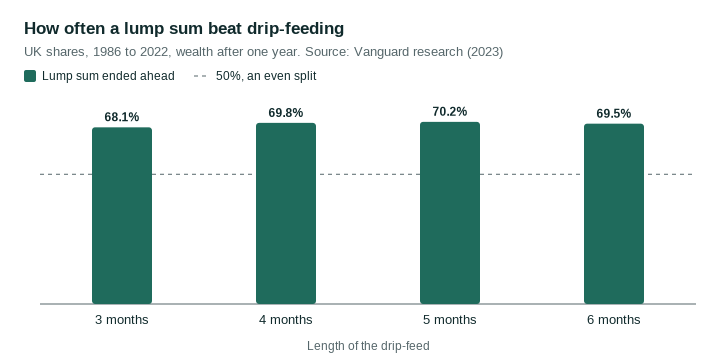
The finding isn’t new. A 1979 paper in the Journal of Financial and Quantitative Analysis was titled A Note on the Suboptimality of Dollar-Cost Averaging as an Investment Policy. The pattern describes the past, though, not what will happen next.
Why has a lump sum usually come out ahead?
A lump sum usually wins because share prices have risen in more periods than they’ve fallen, so money waiting in cash tends to miss growth it would otherwise have had. Drip-feeding only comes out ahead when prices fall during the months the money is being phased in, and that has happened less often than prices rising.
The same 2023 study found the cost of waiting grows with the length of the drip-feed. In its simulations, starting with $100,000 and earning no interest on the waiting cash, drip-feeding over three months ended the year $504 behind the lump sum for a portfolio of 60% shares and 40% bonds, and drip-feeding over six months $1,491 behind. When the waiting money earned interest at a short-term government bill rate, the lump sum still beat a three-month drip-feed 65% of the time for an all-shares portfolio.
None of this means a lump sum is safe. Money invested just before a crash can fall sharply and take years to recover. In the study’s global data, among the worst 5% of outcomes, drip-feeding ended higher than the lump sum in all three portfolios tested: for all shares, $85,906 against $82,947 from a $100,000 start. The lump sum tends to win more often, but its bad outcomes are worse.
How does pound-cost averaging work?
Pound-cost averaging means investing a fixed amount at regular intervals, so you automatically buy more units when prices are low and fewer when they’re high. A unit is a share of a fund. The FCA’s InvestSmart guidance describes this: a regular monthly investment “buys more during months when prices have dipped.”
Here’s an illustration, not a forecast. Someone invests £900, either all at once at a unit price of £1.00, or as £300 a month for three months.
| Prices over three months | Units from drip-feeding | Units from the lump sum | Value at £1.25 (drip-feed) | Value at £1.25 (lump sum) |
|---|---|---|---|---|
| £1.00, then £0.75, then £1.25 | 940 | 900 | £1,175 | £1,125 |
| £1.00, then £1.10, then £1.25 | 813 | 900 | £1,016 | £1,125 |
When the price dipped in the middle month, drip-feeding bought extra cheap units and finished ahead. When the price rose steadily, it bought fewer units and finished behind. Pound-cost averaging doesn’t guarantee a better result; it changes which outcomes are possible.
What does waiting cost in a worked example?
In a steady-growth model, phasing money in always ends up behind, because the waiting money isn’t growing. This example uses the same calculation as our compound interest calculator. It assumes 5% a year growth, no charges, and no interest on the cash waiting to be invested. It’s an illustration, not a forecast: real markets rise and fall.
Someone has £12,000. They either invest it all at once, or invest £1,000 at the end of each month for 12 months.
| Lump sum | Drip-fed over 12 months | |
|---|---|---|
| Value after 1 year | £12,600 | £12,273 |
| Value after 10 years | £19,547 | £19,039 |
The gap after one year is £327, the growth the waiting money missed. It keeps compounding, so after ten years it’s £508. That’s about 2.6% of the lump sum’s value. Interest on the waiting cash would narrow the gap. A fall in prices during the first year could reverse it, which is the scenario drip-feeding protects against.
Why do some people still choose to drip-feed?
Many people drip-feed because it reduces the chance of a painful start, even though it has usually cost a little on average. The 2023 study modelled investors with different attitudes to risk. When it allowed for loss aversion, the tendency to feel losses more strongly than equal gains, its “very conservative” investors came out better, in their own terms, drip-feeding, and its “moderately conservative” investors very slightly so. The paper concluded that investors with significant loss aversion “may be better suited” to it.
Common reasons people give include:
- Regret. Seeing a large fall soon after investing everything can lead some people to sell at a low point. The FCA warns that trying to time the market “increases your risk of buying or selling at the wrong time.”
- Getting started at all. In the study’s global data for 1976 to 2022, drip-feeding beat holding cash 69% of the time over a year, and the lump sum beat cash 70% of the time. Both did better than staying in cash in most periods.
- The size of the sum. A lump sum that’s large compared with what someone already holds makes a badly timed start matter more to them.
How do people usually set up a drip-feed?
People who drip-feed usually set a fixed timetable in advance, often equal amounts over three to six months, and stick to it whatever the news. Changing the plan because markets have moved turns drip-feeding into market timing, which the FCA warns against.
Practical points people often check:
- Where the waiting cash sits. Many keep it in an easy-access savings account or cash ISA while it waits. Bank and building society deposits are protected by the FSCS up to £120,000 per person, per bank, for firms that failed after 30 November 2025.
- Dealing charges. Some platforms charge for each one-off purchase but offer cheap or free regular investing. The FCA expects platforms to show total costs both in pounds and as a percentage. Our platform fees guide explains the different charges.
- The ISA allowance. You can pay in up to £20,000 in the 2026/27 tax year, which runs from 6 April to 5 April. Unused allowance can’t be carried forward. Someone with a sum larger than one year’s allowance may phase it across tax years anyway. Our ISA allowance guide and ISA allowance checker explain the limits.
Is investing monthly from your pay the same as drip-feeding?
Not really: investing a set amount from each month’s pay is simply investing money as it’s earned, because there’s no lump sum sitting in cash. Most people build up their ISAs and pensions this way, and workplace pension contributions work like this automatically. The FCA’s InvestSmart guidance describes committing to save regularly, “perhaps every month immediately after pay day,” as one approach.
It brings the same side effect as pound-cost averaging. Each month’s fixed amount buys more units when prices are low, so falls along the way are less painful in practice.
As an illustration, £250 a month for 20 years, growing at a steady 5% a year with no charges, would reach about £101,451, from £60,000 paid in. The savings goal calculator and compound interest calculator let you try other amounts. Real returns vary and can be negative.
What matters more than lump sum or drip-feed?
Over the long term, how long money stays invested, what it costs and how widely it’s spread usually make more difference than how it went in. In the study’s global data, the middle outcome for a lump sum was about 1.2% to 2.2% ahead of drip-feeding after one year, depending on the mix of shares and bonds. Time, charges and diversification compound over decades.
- Time. The FCA suggests a time frame of at least five years, and MoneyHelper describes investments as usually for the long term, five years plus.
- Charges. Our fee study found 1% a year in charges took about a sixth of a pot over 30 years.
- Diversification. Spreading money widely, for example through a global index fund, limits the damage any one company or country can do. Our diversification guide explains how.
- An emergency fund first. MoneyHelper suggests three to six months’ essential outgoings in instant-access savings, so investments don’t have to be sold at a bad time.
- Inflation. Cash held for years can lose buying power. The Bank of England’s target for inflation is 2% a year. Our inflation calculator shows the effect.
Common questions about lump sums and drip-feeding
How long do people usually drip-feed a lump sum over?
The research tested three to six months, and the cost of waiting rose with the length. Periods of three to six months are common; drip-feeding over a year or more keeps more money out of the market for longer. Whatever the length, a fixed timetable set in advance avoids the drip-feed turning into guessing the market.
Does pound-cost averaging reduce risk?
It reduces the risk of a badly timed start, because the money goes in at several prices rather than one. It doesn’t reduce the risk of the investments themselves: once all the money is invested, it rises and falls the same either way. In the 2023 study, drip-feeding narrowed the range of one-year outcomes and lowered the average.
Should a lump sum wait until the market falls?
Falls are hard to predict, and the FCA warns that trying to time the market increases the risk of buying or selling at the wrong time. Money waiting for a dip may wait while prices rise further. That’s why the research compares a fixed drip-feed with investing at once, not with waiting for a better moment.
Is a lump sum into a pension different?
The same timing trade-off applies once the money is inside the pension. Pensions add tax relief and an annual allowance on contributions, which affect how much goes in and when. Our pension tax relief guide and pension tax relief calculator explain how relief is added.
What about interest on the cash while it waits?
Interest on the waiting money narrows the gap but hasn’t usually closed it. In the 2023 study, with interest at a short-term government bill rate, a lump sum still beat a three-month drip-feed 65% of the time for an all-shares portfolio. Our cash vs investing calculator compares cash and investing over different periods.
Sources
- MoneyHelper: Thinking about investing? Make sure you understand the risks
- Vanguard research paper: Cost averaging: Invest now or temporarily hold your cash? (February 2023)
- Constantinides, G. M. (1979): A Note on the Suboptimality of Dollar-Cost Averaging as an Investment Policy, Journal of Financial and Quantitative Analysis 14(2), 443–450
- FCA InvestSmart: Golden rules of investing
- FCA InvestSmart: Should you invest?
- FCA InvestSmart: Risk and returns
- FCA: Investment platforms, consumers' investment costs (good and poor practice)
- MoneyHelper: A beginner's guide to investing
- MoneyHelper: How to save for an emergency
- FSCS: Banks, building societies and credit unions (deposit limit)
- GOV.UK: How ISAs work
- GOV.UK: Manage ISA subscriptions for your investors
- Bank of England: Inflation and the 2% target
Our guides are general information and education, not personal financial advice. If you are unsure whether an investment is right for you, speak to a regulated financial adviser. Capital at risk. Investments can fall as well as rise, and you may get back less than you put in.