Child Trust Funds: Find, Claim and Transfer
TL;DR
- Child Trust Funds (CTFs) are tax-free savings accounts set up for children born between 1 September 2002 and 2 January 2011.
- HMRC's free online tool tells you which provider holds a CTF. It doesn't show the balance, and there's no need to pay anyone.
- Around 827,000 matured CTFs were unclaimed in HMRC's September 2026 figures, worth £2,310 on average.
- The child can run the account from 16. At 18 it matures: the money is theirs to take out or move to an adult ISA.
- Anyone can pay in up to £9,000 a year until 18. The whole fund can be moved into a Junior ISA.
Quick answers
- DateWho has a Child Trust Fund? Children born 1 September 2002 to 2 January 2011. HMRC opened one if parents didn't.
- NoDoes finding a lost CTF cost anything? No. HMRC's online tool is free. It shows the provider, not the balance.
- DateWhen can the money come out? From 18, when it matures. Before that, only if the child is terminally ill or dies.
- LimitHow much can be paid in? Up to £9,000 a year, counted from the child's birthday, not the tax year.
- Tax-freeIs it taxed? No tax on interest, dividends or gains, and the £100 parental interest rule doesn't apply.
- YesCan it move to a Junior ISA? Yes, but the whole fund must move and the CTF closes. Part transfers aren't allowed.
- Unclaimed matured Child Trust Funds (HMRC, 2026)
- 827,000
- Average value of an unclaimed matured CTF
- £2,310
- Yearly CTF payment limit, birthday to birthday
- £9,000
- Yearly charge cap on stakeholder CTFs
- 1.5%
On this page
- Who got a Child Trust Fund?
- How do you find a lost Child Trust Fund?
- How many Child Trust Funds are unclaimed?
- What happens to a Child Trust Fund at 16?
- What happens to a Child Trust Fund at 18?
- How much can be paid into a Child Trust Fund?
- Can you transfer a Child Trust Fund to a Junior ISA?
- Is a Child Trust Fund taxed?
- What do Child Trust Funds charge?
- Can money be taken out of a Child Trust Fund early?
- Common questions about Child Trust Funds
- What to do next
- Related guides
- Sources
A Child Trust Fund (CTF) is a long-term, tax-free savings or investment account that the government opened for millions of children born in the 2000s. The scheme closed to new children in 2011, but the accounts didn’t close with it. Many are still running, many have matured, and hundreds of thousands have never been claimed. This guide explains who got one, how to find a lost account for free, what happens at 16 and 18, the rules on paying in and charges, and how a CTF can be moved into a Junior ISA.
Who got a Child Trust Fund?
Children born between 1 September 2002 and 2 January 2011 were given a Child Trust Fund, with a starting payment from the government. That payment came as a voucher sent to parents, who used it to open an account with a provider of their choice. If they hadn’t done so within 12 months, HMRC opened an account for the child. The National Audit Office found that 6.3 million CTFs were opened in total, and that HMRC opened 1.7 million of them, 28%, because no one else had.
The government payments were:
| Payment | Amount |
|---|---|
| Starting payment at birth | £250, plus a further £250 for lower-income families (£500 for children in care) |
| Payment at age 7 | £250, plus a further £250 for lower-income families (£500 for children in care) |
| From August 2010 | Starting payments cut to £50, or £100 for lower-income families and children in care. Age 7 payments stopped |
| From January 2011 | All new government payments stopped |
Children born after 2 January 2011 can’t have a CTF. The Junior ISA replaced it for them.
How do you find a lost Child Trust Fund?
HMRC runs a free online tool on GOV.UK that tells you which provider holds a Child Trust Fund. Anyone aged 16 or over can search for their own CTF, and a parent or guardian can search for a child under 18. If you already know the provider, you can contact it directly instead; if not, GOV.UK suggests asking a parent or guardian first.
Before starting, you need:
- your National Insurance number (and adoption details, if relevant), or
- for a child’s account, their full name, address, date of birth and any previous names, plus their National Insurance number if they have one
The form has to be completed in one go. HMRC usually replies by letter within 3 weeks; postal requests take longer. If nothing arrives within 6 weeks, GOV.UK gives a postal address to chase.
The tool has limits. It tells you the provider, not the balance, so the next step is to contact the provider with proof of identity. It can’t find Junior ISAs. And it’s free: GOV.UK says there’s no need to pay a company to search on your behalf. GOV.UK also links to a free search run by The Share Foundation, a charity.
How many Child Trust Funds are unclaimed?
HMRC said on 23 September 2026 that around 827,000 young adults have a matured CTF waiting to be claimed, worth £2,310 on average. The figures come from HMRC’s annual savings statistics, which cover data up to April 2026.
The same release said that almost 3 million matured CTFs held by 18 to 24-year-olds have been claimed or transferred since the first accounts matured in September 2020, and that almost 500,000 young people used the GOV.UK locator tool in the nine months to August 2026.
Accounts go unclaimed for ordinary reasons. Many were opened by HMRC rather than by a parent, so the family may never have known the provider’s name. Providers have merged or changed names, and families have moved house since the letters were sent. None of that affects the money, which stays in the account until the young person claims it. These figures match those in our guides to Junior ISAs and Junior ISAs at 18, which come from the same HMRC release.
What happens to a Child Trust Fund at 16?
At 16, the child can take over running their Child Trust Fund, but they still can’t take any money out until 18. Until then, the account is run by the registered contact, usually a parent. Only the registered contact can tell the provider how to invest the money, change personal details, switch the account type (for example from cash to stocks and shares) or move it to another provider.
From 16 the child can either take over the account by contacting the provider or leave the registered contact in charge. Nothing changes if they do nothing.
Sixteen is also the age at which a young person can use HMRC’s tool to find their own CTF without help from a parent. Many families use the two years between 16 and 18 to talk about what the account holds and what it might be used for, since from 18 the decision is the young person’s alone.
What happens to a Child Trust Fund at 18?
On the 18th birthday the CTF matures. The young person automatically takes over the account and no more money can be paid in. They can then take the money out, or transfer it to an adult ISA, after which the CTF closes. Until they do one or the other, nobody else can access the money.
If the young person gives no instructions, the money doesn’t disappear and isn’t paid out. Under rules in force since 6 April 2020, the provider must place it in a protected account, either a matured CTF account or a cash or stocks and shares ISA with the same provider. Money in a protected account keeps its tax-free status and the terms that applied before maturity, until the young person decides what to do.
Moving a matured CTF into an adult ISA doesn’t use the young person’s £20,000 ISA allowance, so the whole amount can go in on top of any new savings. Our guide to Junior ISAs at 18 covers the options at 18 in more detail, including the Lifetime ISA.
If the young person lacks the mental capacity to manage the account, a parent, close friend or relative needs an order before they can withdraw or transfer the money. In England and Wales that’s a financial deputyship order from the Court of Protection. In Scotland the Office of the Public Guardian handles it, and in Northern Ireland the Office of Care and Protection.
On 3 November 2026 the Government announced plans to change the Court of Protection route. New legislation would let parents and carers go straight to the CTF provider to reach the money, with the Court of Protection still available as an option. Who can use it, what evidence is needed and the safeguards are still being worked out, and the announcement doesn’t say whether it covers Scotland and Northern Ireland. The Government estimates 63,000 to 126,000 young adults are affected. The change needs an amendment to the Financial Services and Markets Bill and later regulations, and no start date has been set, so the current process still applies for now.
How much can be paid into a Child Trust Fund?
Anyone can pay into a Child Trust Fund that is still open, up to £9,000 a year, the same limit as a Junior ISA. The difference is the timing: a CTF year runs from the child’s birthday to the day before their next birthday, not from 6 April like the tax year. Any allowance not used in that year is lost.
HMRC confirmed in November 2025 that the CTF limit, like the Junior ISA limit, stays at £9,000 until April 2031. Government payments into the account didn’t count towards the limit, except payments a local council made for a child in care.
For stakeholder accounts, payments can be made by cheque, standing order or direct debit. Other types of CTF follow the provider’s own rules. The regulations for stakeholder accounts set a minimum payment of £10, though a provider can allow less.
All CTFs born in the qualifying window have now reached at least 15, so the latest an account can mature is January 2029. Every CTF will have matured by then.
Can you transfer a Child Trust Fund to a Junior ISA?
Yes. A child can’t hold both a CTF and a Junior ISA, but the CTF can be moved into a cash or stocks and shares Junior ISA. The registered contact asks the Junior ISA provider, which arranges the transfer. HMRC’s rules for providers say:
- the whole CTF must move, and the CTF then closes; part transfers aren’t allowed
- the transfer should happen within a reasonable business period of up to 30 calendar days
- money paid into the CTF earlier that year doesn’t reduce the Junior ISA limit, so the full £9,000 is available in the tax year of transfer
- Junior ISA providers don’t have to accept CTF transfers
Some families move a CTF because a Junior ISA offers a wider choice of funds, a different cash rate or lower charges. The money still belongs to the child, the access rules at 16 and 18 are the same, and the tax treatment is the same. Our guide to how ISA transfers work explains the general process. The money moves directly between providers; a CTF can’t be cashed in before 18 in any case.
Is a Child Trust Fund taxed?
No. There’s no tax on interest, dividends or gains inside a Child Trust Fund, and nothing to declare on a tax return. GOV.UK also says a CTF doesn’t affect benefits for the family.
CTFs are also outside the £100 rule that applies to other children’s savings. Normally, if money given by a parent earns a child more than £100 of interest in a tax year, the parent can be taxed on all of it. GOV.UK says that limit doesn’t apply to money in a Junior ISA or Child Trust Fund. So a parent paying into a CTF doesn’t need to track the interest it earns.
The tax-free status continues after maturity while the money stays in a protected account or is transferred into an ISA. Money withdrawn and saved elsewhere falls under the normal rules on savings interest, dividends and gains; our guide to tax on investments explains them.
What do Child Trust Funds charge?
Charges depend on the type of account. There were three types of CTF: savings accounts (cash), share accounts (investments) and stakeholder accounts, a standard investment account with rules set out in law.
The Child Trust Funds Regulations 2004 cap the charges on a stakeholder account at 3/730 per cent of its value for each day it is held. That works out at 1.5% a year. Some costs, such as stamp duty and tax, sit outside the cap. The same rules require a stakeholder account to have some exposure to shares, and any cash in it to earn interest of at least the Bank of England base rate minus 1%. Charges on savings and share accounts depend on the provider’s terms.
A 1.5% yearly charge is a cap, not a guide price, and it adds up over time.
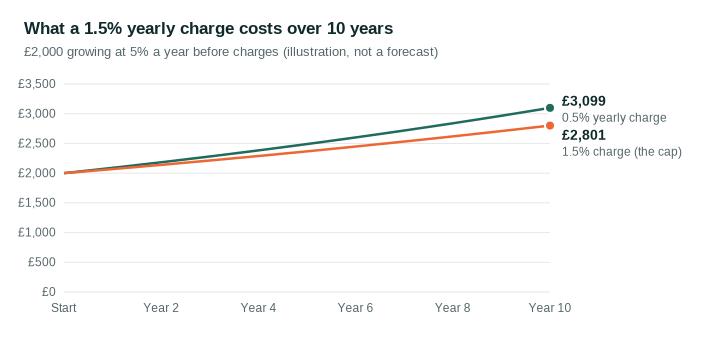
Illustration: £2,000 invested for 10 years, growing at 5% a year before charges, would be worth about £2,801 with a 1.5% yearly charge, and about £3,099 with a 0.5% yearly charge. The £298 gap is the cost of the higher charge. This is an illustration, not a forecast: returns aren’t guaranteed and investments can fall in value. It uses the same growth model as our platform fee calculator.
Our guide to platform fees explains how to compare charges.
Can money be taken out of a Child Trust Fund early?
Only if the child is terminally ill or dies. GOV.UK defines terminally ill as having an illness that is getting worse and not being likely to live more than 6 months. The registered contact applies to HMRC with the terminal illness early access form and evidence. There are time limits from the date of diagnosis: 6 months in England and Wales and 12 months in Northern Ireland, with no limit in Scotland.
If the child dies, the money goes to whoever inherits the child’s estate, often a parent. The family tells the provider, which usually asks for proof such as a death certificate.
In every other case the money stays in the account until 18.
Common questions about Child Trust Funds
How do I know if I have a Child Trust Fund?
If you were born between 1 September 2002 and 2 January 2011 you’re likely to have had one opened for you, either by a parent or by HMRC. Ask a parent or guardian first. If they don’t know the provider, HMRC’s free online tool on GOV.UK will tell you where the account was opened.
Can I find out my Child Trust Fund balance online through HMRC?
No. HMRC’s tool only tells you which provider holds the account. To find out the balance, contact that provider with your details and proof of identity.
Is it worth claiming a small Child Trust Fund?
The money belongs to the young person whatever the amount, and HMRC’s search costs nothing. The average unclaimed matured CTF was worth £2,310 in HMRC’s September 2026 figures. Some accounts hold much less, particularly those opened with a £50 voucher in late 2010, and some much more.
Can a grandparent pay into a Child Trust Fund?
Yes. Anyone can pay into an open CTF, including grandparents and family friends, up to £9,000 in total for each year from the child’s birthday. Once paid in, the money belongs to the child. Payments stop when the account matures at 18.
Does a matured Child Trust Fund lose its tax-free status?
No, not while it’s in the protected account. Since April 2020, providers must hold unclaimed matured funds in a protected account that keeps its tax-free status until the young person withdraws the money or transfers it to an ISA. Transferring to an adult ISA keeps it tax-free without using that year’s ISA allowance.
What if my child has a Child Trust Fund and I want to open a Junior ISA?
A child can’t have both at once. The CTF has to be transferred into the Junior ISA, in full, and the CTF closes. The Junior ISA provider arranges this with the registered contact’s authority. Our Junior ISA guide covers how Junior ISAs work, and the Junior ISA calculator shows what regular payments could grow to.
Sources
- GOV.UK: Child Trust Funds
- GOV.UK: Child Trust Funds, find a Child Trust Fund
- GOV.UK: Child Trust Funds, managing the account
- GOV.UK: Child Trust Funds, adding money to the account
- GOV.UK: Child Trust Funds, what happens when your child is 18
- GOV.UK: Child Trust Funds, if your child is terminally ill or dies
- HMRC: Unclaimed Child Trust Funds press release (September 2026)
- Ministry of Justice and HM Treasury: Child Trust Fund injustice to end under Government plans (3 November 2026)
- HMRC: Maturing Child Trust Funds
- HMRC: Transfer of a Child Trust Fund or Junior ISA (guidance for ISA managers)
- HMRC: Tax-free savings newsletter 19 (November 2025)
- legislation.gov.uk: Child Trust Funds Regulations 2004, Schedule (stakeholder accounts)
- legislation.gov.uk: Child Trust Funds (Amendment) Regulations 2009, explanatory note (age 7 payments)
- legislation.gov.uk: Savings Accounts and Health in Pregnancy Grant Act 2010, explanatory notes
- National Audit Office: Investigation into Child Trust Funds (March 2023)
- GOV.UK: Savings for children
Our guides are general information and education, not personal financial advice. If you are unsure whether an investment is right for you, speak to a regulated financial adviser. Capital at risk. Investments can fall as well as rise, and you may get back less than you put in.