Junior ISA at 18: What Happens Next
TL;DR
- From 16, a child can take over running their Junior ISA without a parent's consent, but can't take money out until 18.
- At 18 it automatically becomes an adult ISA in their name. The money stays where it is and stays tax-free.
- From 18 they control the money and can withdraw some or all of it. Parents can't stop them.
- The balance at 18 doesn't use their £20,000 adult allowance. That allowance is for new money paid in.
- A Lifetime ISA can be opened from 18. HMRC's free online tool finds lost Child Trust Funds.
Quick answers
- NoCan parents stop them withdrawing at 18? No. From 18 the young person controls the money and can withdraw it.
- NoDoes the account close at 18? No. It becomes an adult ISA with the same provider, and stays tax-free.
- NoDoes it use the adult allowance? No. The balance stays in the ISA; the £20,000 allowance is for new money.
- Tax-freeIs there tax when it matures? No tax when it becomes an adult ISA, or when money is taken out.
- NoCan 16-year-olds open an adult cash ISA? Not in 2026/27. The minimum age for every adult ISA has been 18 since April 2024.
- DependsAnything to do on the birthday? Nothing is needed. To pay new money in, the provider needs their National Insurance number and an ISA declaration.
- Age a child can take over running their Junior ISA
- 16
- Adult ISA allowance from age 18, 2026/27
- £20,000
- Yearly Lifetime ISA limit, open from 18
- £4,000
- Unclaimed matured Child Trust Funds (HMRC, 2026)
- 827,000
On this page
- What happens to a Junior ISA when the child turns 16?
- What happens to a Junior ISA at 18?
- Can parents stop an 18-year-old taking the money out?
- Can 16 and 17-year-olds open an adult cash ISA?
- Does a matured Junior ISA use the adult ISA allowance?
- When can someone open a Lifetime ISA?
- What happens to a Child Trust Fund at 18?
- Is there tax to pay when a Junior ISA matures?
- What can a young person do with the money at 18?
- Common questions about Junior ISAs at 18
- What to do next
- Related guides
- Sources
A Junior ISA is built around two birthdays. At 16 the child can take over running the account. At 18 it stops being a Junior ISA, the money becomes theirs to use, and a new set of choices opens up: an adult ISA allowance of £20,000 a year, the Lifetime ISA, and in some cases a forgotten Child Trust Fund. This guide explains what happens at each stage, what providers do automatically and what the young person can then do with the money.
What happens to a Junior ISA when the child turns 16?
At 16 a child can take over the day-to-day running of their Junior ISA, but they still can’t take any money out until 18. They do this by becoming the account’s registered contact: the one person the provider takes instructions from. Until then, that’s a parent or guardian with parental responsibility.
HMRC’s guidance for providers says a child of 16 or over can become the registered contact at any time, and without the consent of the existing registered contact. They apply to the provider in the normal way. Once a child has taken on the role, it can’t be passed back to a parent, unless the child later lacks mental capacity.
As registered contact, a 16 or 17-year-old can give instructions on how the money is invested, switch between cash and investments, and move the account to another provider. They can also open a Junior ISA themselves from 16. What they can’t do is withdraw: under the Junior ISA rules, money stays in the account until their 18th birthday, except in cases of terminal illness or death.
If the child doesn’t apply, nothing changes. The parent simply carries on as registered contact until 18.
What happens to a Junior ISA at 18?
On the child’s 18th birthday, the account stops being a Junior ISA and becomes an adult ISA in their name, with no action needed from anyone. GOV.UK says Junior ISAs “automatically turn into an adult ISA” at 18. HMRC’s guidance for providers adds the detail:
- the investments or cash held on the birthday stay inside the ISA and remain tax-free, until the young person closes the account
- from 18, the account runs under the provider’s adult ISA terms and conditions, which may differ from the Junior ISA terms (for example on charges or interest rates)
- providers may send the new terms before the birthday
- the provider can’t accept new payments into the account until the young person has given their National Insurance number (if they have one) and an ISA declaration, including that they live in the UK
So the money doesn’t move, isn’t sold and isn’t paid out by default. It sits in the same account, now an adult ISA, until the young person decides what to do with it. It’s worth checking the new terms, because a cash rate or a platform charge that suited a Junior ISA won’t necessarily match what’s available on adult accounts.
If the young person lacks the mental capacity to manage the account at 18, a parent, relative or close friend has to apply for a financial deputyship order to manage it for them. In England and Wales that’s through the Court of Protection, in Scotland the Office of the Public Guardian, and in Northern Ireland the Office of Care and Protection.
Can parents stop an 18-year-old taking the money out?
No. From the 18th birthday the young person controls the money, and they can take out some or all of it whenever they like. GOV.UK states that when the child turns 18 “they can take out any money in their Junior ISAs”. Neither the parent who opened the account nor anyone who paid into it has any legal say.
This is the trade-off built into Junior ISAs from the start. Every payment into one is a gift to the child, and it can’t be taken back, so there’s no mechanism to attach conditions such as “only for a house deposit” or “only after university”. The account isn’t a trust, and the former registered contact loses their role on the birthday.
What families do instead is talk about it. Many parents explain what the money is, how much is in it and what it might be useful for well before 18, often around the time the child turns 16 and could take over the account anyway. Families who want legal control over how and when money reaches a young adult sometimes look at a trust instead; our guide to investing for children compares the options.
Can 16 and 17-year-olds open an adult cash ISA?
No, not in 2026/27. Until 5 April 2024, 16 and 17-year-olds could open and pay into an adult cash ISA alongside their Junior ISA, which in effect gave them two allowances. From 6 April 2024 the minimum age for every adult ISA, including cash ISAs, became 18.
HMRC set up transitional arrangements for those already caught in between. Someone aged 16 or 17 on 5 April 2024 could still open a single cash ISA, and those who already had one could keep paying in or transfer it. HMRC’s guidance for providers says those arrangements ended at 11:59pm on 5 April 2026. HMRC’s guidance doesn’t spell out what happens to an existing account after that date, so anyone in that position may want to ask their provider.
So in 2026/27, a Junior ISA is the only ISA open to anyone under 18. A planned £12,000 limit on adult cash ISAs for under-65s from April 2027 was cancelled at the Budget on 28 October 2026, so an 18-year-old can put the full £20,000 into cash ISAs if they choose.
Does a matured Junior ISA use the adult ISA allowance?
No. The money already in the account on the 18th birthday doesn’t count towards the young person’s adult allowance. The allowance limits new money paid in each tax year, and the matured Junior ISA balance isn’t a new payment: HMRC’s guidance says the investments held at 18 simply “remain in the tax-free ISA”.
From the birthday, the young person has the full adult allowance of £20,000 for the rest of the 2026/27 tax year, which runs to 5 April. They can split it across cash, stocks and shares, Innovative Finance and Lifetime ISAs. Our ISA allowance guide explains the rules, and the ISA allowance checker adds up what’s been used.
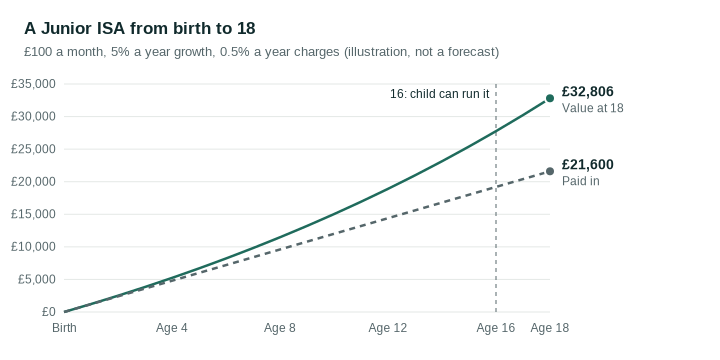
Illustration: £100 a month paid into a Junior ISA from birth, growing at 5% a year with 0.5% a year in charges, would be worth about £32,806 at 18, from £21,600 paid in. That’s about £27,762 by 16, when the child can take over running it. All of that stays in the ISA wrapper, and the young person can still pay in up to £20,000 of new money that year. This is an illustration, not a forecast: returns aren’t guaranteed and investments can fall in value. The Junior ISA calculator uses the same growth model.
There’s one catch. If the young person withdraws the money and later wants it back in an ISA, paying it back in counts as a new payment and uses that year’s allowance, unless the account is a flexible ISA that allows money to be replaced in the same tax year. Moving it to another ISA by transfer avoids this.
When can someone open a Lifetime ISA?
A Lifetime ISA can be opened from 18, so it becomes available on the same birthday a Junior ISA matures. GOV.UK says you must be 18 or over but under 40 to open one, and you can pay in up to £4,000 a year until you’re 50.
The government adds a 25% bonus to what’s paid in, up to £1,000 a year. Payments into a Lifetime ISA count towards the overall £20,000 allowance. The money can be withdrawn without a charge to buy a first home costing £450,000 or less, from age 60, or in case of terminal illness. Any other withdrawal costs 25% of the amount taken, which takes back more than the bonus added.
That makes the Lifetime ISA a narrower tool than an ordinary ISA. It suits money that’s genuinely meant for a first home or for later life, and doesn’t suit money that might be needed for something else. Our Lifetime ISA guide covers the rules in detail, including the government’s plans for a replacement, and the Lifetime ISA calculator shows how the bonus adds up.
What happens to a Child Trust Fund at 18?
A Child Trust Fund (CTF) matures at 18 in the same way, and many have never been claimed. CTFs were set up for children born between 1 September 2002 and 2 January 2011, before Junior ISAs replaced them. Like a Junior ISA, the young person can take control of the account from 16 and take the money out from 18.
Our guide to Child Trust Funds explains how to find a lost account and what the options are.
GOV.UK says that at 18 the young person automatically takes over the account and no more money can be added. They can then withdraw the money or transfer it to an adult ISA, and the CTF closes. Until they do one or the other, the money stays in an account that nobody else can access.
HMRC said in September 2026 that around 827,000 young adults have a matured CTF waiting to be claimed, worth an average of £2,310, and that almost 3 million matured CTFs have been claimed or transferred so far.
Anyone aged 16 or over can find their own CTF through HMRC’s free online tool on GOV.UK, and parents can search for a child under 18. It asks for details such as date of birth and, where known, a National Insurance number, and HMRC usually replies by letter within about three weeks. HMRC doesn’t charge for this, so there’s no need to pay a company to find a CTF.
Is there tax to pay when a Junior ISA matures?
No. There’s no tax on a Junior ISA turning into an adult ISA, and no tax on taking the money out. Interest, dividends and gains inside an ISA are tax-free, and ISA income doesn’t need to be declared on a tax return. The same applies inside a Child Trust Fund.
Tax only becomes relevant once money leaves the ISA wrapper and earns a return somewhere else. Interest in an ordinary savings account counts towards the Personal Savings Allowance: £1,000 of interest a year tax-free for basic-rate taxpayers and £500 for higher-rate taxpayers. Many 18-year-olds with low earnings can also use the starting rate for savings, which allows up to £5,000 of interest tax-free when other income is low enough. Investments held outside an ISA can be liable for dividend tax and Capital Gains Tax. Our guide to tax on investments explains how those work.
Leaving the money in the ISA keeps it outside all of these rules, however large the pot grows.
What can a young person do with the money at 18?
There are four broad options, and many people combine them. Which one fits depends on what the money is for and when it might be needed; none is right for everyone.
- Leave it where it is. The account carries on as an adult ISA with the same provider, under adult terms. It stays tax-free and can be accessed at any time.
- Move it to another ISA. An adult ISA can be transferred to another provider, or between cash and stocks and shares, at any time. Transferring, rather than withdrawing and paying back in, keeps the money tax-free without using the £20,000 allowance. See how ISA transfers work.
- Use some of it towards a Lifetime ISA. Up to £4,000 a year can go into a Lifetime ISA to earn the bonus, with the withdrawal restrictions described above.
- Take some or all of it out. The money can go on anything, from university living costs to driving lessons. Money taken out loses its ISA tax protection.
For money that might be needed within a few years, people often weigh the steadiness of cash against the ups and downs of investing. Our guide to stocks and shares ISAs versus cash ISAs sets out the trade-offs, and the cash vs investing calculator compares the two over different time spans.
Common questions about Junior ISAs at 18
Does a Junior ISA close at 18?
No. It stops being a Junior ISA, but the account stays open as an adult ISA with the same provider. The cash or investments stay put and remain tax-free. Nothing is paid out unless the young person asks for it. New payments can only go in once they’ve given the provider their National Insurance number and an ISA declaration.
Can a parent take money out of a Junior ISA after the child turns 18?
No. From 18 the account belongs to the young person and only they can give instructions or withdraw. The parent’s role as registered contact ends on the birthday. The exception is where the young person lacks mental capacity, when someone needs a financial deputyship order to manage the account for them.
Can you pay into a Junior ISA in the year the child turns 18?
Yes, up to the 18th birthday. Payments before the birthday count towards that tax year’s £9,000 Junior ISA limit. From the birthday, the account is an adult ISA, and any new payments count towards the young person’s own £20,000 adult allowance instead.
Can a Junior ISA be transferred straight into a Lifetime ISA?
The adult ISA that a Junior ISA becomes can be moved to another ISA by transfer, and HMRC’s rules allow transfers between ISA types. Payments into a Lifetime ISA are limited to £4,000 a year, so only part of a larger pot could go in each year. It’s worth checking with the receiving provider how it handles transfers in.
How do I find a Child Trust Fund I didn’t know I had?
Contact the provider if you know who it is. If not, HMRC’s free online tool on GOV.UK tells you where the account was opened. It asks for details such as your date of birth and National Insurance number, and HMRC usually replies within about three weeks. It can’t find Junior ISAs and won’t tell you the balance.
Does the young person need to do anything on their 18th birthday?
No. The switch to an adult ISA happens automatically and the money stays invested or in cash as before. To pay new money in, they’ll need to give the provider their National Insurance number and an ISA declaration. It’s also worth reading the adult terms, as charges or interest rates may change.
Sources
- HM Treasury: Budget 2026 press release (28 October 2026)
- GOV.UK: Junior ISAs, manage an account
- HMRC: Manage the registered contact for a Junior ISA (guidance for ISA managers)
- HMRC: Junior ISAs for ISA managers
- HMRC: Close, void or withdraw investments from a Junior ISA as an ISA manager
- HMRC: Who can invest in an ISA if you're an ISA manager
- GOV.UK: Individual Savings Accounts, who can open an ISA
- GOV.UK: Individual Savings Accounts, how ISAs work
- GOV.UK: Individual Savings Accounts, withdrawing your money
- GOV.UK: Individual Savings Accounts, transferring your ISA
- GOV.UK: Lifetime ISA
- GOV.UK: Who can open a Lifetime ISA
- GOV.UK: Withdrawing money from your Lifetime ISA
- GOV.UK: Child Trust Funds
- GOV.UK: Child Trust Funds, what happens when your child is 18
- GOV.UK: Find a Child Trust Fund
- HMRC: Unclaimed Child Trust Funds press release (September 2026)
- GOV.UK: Tax on savings interest, how much is tax-free
- HMRC: Tax-free savings newsletter 19 (November 2025)
- HMRC: Tax-free savings newsletter 23 (September 2026)
Our guides are general information and education, not personal financial advice. If you are unsure whether an investment is right for you, speak to a regulated financial adviser. Capital at risk. Investments can fall as well as rise, and you may get back less than you put in.