Investing for Children: Your Options
TL;DR
- A Junior ISA takes up to £9,000 a year, tax-free. The money becomes the child's to use at 18.
- A junior pension adds 20% tax relief, so £2,880 paid in becomes £3,600, but it's locked until pension age.
- A bare trust has no yearly limit. If a parent's gift earns over £100 a year, all that income is taxed as the parent's.
- Children born 1 September 2002 to 2 January 2011 had a Child Trust Fund opened for them. HMRC's free tool finds lost ones.
- Gifts to children can be free of inheritance tax, using exemptions such as £3,000 a year or regular gifts from income.
Quick answers
- YesWho can pay into a Junior ISA? Anyone, up to £9,000 a year in total. A parent or guardian opens it.
- DateWhen can the child use the money? Junior ISA at 18. A junior pension at minimum pension age: 55 now, 57 from 6 April 2028.
- YesDoes a junior pension get tax relief? Yes. £2,880 a year paid in gets 20% relief, making £3,600, even with no earnings.
- NoDoes the £100 rule cover grandparents' gifts? No. It only covers a parent's gifts, and doesn't apply to Junior ISAs or Child Trust Funds.
- NoCan money given be taken back? Not from a Junior ISA, Child Trust Fund, junior pension or bare trust. It belongs to the child.
- Junior ISA limit, 2026/27
- £9,000
- Most a child's pension can receive with tax relief (£2,880 paid in)
- £3,600
- Yearly income limit on a parent's gift before the parent is taxed
- £100
- Age a child takes control of a Junior ISA
- 18
On this page
- How do the options for a child compare?
- How does a Junior ISA work for a child?
- How does a junior pension work?
- Junior ISA or junior pension: a worked comparison
- How does a bare trust work?
- What is the £100 parental gift rule?
- What about children’s savings accounts?
- Can you buy Premium Bonds for a child?
- What if a child already has a Child Trust Fund?
- Are gifts to children caught by inheritance tax?
- How does saving in your own name compare?
- What do the options suit?
- Common questions about investing for children
- What to do next
- Related guides
- Sources
Investing for a child gives money a long time to grow: 18 years before they can use it in a Junior ISA, or decades longer in a pension. The main choices are a Junior ISA, a junior pension, a bare trust, a children’s savings account, Premium Bonds, or saving in your own name. Older children may also already have a Child Trust Fund. The options differ on tax, limits and, above all, on who controls the money and when. This guide compares them, with a worked example and the tax rules that apply to gifts.
How do the options for a child compare?
The main difference between the options is not the tax but who owns the money and when the child can use it. A Junior ISA, junior pension and bare trust all belong to the child from the moment money goes in, and can’t be taken back. Saving in your own name keeps the money yours.
| Junior ISA | Junior pension | Bare trust | Children’s savings account | Your own ISA | |
|---|---|---|---|---|---|
| Yearly limit | £9,000 | £2,880 with tax relief, topped up to £3,600 | None | Set by the provider | £20,000 (your allowance) |
| Tax on growth | None | None | Child’s allowances, with the £100 rule for parents’ gifts | Child’s allowances, with the £100 rule for parents’ gifts | None |
| Tax relief on payments | No | Yes, 20% | No | No | No |
| Who owns it | The child | The child | The child | The child | You |
| Child can access it | At 18 | At minimum pension age, 57 from 2028 | At 18 (16 in Scotland) | Depends on the account | Whenever you give it to them |
Many families use more than one: for example a Junior ISA for money aimed at 18, and Premium Bonds or a savings account for money that might be needed sooner.
How does a Junior ISA work for a child?
A Junior ISA is a tax-free savings or investment account for a child under 18 living in the UK. A parent or guardian opens it, anyone can pay in, and the total from everyone is capped at £9,000 in 2026/27. HMRC has confirmed the limit stays at that level until April 2031. A child can have one cash and one stocks and shares Junior ISA, sharing the limit.
There’s no tax on interest, dividends or gains. The £100 parental rule doesn’t apply, so parents can pay in large amounts without the interest being taxed as theirs.
The child can take over running the account at 16, but can’t withdraw until 18. On the 18th birthday it becomes an adult ISA and the money is theirs to spend. That’s the trade-off many parents weigh: nobody can stop an 18-year-old using it however they choose. Our Junior ISA guide covers the details, Junior ISAs at 18 explains what happens next, and the Junior ISA calculator shows what regular payments could grow to.
How does a junior pension work?
A parent or guardian can open a personal pension for a child, often called a junior pension or junior SIPP. Up to £2,880 a year paid in gets tax relief: the provider claims 20% basic-rate tax relief on top, making £3,600. That relief is available even though the child has no earnings, because GOV.UK allows relief on up to £2,880 of payments a year for someone with no earnings.
The catch is access. The money is locked until the child reaches the minimum pension age. That is 55 now, rises to 57 from 6 April 2028, and could be higher again by the time today’s children reach it. So a junior pension doesn’t help with university costs, a first car or a house deposit. What it offers is time: money paid in at birth could be invested for more than 50 years before it can be used.
Our junior pension calculator projects what payments could grow to, and the SIPPs guide explains how self-invested pensions work.
Junior ISA or junior pension: a worked comparison
The same payments grow to different amounts in a Junior ISA and a junior pension, because the pension adds tax relief and is invested for longer. This example uses the same code as our calculators.
Illustration: £100 a month paid in from birth to 18, growing at 5% a year with 0.5% a year in charges. In total £21,600 is paid in either way.
- Junior ISA: about £32,806 at 18, available to the young person to use as they choose.
- Junior pension: tax relief adds £5,400, so £125 a month goes in. That’s worth about £41,007 at 18. If nothing more is added, it could grow to about £226,123 by age 57, or about £73,137 in today’s money if prices rise by 2% a year.
This is an illustration, not a forecast. Returns aren’t guaranteed, investments can fall in value, and the pension age and tax rules could change before the child can use the money.
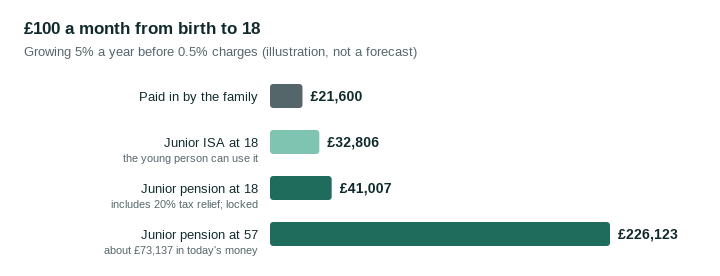
The comparison isn’t only about the bigger number. The Junior ISA money is usable at 18; the pension money can’t be touched for decades. Families often decide based on what the money is meant for, and some split payments between the two.
How does a bare trust work?
A bare trust holds money or investments in the name of an adult trustee for a child who is absolutely entitled to them. GOV.UK says the beneficiary has the right to all of the capital and income at 18 in England and Wales, or 16 in Scotland. There’s no limit on how much can be put in, and once given, the money can’t be taken back.
For tax, a bare trust’s income and gains are normally treated as the child’s. HMRC’s Capital Gains Manual confirms that gains are taxed as if the assets belonged to the child, even when the child is a minor, so the child’s own £3,000 Capital Gains Tax allowance is available. The child can also use their own Personal Allowance against income.
The big exception is money from a parent. Under the £100 rule, explained below, income above £100 a year from a parent’s gift is taxed as the parent’s. That’s why bare trusts are often used for gifts from grandparents and other relatives, or for investments aimed at growth rather than income. A “designated account” opened in an adult’s name with a child’s initials may or may not be a bare trust, depending on what was intended. Larger trusts can raise inheritance tax and reporting questions, and many families take professional advice before setting one up.
What is the £100 parental gift rule?
If money given by a parent earns a child more than £100 of income in a tax year, all of that income is taxed as the parent’s, not just the part over £100. The rule is in section 629 of the Income Tax (Trading and Other Income) Act 2005, and stops parents moving savings into a child’s name to use the child’s allowances.
HMRC’s guidance shows how it works:
- the £100 limit applies separately to each parent and each child, so two parents could each give a child money earning up to £100
- once a parent’s gift produces more than £100 in a year, the whole amount is treated as that parent’s income
- GOV.UK says the parent then pays tax on it if it takes them over their own Personal Savings Allowance
The rule doesn’t apply to money from grandparents, other relatives or friends, or to money in a Junior ISA or Child Trust Fund. It covers income such as interest and dividends; under HMRC’s capital gains rules, gains in a bare trust are taxed as the child’s.
What about children’s savings accounts?
Banks and building societies offer savings accounts for children under 18. MoneyHelper notes that some can be opened with as little as £1, and that children can often start managing their own account from about age seven. GOV.UK says there’s usually no tax to pay on children’s accounts, because most children’s income is well within their own allowances. A child must tell HMRC if their income goes above their Personal Allowance, for example from a trust.
The £100 rule applies here too. Interest on money a parent has given counts towards the parent’s £100 limit, which matters most for larger balances. Money from grandparents and others doesn’t count.
The appeal of a savings account is flexibility. The money doesn’t fall with markets, and unlike a Junior ISA, many accounts can be accessed before 18. The trade-off is that cash has tended to grow more slowly than investments over long periods, though investments can fall in value. Our cash vs investing calculator compares the two over different time spans.
Can you buy Premium Bonds for a child?
Yes. NS&I sells Premium Bonds for children under 16, from £25. A parent or guardian can buy them for their own child. A grandparent, other relative or family friend can buy them too, as long as the child’s parent or guardian agrees to look after the bonds. The parent or guardian is responsible for the bonds until the child’s 16th birthday.
Premium Bonds don’t pay interest. Each £1 bond goes into a monthly prize draw, and prizes from £25 to £1 million are tax-free. NS&I is backed by HM Treasury, so the money is secure, but the return is down to luck and the prize fund rate changes. Many holdings win little or nothing in a given year. Because prizes aren’t interest, the £100 rule doesn’t come into play.
Our guide to Premium Bonds, savings or investing explains the current prize fund rate and odds, and how they compare with interest.
What if a child already has a Child Trust Fund?
Children born between 1 September 2002 and 2 January 2011 had a Child Trust Fund (CTF) opened for them, with a starting payment from the government. A child with a CTF can’t also have a Junior ISA, but the whole CTF can be transferred into one. Up to £9,000 a year can still be paid into an open CTF, measured from the child’s birthday.
CTFs follow the same pattern as Junior ISAs: the child can run the account from 16 and use the money from 18. They’re tax-free and outside the £100 rule.
Many CTFs have been forgotten. HMRC said in September 2026 that around 827,000 matured CTFs were unclaimed, worth £2,310 on average. HMRC’s online tool finds where a CTF is held, free of charge, for anyone aged 16 or over or for a parent searching for a child under 18. Our guide to Child Trust Funds explains how to find one, what happens at 18 and how to transfer to a Junior ISA.
Are gifts to children caught by inheritance tax?
Usually not, if they fall within the inheritance tax exemptions or the giver lives for seven years afterwards. Money paid into a child’s Junior ISA, pension, bare trust or savings account is a gift from whoever paid it. GOV.UK sets out several exemptions that take gifts outside the giver’s estate straight away:
- the annual exemption: £3,000 of gifts a tax year in total, with any unused amount carried forward one year only
- small gifts of up to £250 per person a year, as long as no other exemption is used for that person
- regular gifts from income, with no set limit, if they come out of regular income left after normal living costs. GOV.UK gives saving for a child under 18 as an example
- wedding gifts: up to £5,000 to a child, or £2,500 to a grandchild
Larger gifts outside these exemptions, other than gifts into most trusts, are usually free of inheritance tax if the giver survives seven years. If they die sooner, the gift counts towards their estate, and taper relief can reduce the tax on gifts made three to seven years before death, where total gifts exceed the £325,000 threshold. Records of what was given, when and from what money help executors later. Our guide to inheritance tax on pensions covers how pensions fit in.
How does saving in your own name compare?
Some parents invest in their own ISA and hand the money over later. This keeps control, which appeals to people who are unsure how an 18-year-old would use a large sum, or who might need the money themselves. But there are trade-offs:
- it uses your own £20,000 ISA allowance
- the money is legally yours, so it’s part of your estate and exposed to your creditors
- when you do give it away, it’s a gift like any other for inheritance tax, as described above
Our ISA allowance guide explains how the adult allowance works.
What do the options suit?
Each option fits a different job. In broad terms:
- Money for a child’s future at 18: a Junior ISA keeps it tax-free with simple rules, at the cost of the child getting control at 18.
- Very long-term money: a junior pension adds tax relief but can’t be touched for decades.
- Larger gifts, especially from grandparents: a bare trust has no limit, with income and gains taxed as the child’s.
- Money that might be needed sooner: a children’s savings account or Premium Bonds keep it accessible and steady.
- If control after 18 matters most: saving in your own name keeps it, at the cost of using your own allowances.
Investments can fall as well as rise. Many families keep money a child will need in the next few years in cash.
Common questions about investing for children
What’s the most tax-efficient way to save for a child?
Junior ISAs and junior pensions are both free of tax on growth, and the junior pension adds 20% tax relief on payments. Which suits depends on when the money is needed: from 18 for a Junior ISA, or from pension age for a pension. A bare trust can also be tax-efficient for gifts from grandparents.
Can grandparents open a Junior ISA?
Not unless they have parental responsibility. A parent or guardian opens the Junior ISA, but grandparents can pay into it once it’s open, within the child’s £9,000 yearly limit. Grandparents can also buy Premium Bonds for a child with the parent’s agreement, or set up a bare trust, where the £100 rule doesn’t apply to their gifts.
Do I have to tell HMRC about my child’s savings?
GOV.UK says HMRC should be told if a child gets more than £100 of interest in a tax year from money a parent gave them. A child also has to tell HMRC if their income goes above their Personal Allowance, for example from a trust. Money in a Junior ISA or Child Trust Fund is exempt.
Can a child have a Junior ISA and a pension at the same time?
Yes. They’re separate accounts with separate limits: up to £9,000 a year into Junior ISAs, and up to £2,880 a year into a pension with tax relief, topped up to £3,600 with tax relief. Some families use both, for money aimed at 18 and money for retirement.
Can I take back money I’ve given to my child?
Not from a Junior ISA, Child Trust Fund, junior pension or bare trust. Once paid in, the money belongs to the child. Junior ISA and CTF money stays locked until 18, except in cases of terminal illness or death. Only money kept in your own name stays yours.
Sources
- GOV.UK: Junior Individual Savings Accounts
- GOV.UK: Savings for children
- GOV.UK: Child Trust Funds
- GOV.UK: Child Trust Funds, find a Child Trust Fund
- HMRC: Unclaimed Child Trust Funds press release (September 2026)
- HMRC: Tax-free savings newsletter 19 (November 2025)
- GOV.UK: Tax on your private pension contributions, tax relief
- GOV.UK: Increasing Normal Minimum Pension Age
- GOV.UK: Trusts and taxes, types of trust
- GOV.UK: Trusts and Income Tax
- HMRC Trusts, Settlements and Estates Manual TSEM4300: settlement for unmarried minor child
- HMRC Trusts, Settlements and Estates Manual TSEM4310: income less than £100
- legislation.gov.uk: Income Tax (Trading and Other Income) Act 2005, section 629
- HMRC Capital Gains Manual CG34320: bare trusts, main principles
- GOV.UK: Inheritance Tax, gifts
- NS&I: Giving the gift of Premium Bonds
- NS&I: For young savers
- MoneyHelper: Saving for your children
Our guides are general information and education, not personal financial advice. If you are unsure whether an investment is right for you, speak to a regulated financial adviser. Capital at risk. Investments can fall as well as rise, and you may get back less than you put in.