The State Pension: Age, Amount and Gaps
TL;DR
- The full new State Pension is £241.30 a week in 2026/27, about £12,548 a year. It rises each April under the triple lock.
- You need 35 qualifying years of National Insurance for the full amount and at least 10 to get anything.
- State Pension age started rising from 66 to 67 on 6 April 2026. The rise finishes on 5 March 2028.
- You can usually fill gaps from the last 6 tax years at £18.40 a week. Your forecast shows whether paying would help.
- Taxable, but paid without tax taken off. For 2027/28 to 2029/30, pensioners whose total income is at most the full rate pay no income tax.
Quick answers
- LimitHow much is the full State Pension? £241.30 a week in 2026/27, about £12,548 a year. What you get depends on your record.
- LimitHow many years do I need? 35 qualifying years for the full amount, at least 10 for anything. Contracting out can mean more.
- DateWhen can I get it? At State Pension age. The rise from 66 to 67 began 6 April 2026 and finishes 5 March 2028.
- NoIs it paid automatically? No. You need to claim it; GOV.UK sends an invitation code by letter.
- YesDo I get more if I defer? Yes, 1% extra for every 9 weeks deferred, if you reach State Pension age from 6 April 2016.
- CostCan I fill gaps in my record? Usually, for the last 6 tax years, at £18.40 a week in 2026/27. It doesn't always increase your pension.
- Full new State Pension a week, 2026/27
- £241.30
- Qualifying years for the full new State Pension
- 35 years
- State Pension age for people born 6 March 1961 to 5 April 1977
- 67
- Voluntary Class 3 contributions a week, 2026/27
- £18.40
On this page
- How much is the State Pension in 2026/27?
- How does the triple lock work?
- What’s the difference between the old and new State Pension?
- How does contracting out affect your State Pension?
- When can you get it? State Pension age
- What happens if you defer your State Pension?
- How to check your State Pension forecast
- How do National Insurance credits help?
- Can you fill gaps with voluntary National Insurance?
- What is Pension Credit?
- Is the State Pension taxed?
- How the State Pension fits your retirement plans
- Common questions about the State Pension
- What to do next
- Related guides
- Sources
The State Pension is a regular payment from the government once you reach State Pension age. It’s based on your National Insurance record, not on your earnings or savings, and for many people it’s the foundation that workplace and private pensions build on. This guide covers how much it is and how it rises, when you can get it, the difference between the old and new systems, how to check and fill gaps in your record, deferring, Pension Credit and tax.
How much is the State Pension in 2026/27?
The full new State Pension is £241.30 a week in 2026/27, about £12,547.60 a year. The full basic State Pension, for people who reached State Pension age before 6 April 2016, is £184.90 a week.
| Weekly | Yearly (52 weeks) | |
|---|---|---|
| Full new State Pension | £241.30 | £12,547.60 |
| Full basic State Pension | £184.90 | £9,614.80 |
These are full rates. What you actually get depends on your National Insurance record, so it can be lower, and some people get more through older additional pension rights.
Under the new State Pension, each qualifying year is usually worth 1/35th of the full rate, about £6.89 a week. Someone with the minimum 10 qualifying years and no older rights would get about £68.94 a week. Someone with fewer than 10 gets no new State Pension at all.
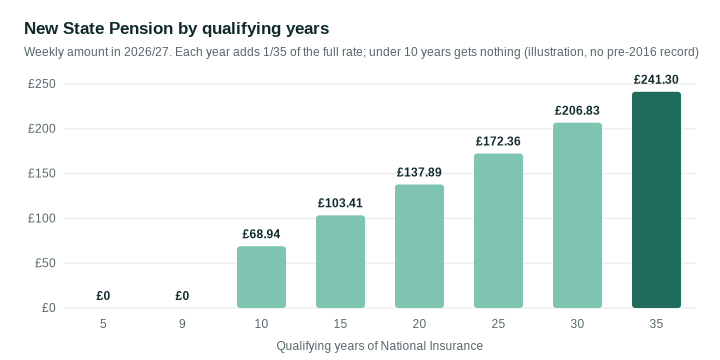
Example (illustration): with no National Insurance record before April 2016, 10 qualifying years give about £68.94 a week, 20 years about £137.89, 30 years about £206.83, and 35 years the full £241.30.
Our tax rates and allowances page always shows the current figures.
How does the triple lock work?
The triple lock means the basic and new State Pension rise each April by the highest of three measures. GOV.UK lists them as average wage growth in Great Britain, UK Consumer Prices Index (CPI) inflation, and 2.5%. The term “triple lock” is the common name for this policy rather than an official one.
For 2026/27, earnings growth was the highest. The government’s written statement of 26 November 2025 said the basic and new State Pensions would rise by 4.8%, in line with average weekly earnings growth in the year to May to July 2025. CPI in the year to September 2025 was 3.8%, which was used for most other benefits. So the full new State Pension went from £230.25 to £241.30 a week, a rise of 4.8%.
Not every part of a State Pension gets the triple lock. GOV.UK says protected payments (see below) rise only in line with CPI. Extra State Pension earned by deferring rises with CPI too, which is why the 2026/27 rates paper shows a 3.8% increase for State Pension increments.
What’s the difference between the old and new State Pension?
Which system you’re on depends on your date of birth. The new State Pension is for men born on or after 6 April 1951 and women born on or after 6 April 1953, so it covers everyone reaching State Pension age from 6 April 2016. People born earlier get the basic State Pension under the old rules.
Under the old system, the basic State Pension had a separate qualifying-year rule. GOV.UK says men born between 1945 and 1951 and women born between 1950 and 1953 usually needed 30 qualifying years for the full £184.90. On top of that, many people built up an Additional State Pension, known earlier as SERPS and later as the State Second Pension, which depended on earnings.
The new system replaced both with a single flat-rate pension. To move people across fairly, DWP worked out a starting amount for everyone with a National Insurance record before April 2016. It calculated their pension under both the old and the new rules and used whichever was higher. If the starting amount was above the full new rate, the extra is paid as a protected payment on top.
How does contracting out affect your State Pension?
If you were contracted out before April 2016, your starting amount was reduced, so you’ll usually need more than 35 qualifying years to reach the full new rate. GOV.UK explains that contracting out meant you or your employer paid lower National Insurance, or paid some of it into a workplace or private pension instead of the Additional State Pension. All contracting out stopped on 5 April 2016.
Many people in defined benefit (final salary) workplace schemes, and some in personal pensions, were contracted out. DWP’s fact sheet says both starting-amount calculations take it into account. Under the old rules, a contracted-out deduction reflects the guaranteed minimum pension your scheme is meant to provide. Under the new rules, a deduction called the rebate derived amount covers all contracted-out periods.
This isn’t money lost: the workplace or personal pension was meant to provide it instead. GOV.UK says you might need more qualifying years to increase your State Pension, and years from April 2016 onwards can raise a reduced starting amount towards the full rate. Your forecast shows how many more years would help.
When can you get it? State Pension age
State Pension age is the same for men and women. It was 66 and began rising to 67 on 6 April 2026; the rise finishes on 5 March 2028, under the Pensions Act 2014.
| Date of birth | State Pension age |
|---|---|
| 6 October 1954 to 5 April 1960 | 66 |
| 6 April 1960 to 5 March 1961 | Between 66 years 1 month and 66 years 11 months |
| 6 March 1961 to 5 April 1977 | 67 |
According to the Pensions Act 2014 explanatory notes, people born between 6 April 1960 and 5 March 1961 have a transitional age that rises by month of birth. Those born from 6 March 1961 reach State Pension age on their 67th birthday.
Under current law, State Pension age is due to rise to 68 between 2044 and 2046. The government launched a third review of State Pension age in July 2025, drawing on an independent report and one from the Government Actuary, so the timetable could change. Use GOV.UK’s State Pension age checker for your exact date.
You don’t get the State Pension automatically: you need to claim it. GOV.UK’s online claim uses an invitation code sent by letter, and anyone within 3 months of State Pension age who hasn’t had one can request a code. You can also claim by phone within 4 months of State Pension age, or by post. If you retire before State Pension age, your own savings have to cover the gap.
What happens if you defer your State Pension?
If you don’t claim at State Pension age, your State Pension is deferred automatically, and you get more when you do claim. For people reaching State Pension age on or after 6 April 2016, GOV.UK says you get 1% extra for every 9 weeks you defer. That’s just under 5.8% for each full year.
On the full new State Pension, a year’s deferral adds about £14 a week for life. You have to defer for at least 9 weeks to get the increase. GOV.UK also lets you take up to 52 weeks of deferred pension as a one-off arrears payment instead, with no interest added. Any deferral beyond 52 weeks is paid as extra weekly pension.
The rules are more generous for people who reached State Pension age before 6 April 2016. They get 1% for every 5 weeks deferred, just under 10.4% a year. If they defer for at least 12 months, they can choose a one-off lump sum instead, with interest at 2% above the Bank of England base rate.
GOV.UK warns that the extra payments could be taxed, and that you can’t build up deferred pension while you or your partner get certain benefits. Whether deferring pays off depends on how long you then draw the pension.
How to check your State Pension forecast
GOV.UK’s Check your State Pension forecast service shows how much you could get, when you can get it, and whether you can increase it. It includes your National Insurance record year by year, so you can see any gaps and what filling them would add.
You’ll need to sign in to use it. You can also see your National Insurance record in your HMRC personal tax account or the HMRC app.
Many people check every few years, especially after time out of work, living abroad, self-employment or part-time work on low earnings. The forecast is the only reliable way to see the effect of contracting out, because that depends on your own history.
It’s worth checking your other pensions at the same time. Our pension check-up checklist goes through finding old pots, what to look for on each statement and how the State Pension fits alongside them.
How do National Insurance credits help?
Credits fill your National Insurance record when you’re not working or not earning enough, so those years can still count. GOV.UK lists many situations. Some credits are added automatically, others you have to apply for. Common ones include:
- claiming Child Benefit for a child under 12 (automatic for the person registered for it)
- getting Carer’s Allowance, or caring for someone at least 20 hours a week without it (you apply for carer’s credits)
- getting Universal Credit, Jobseeker’s Allowance or Employment and Support Allowance
- getting Maternity Allowance, or statutory sick or parental pay with earnings too low for a qualifying year
- a grandparent or other family member caring for a child under 12, who can apply for Specified Adult Childcare credits if the parent agrees to transfer them
One trap is Child Benefit itself. Credits go to the person registered for it. Some families opt out of the payments because of the High Income Child Benefit Charge. GOV.UK says you can still make a claim and tick the box to decline the money, which keeps the National Insurance credits that protect your State Pension.
Can you fill gaps with voluntary National Insurance?
Usually, yes, for the last 6 tax years. Voluntary Class 3 contributions cost £18.40 a week in 2026/27, which is £956.80 for a full year. GOV.UK says the deadline for each year is 5 April, six years after it ends: gaps in 2025/26, for example, can be filled until 5 April 2032. Contributions for the previous two tax years are charged at their original rate; earlier years use the 2026/27 rate.
Paying doesn’t always increase your State Pension, for example if you’ll reach 35 qualifying years anyway, or if a contracted-out deduction means a particular year won’t help. That’s why it’s worth checking your forecast first: it shows whether paying would help and how much it would add.
Example: a full year of Class 3 contributions costs £956.80 and, if it increases your new State Pension, could add about £6.89 a week, roughly £359 a year. At 2026/27 rates that’s about 2.7 years of receiving it to get the cost back, before tax. It’s an illustration, not a forecast.
From 6 April 2026, the rules tightened for periods spent abroad. Most people can no longer pay the cheaper Class 2 contributions for time overseas. New applications to pay Class 3 for time abroad need 10 continuous years of UK residence or 10 qualifying years on your UK National Insurance record, and voluntary contributions paid while abroad don’t count towards the 10.
What is Pension Credit?
Pension Credit is a separate, means-tested benefit that tops up low incomes for people over State Pension age. GOV.UK says the Guarantee Credit part tops up weekly income to £238.00 for a single person or £363.25 for a couple. A smaller Savings Credit of up to £17.96 a week (£20.10 for a couple) is only for people who reached State Pension age before 6 April 2016.
You can still qualify with other income, savings or your own home, so it’s worth checking rather than assuming you won’t. It also unlocks other help. GOV.UK lists Housing Benefit for renters, Council Tax Reduction, a free TV licence for those 75 or over, Cold Weather Payments, the Warm Home Discount, and help with NHS dental, glasses and transport costs for those on Guarantee Credit.
GOV.UK’s Pension Credit guidance covers England, Scotland and Wales. Northern Ireland has separate information.
Is the State Pension taxed?
Yes. The State Pension counts as taxable income, but it’s paid without tax taken off. GOV.UK says that if you also work or have a private pension, your tax code is usually changed so the tax is collected there. If the State Pension is your only income and it takes you over your Personal Allowance, HMRC sends a Simple Assessment bill instead.
The Personal Allowance is £12,570 and frozen until 5 April 2031, while the State Pension rises each year. The full new State Pension of £12,547.60 a year is now just £22.40 below the allowance. Anyone getting the full rate plus other income such as earnings or a private pension, even a small one, will usually pay tax on that other income at 20% or more.
That changes from 6 April 2027. The full new State Pension is due to be £13,036.40 a year in 2027/28, about £250.70 a week, according to the Treasury’s Pension Tax Allowance explainer, which would take it above the Personal Allowance. A Pension Tax Allowance, first announced at Budget 2025 and detailed at the Budget on 28 October 2026, means people above State Pension age whose total income is no more than the full new State Pension won’t pay income tax. It’s withdrawn by £1 for every £3 of income above that, so it’s gone at £13,319. HMRC applies it automatically, and it’s available for 2027/28 to 2029/30.
When a new private pension starts alongside the State Pension, the first payment can be taxed on an emergency code. Our guide to emergency tax on pension withdrawals explains why and how to reclaim it.
How the State Pension fits your retirement plans
For many people the State Pension alone won’t cover the retirement they want. Pensions UK’s Retirement Living Standards estimate that a minimum lifestyle for one person costs about £13,900 a year, and a moderate one about £32,700, both assuming no rent or mortgage. That gap is why workplace pensions, SIPPs and ISAs matter. Our guide to how much pension people need at each age shows the pot sizes each lifestyle implies, and what they mean at 25, 40 or 55.
Our retirement calculator works out how big a pension pot you’d need on top of the State Pension, and the pension calculator shows what your current saving could give you. If you plan to retire before State Pension age, your own savings have to cover the years until it starts. Our pension drawdown guide explains how many people bridge that gap.
Common questions about the State Pension
Can you get the State Pension while still working?
Yes. You can claim at State Pension age whether or not you’ve stopped work. You stop paying employee National Insurance once you reach State Pension age, but income tax still applies to your earnings and State Pension together. Deferring is an option if you don’t need the income yet.
Do you get the State Pension if you live abroad?
Yes, if you’ve paid enough UK National Insurance to qualify. GOV.UK says you can claim from abroad within 4 months of State Pension age, through the International Pension Centre or its international claim form. GOV.UK’s guidance on State Pension abroad also explains how living overseas affects your payments. Time abroad can leave gaps in your record, and the rules on paying voluntary contributions from abroad tightened from April 2026.
How often is the State Pension paid?
GOV.UK says the new State Pension is usually paid into your account every 4 weeks. The day depends on the last two digits of your National Insurance number, from Monday for 00 to 19 through to Friday for 80 to 99. Your first payment comes no later than 5 weeks after the start date you choose.
Does a workplace pension reduce your State Pension?
Not directly. Your State Pension depends on your National Insurance record, not on other pensions. The exception is contracting out before April 2016, which reduced the starting amount for many people in workplace schemes. Your forecast already reflects this.
Can you inherit a spouse’s State Pension?
Only in limited cases under the new State Pension, and not if you remarry or form a new civil partnership before State Pension age. GOV.UK says a widowed spouse or civil partner may inherit half of a protected payment, some Additional State Pension, or extra pension from deferral, depending on when the marriage began and when the partner reached State Pension age.
Sources
- GOV.UK: The new State Pension
- GOV.UK: The new State Pension, what you'll get
- GOV.UK: The basic State Pension, how much you get
- GOV.UK: Benefit and pension rates 2026 to 2027
- Hansard: written statement on State Pension and benefit rates, 26 November 2025
- DWP: The new State Pension transition and contracting-out fact sheet
- GOV.UK: Contracted out of the Additional State Pension
- GOV.UK: Check your State Pension age
- Pensions Act 2014 explanatory notes: increase in pensionable age to 67
- GOV.UK: GAD and the State Pension age review
- GOV.UK: Deferring your State Pension (State Pension age on or after 6 April 2016)
- GOV.UK: Deferring your State Pension (State Pension age before 6 April 2016)
- GOV.UK: Check your State Pension forecast
- GOV.UK: National Insurance credits, eligibility
- GOV.UK: Voluntary National Insurance, rates
- GOV.UK: Voluntary National Insurance, deadlines
- GOV.UK: Voluntary National Insurance contributions abroad from 6 April 2026
- GOV.UK: High Income Child Benefit Charge, if your circumstances change
- GOV.UK: The new State Pension, how to claim
- GOV.UK: The new State Pension, when you're paid
- GOV.UK: State Pension if you retire abroad
- GOV.UK: Inheriting or increasing State Pension from a spouse or civil partner
- GOV.UK: Pension Credit
- GOV.UK: Pension Credit, what you'll get
- GOV.UK: Tax when you get a pension, how your tax is paid
- HM Treasury: Budget 2026 press release (28 October 2026)
- HM Treasury: Pension Tax Allowance explainer
- GOV.UK: Income Tax rates and Personal Allowances
- HM Treasury: Maintaining Income Tax thresholds until 5 April 2031
- Pensions UK: Retirement Living Standards
Our guides are general information and education, not personal financial advice. If you are unsure whether an investment is right for you, speak to a regulated financial adviser. Capital at risk. Investments can fall as well as rise, and you may get back less than you put in.