Tax-Free Lump Sum: Taking 25% of a Pension
TL;DR
- You can usually take 25% of a defined contribution pension tax-free, up to £268,275 in total across all your pensions.
- You can take it up front, moving the rest into drawdown or an annuity, or as a quarter of each withdrawal.
- Taking only tax-free cash keeps your pay-in limit. Taking any taxable money usually cuts it to £10,000 a year for defined contribution pensions.
- The rest is taxed as income. The first taxable payment is often over-taxed on an emergency code, but you can get it back.
- The minimum age is 55, rising to 57 on 6 April 2028. Pension Wise offers free guidance from 50.
Quick answers
- Tax-freeHow much can I take tax-free? Usually 25% of each pension, up to £268,275 in total unless you have a protected allowance.
- DateWhen can I take it? From 55 now, rising to 57 on 6 April 2028, unless you have a protected pension age.
- DependsMust I take it all at once? Not necessarily. You can take it in stages or through UFPLS, if your scheme allows.
- DependsDoes it cut what I can pay in? Taking only tax-free cash doesn't. Any taxable withdrawal, including an UFPLS, usually cuts the limit to £10,000 a year.
- Watch outWhy is the first withdrawal over-taxed? Providers often use an emergency code on a month 1 basis. You can reclaim the overpayment.
- DependsCan I take more than £268,275 tax-free? Only with a protected allowance, such as fixed or individual protection from the old lifetime allowance.
- Usual tax-free share of a defined contribution pension
- 25%
- Lump sum allowance: most you can usually take tax-free
- £268,275
- Money purchase annual allowance once you take taxable money
- £10,000
- Minimum pension age from 6 April 2028 (55 now)
- 57
On this page
- How much of your pension can you take tax-free?
- What if you took pension benefits before April 2024?
- What is the lump sum and death benefit allowance?
- Can you take more than £268,275 tax-free?
- When can you take your tax-free cash?
- UFPLS or drawdown: what’s the difference?
- Does taking tax-free cash affect what you can pay into a pension?
- How is the rest of your pension taxed?
- Why is the first withdrawal often over-taxed?
- Worked example: a £200,000 pot
- Common questions about tax-free cash
- Where to get help
- What to do next
- Related guides
- Sources
For most people, the tax-free lump sum is the most valuable tax break in a pension. You can usually take a quarter of a defined contribution pension without paying any income tax on it, up to a lifetime cap. How and when you take it affects how much tax you pay on the rest, whether you can keep paying into a pension with full tax relief, and what’s left for later. This guide explains the rules for defined contribution pensions, such as workplace pensions and SIPPs. Defined benefit (final salary) schemes work differently, so their own scheme rules apply.
How much of your pension can you take tax-free?
You can usually take up to 25% of a defined contribution pension tax-free, but the total across all your pensions is capped at £268,275. This cap is called the lump sum allowance. It replaced the lifetime allowance, which was abolished on 6 April 2024.
The 25% applies to the amount you take from each pension, not to the total of all your pensions in one go. HMRC’s rules set the tax-free cash at the lower of 25% of the money coming into payment, your remaining lump sum allowance, and your remaining lump sum and death benefit allowance (see below).
In practice the cap only bites for larger pots. Since 25% of £1,073,100 is £268,275, anyone whose pensions total less than that will usually get the full 25%. Above it, the extra is taxed as income.
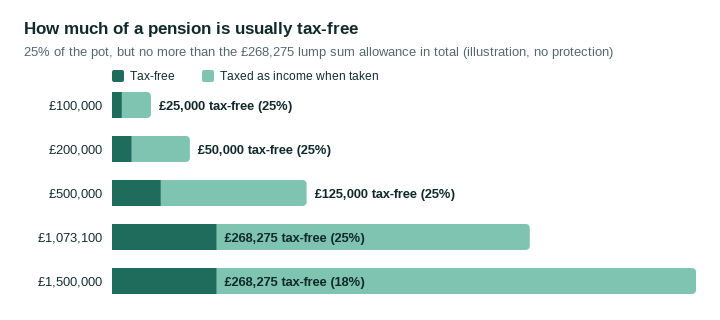
Example (illustration): a £100,000 pension usually gives £25,000 tax-free and a £500,000 one £125,000. A £1,500,000 pension is capped at £268,275, about 18% of it.
Your pension providers keep track of how much allowance you’ve used. If you have several pensions, each provider may ask what you’ve taken elsewhere, so it helps to keep the statements each one sends.
What if you took pension benefits before April 2024?
Some of your lump sum allowance will usually count as already used. Under HMRC’s transitional rules, if you took any pension benefits before 6 April 2024, your allowance is reduced by 25% of the lifetime allowance you used up before then.
For example, HMRC’s own illustration is someone who used £100,000 of lifetime allowance before April 2024. A quarter of that, £25,000, is deducted, leaving £243,275 of lump sum allowance.
This standard calculation assumes you took a full 25% tax-free each time. If you took less, for example because you bought an annuity without tax-free cash or had a pension that paid less, you can ask your scheme administrator for a transitional tax-free amount certificate. You need full evidence of what you actually took. The certificate replaces the standard deduction with the real amount, which can leave you more allowance. HMRC’s rules say you can’t apply once you’ve become entitled to a tax-free lump sum under the new rules, so the certificate has to come before the next withdrawal.
What is the lump sum and death benefit allowance?
It’s a second, larger cap of £1,073,100 on tax-free lump sums, including those paid when you die. GOV.UK calls it the lump sum and death benefit allowance. Every lump sum that counts against the £268,275 lump sum allowance also counts against this one.
The extra room is for two kinds of payment that don’t use the smaller allowance:
- serious ill-health lump sums, paid when someone is seriously ill
- certain lump sum death benefits, paid to your beneficiaries if you die before 75
Any part of a lump sum above the remaining allowance is usually taxed as income. For most people, the £268,275 cap is the one that matters day to day.
From 6 April 2027, unused pension funds will also usually count towards your estate for inheritance tax. That’s a separate tax from the allowances here. Our guide to inheritance tax on pensions explains the change and who’s affected.
Can you take more than £268,275 tax-free?
Only if you hold a protected allowance. Between 2006 and 2016, the government cut the old lifetime allowance several times and let people protect a higher figure. Those protections still apply, and they now set a higher tax-free lump sum instead.
According to GOV.UK, the maximum tax-free cash under each one is:
| Protection | Maximum tax-free lump sum |
|---|---|
| Primary protection | With lump sum protection, the amount on your certificate; without it, 25% of the pot up to £375,000 |
| Enhanced protection | With lump sum protection, the protected percentage of your pensions’ value on 5 April 2023; without it, £375,000 |
| Fixed protection (2012) | £450,000 |
| Fixed protection 2014 | £375,000 |
| Fixed protection 2016 | £312,500 |
| Individual protection 2014 | Lower of 25% of your pensions on 5 April 2014 or £375,000 |
| Individual protection 2016 | Lower of 25% of your pensions on 5 April 2016 or £312,500 |
If you hold one, tell each pension scheme before you take money. Some protections also limit the way you can take your pension: for example, HMRC says certain people with primary or enhanced protection and lump sum rights over £375,000 can’t take an UFPLS.
When can you take your tax-free cash?
From the minimum pension age, which is 55 now and rises to 57 on 6 April 2028 under the Finance Act 2022. Some people have a protected pension age below this, set by their scheme rules before the change. You can also take money earlier if you’re retiring because of ill health.
You don’t need to have stopped working. Many people take their pension while still earning, though that affects how the taxable part is taxed (see below).
Anyone who contacts you offering to release pension money before the minimum age, outside these exceptions, is a warning sign: payments outside the rules are unauthorised and face heavy tax charges, and pension scams often start this way.
UFPLS or drawdown: what’s the difference?
Both give you 25% tax-free, but they release it at different times. The choice is mainly about whether you want the tax-free cash in one go or spread over many years.
Tax-free cash up front, then drawdown. You move some or all of your pension into flexi-access drawdown and take up to 25% of the amount moved as a single tax-free lump sum. HMRC calls this a pension commencement lump sum. The rest stays invested, and anything you later withdraw from it is fully taxable. GOV.UK says you then have 6 months to start taking the remaining 75%, which in practice means moving it into drawdown or buying an annuity.
Lump sums as you go (UFPLS). You leave the pension untouched and take cash from it when you need it. Each payment is an uncrystallised funds pension lump sum: 25% of it is tax-free and 75% is taxed as income. Your tax-free cash is spread across every withdrawal.
| Tax-free cash up front | UFPLS | |
|---|---|---|
| Tax-free part | Up to 25%, paid at the start | 25% of every payment |
| Rest of the pot | Stays invested in drawdown | Stays invested, untouched until you take it |
| Triggers £10,000 MPAA? | Not until your first taxable withdrawal | Yes, from the first payment |
| Can you take tax-free cash only? | Yes | No |
You can also mix them: take tax-free cash from part of the pot and leave the rest uncrystallised for later. Not every scheme offers both, so it’s worth checking what yours allows.
Does taking tax-free cash affect what you can pay into a pension?
Taking only your tax-free cash doesn’t, but taking any taxable money usually does. HMRC lists the events that trigger the money purchase annual allowance (MPAA). They include the first income withdrawal from drawdown and the first UFPLS. A pension commencement lump sum on its own isn’t one of them.
Once triggered, the amount you can pay into defined contribution pensions with tax relief falls from £60,000 to £10,000 a year from then on. That includes your employer’s contributions. Cashing in a small pot of £10,000 or less doesn’t trigger it either, though you can only cash in up to three small pots from personal pensions this way.
This matters most if you’re still working and paying into a pension. Some people take only their tax-free cash at first, so they can keep paying in at the full allowance, and leave taxable withdrawals until they’ve stopped. Others are happy to accept the lower limit.
A separate recycling rule stops people taking tax-free cash and paying it straight back in for a second round of relief. It applies when the lump sums over 12 months exceed £7,500, the extra contributions exceed 30% of the lump sum, and the recycling was planned. HMRC then treats the lump sum as an unauthorised payment.
How is the rest of your pension taxed?
Everything you take above the tax-free part is added to your other income for the tax year and taxed at your income tax rates. That includes State Pension, earnings, rental income and any other pensions. In 2026/27, the first £12,570 of total income is covered by the Personal Allowance in England, Wales and Northern Ireland, then the basic rate of 20% applies, rising to 40% and 45%. Scotland has its own bands.
Because tax depends on your total income in a year, how you spread withdrawals can make a large difference. A big withdrawal in one year can push income into a higher band, and above £100,000 you also start to lose the Personal Allowance.
Example: someone with no other income takes £30,000 of taxable pension in one tax year and pays £3,486 in income tax. Taking £15,000 in each of two tax years instead would cost £972 in total, because more of it falls within two years’ worth of Personal Allowance.
Our take-home pay calculator shows the tax on any level of income.
Why is the first withdrawal often over-taxed?
Because your provider usually doesn’t yet have the right tax code. When there’s no suitable P45 or HMRC code for the first flexible payment, HMRC’s PAYE manual says the provider uses the emergency tax code on a month 1 basis. That treats the payment as if you’ll receive the same amount every month, so a one-off withdrawal is often taxed far too heavily.
Our guide to emergency tax on pension withdrawals goes through a worked example and each refund form in more detail.
You get the money back, either during the year or after it ends. To claim in the same tax year, HMRC has three forms:
- P55 if you’ve taken some but not all of your pension, won’t take more regular or flexible payments this tax year, and the provider can’t refund you
- P53Z if you’ve taken the whole pot and have other income
- P50Z if you’ve taken the whole pot, have a P45 from the provider, have stopped work for good and have no other income
GOV.UK now asks people to check whether they can claim online first, and warns that using the wrong form can delay a refund. If you don’t claim, HMRC says it reviews the position automatically after the tax year ends. Later payments use a code HMRC issues, so the problem usually affects only the first one.
The tax-free part itself isn’t affected: only the taxable part goes through PAYE.
Worked example: a £200,000 pot
This illustration shows three ways the same £200,000 pension could be taken by someone aged 60 with no other taxable income. It uses 2026/27 rates for England, Wales and Northern Ireland and ignores investment growth and charges. It’s not a forecast or a recommendation.
How much is tax-free? 25% of £200,000 is £50,000, well within the £268,275 lump sum allowance. The other £150,000 is taxable when it comes out.
- Tax-free cash up front, then drawdown. They take £50,000 tax-free and move £150,000 into drawdown. If they then withdraw £12,570 a year, all of it falls within the Personal Allowance, so no income tax is due while they have no other income. The MPAA is triggered at the first withdrawal.
- UFPLS as they go. They take £16,760 a year as UFPLS: £4,190 tax-free and £12,570 taxable, so again no income tax is due. Their tax-free cash comes out gradually, and the MPAA is triggered at the first payment.
- The whole pot at once. They take all £200,000 in one tax year: £50,000 tax-free and £150,000 taxable. That income is high enough to remove the Personal Allowance completely (it falls to £0), and the income tax is £53,703, leaving £146,297.
Once the State Pension starts, it uses up most or all of the Personal Allowance, so withdrawals from then on are usually taxed. Our pension drawdown calculator shows how long a pot could last at different withdrawal levels and how much tax is due.
Common questions about tax-free cash
Do you have to take all your tax-free cash at once?
No. You can take tax-free cash from part of your pension and leave the rest uncrystallised, then do the same again later. Or you can take UFPLS payments, where a quarter of each is tax-free. Whether you can split it depends on your scheme: some only allow one withdrawal or a full transfer into drawdown.
Can you take the tax-free cash and leave the rest invested?
Yes. Taking a pension commencement lump sum and moving the rest into drawdown leaves the remaining 75% invested. You don’t have to withdraw any of it straight away, and taking only the tax-free cash doesn’t trigger the £10,000 money purchase annual allowance.
Is the 25% tax-free if you’re still working?
Yes. The tax-free part is free of income tax whatever your other income. The taxable part is added to your earnings for the year, so if you’re working it’s more likely to be taxed at 40% or higher. Taking taxable money also triggers the MPAA, which caps future contributions, including your employer’s.
Can you pay your tax-free cash back into a pension?
Only within limits. HMRC’s recycling rule treats tax-free cash as an unauthorised payment if it was planned to be paid back in, the lump sums exceed £7,500 in 12 months, and the extra contributions exceed 30% of the lump sum. Ordinary contributions you’d have made anyway aren’t affected.
Does the tax-free lump sum count for inheritance tax?
Once it’s paid out, the cash is part of your savings, so anything you haven’t spent counts towards your estate in the usual way. From 6 April 2027, money left inside the pension will usually count too. Our guide to inheritance tax on pensions explains the change.
Where to get help
If you’re 50 or over and have a defined contribution pension, Pension Wise from MoneyHelper offers a free, impartial guidance appointment, online or with a specialist. It’s backed by the government, there’s no minimum pot size, and it covers when you can take your pension, the options, how each is taxed and how to spot scams. It explains options rather than recommending one. For a personal recommendation, you need a regulated financial adviser. See also our guides to pension drawdown and annuities, and the glossary for any unfamiliar terms.
Sources
- GOV.UK: Lump sum allowance and lump sum and death benefit allowance
- GOV.UK: Personal pensions, how you can take your pension
- HMRC Pensions Tax Manual PTM063230: pension commencement lump sum limits
- HMRC Pensions Tax Manual PTM063300: uncrystallised funds pension lump sum
- HMRC Pensions Tax Manual PTM056520: money purchase annual allowance trigger events
- HMRC Pensions Tax Manual PTM056530: events that don't trigger the money purchase annual allowance
- HMRC Pensions Tax Manual PTM174300: transitional tax-free amount certificates
- HMRC Pensions Tax Manual PTM174100: lump sum allowance after benefits taken before 6 April 2024
- GOV.UK: Taking higher tax-free lump sums with protected allowances
- HMRC Pensions Tax Manual PTM133810: recycling of lump sums
- HMRC PAYE Manual PAYE94055: flexibly accessed pension rights
- GOV.UK: Claim a tax refund on your pension by post
- GOV.UK: Income Tax rates and Personal Allowances
- Finance Act 2022, section 10: normal minimum pension age
- HMRC: Inheritance Tax on unused pension funds and death benefits
- MoneyHelper: Pension Wise
Our guides are general information and education, not personal financial advice. If you are unsure whether an investment is right for you, speak to a regulated financial adviser. Capital at risk. Investments can fall as well as rise, and you may get back less than you put in.