Emergency Tax on Pension Withdrawals
TL;DR
- Your first taxable pension withdrawal is often over-taxed, because the provider uses an emergency tax code until HMRC sends the right one.
- The emergency code treats a one-off sum as if you'd get it every month, so often far more tax is taken off.
- You can claim it back during the tax year with form P55, P53Z or P50Z, depending on your situation.
- If you don't claim, HMRC checks after the tax year ends and repays any overpayment.
- The tax-free part is paid in full. Only the taxable part is affected.
Quick answers
- Watch outWhy was so much tax taken? An emergency code on a month 1 basis taxes a one-off payment as if it came every month.
- YesCan I get it back? Yes. Claim during the tax year, or HMRC repays it after the year ends.
- DependsWhich form do I use? P55 if you've taken part of your pot and won't take more this year; P53Z or P50Z if emptied.
- NoIs the tax-free 25% affected? No. Only the taxable part goes through PAYE, so the tax-free part is paid in full.
- Watch outAny catch with a small first withdrawal? Usually. A small taxable withdrawal can trigger a tax charge on defined contribution saving over £10,000 a year.
- Basis the emergency code uses on a first flexible payment
- Month 1
- Share of the yearly Personal Allowance and bands applied
- 1/12
- HMRC forms to reclaim within the tax year
- P55, P53Z, P50Z
- Personal Allowance, 2026/27
- £12,570
On this page
- Why is your first pension withdrawal taxed so heavily?
- How does the month 1 calculation work?
- Worked example: a £20,000 withdrawal
- How do you claim the money back during the tax year?
- Can you just wait until the end of the tax year?
- How is the tax code corrected afterwards?
- Can you avoid emergency tax in the first place?
- Does emergency tax apply to every type of pension payment?
- Common questions about emergency tax on pensions
- Where to get help
- What to do next
- Related guides
- Sources
When you take taxable money from a pension for the first time, the tax taken off is often far higher than you’ll actually owe. This is usually down to an emergency tax code applied on a month 1 basis. The money isn’t lost: you can reclaim it during the tax year with an HMRC form, or wait for HMRC to sort it out after the year ends. This guide explains why it happens, how big the overpayment can be, which form fits which situation, and how the tax code gets corrected afterwards. It applies to flexible withdrawals from defined contribution pensions, such as drawdown income and lump sums taken straight from the pot.
Why is your first pension withdrawal taxed so heavily?
Because your pension provider usually doesn’t have the right tax code for you when it makes the first payment. HMRC’s PAYE manual says that when a provider makes a first flexible payment and has no P45 for the current tax year, it uses the emergency tax code on a month 1 basis. If it holds a P45 from earlier in the same tax year, it uses that code, also on a month 1 basis.
A tax code tells the payer how much tax-free income to allow you in each pay period. The month 1 basis (also called non-cumulative) ignores anything paid earlier in the year. HMRC’s manual says all payments are taxed “as though it was week 1 or month 1 of the tax year”. In practice, you get one-twelfth of a year’s Personal Allowance and one-twelfth of each tax band.
That works for a regular monthly salary. It doesn’t work for a one-off lump sum. A single large withdrawal is taxed as if you’ll receive the same amount every month for a year, so much of it falls into the higher and additional rate bands.
How does the month 1 calculation work?
The provider taxes the payment as one month’s income, using one-twelfth of the yearly allowance and bands. In 2026/27, for England, Wales and Northern Ireland, that means roughly:
- the first £1,047.50 is tax-free (one-twelfth of the £12,570 Personal Allowance)
- the next £3,141.67 is taxed at 20%
- income above about £4,189.17 is taxed at 40%
- income above about £11,475.83 is taxed at 45%
An easy way to see the effect is to multiply the payment by 12, work out the tax on that yearly figure, then divide by 12. That gives the same answer as the monthly bands. Payroll tables round the allowance slightly, so a real deduction can differ by a few pounds.
Only the taxable part of a withdrawal goes through PAYE. When you take a lump sum straight from the pot (an uncrystallised funds pension lump sum, or UFPLS), 25% is usually tax-free and 75% is taxable. Scottish taxpayers have different bands, so their figures differ.
Worked example: a £20,000 withdrawal
This illustration uses 2026/27 rates for England, Wales and Northern Ireland and the same tax code the site’s calculators use. It’s not a forecast, and real payroll figures can differ slightly.
Someone aged 60 with no other income takes a single £20,000 UFPLS early in the tax year. £5,000 is tax-free and £15,000 is taxable. Their provider has no tax code, so it uses the emergency code on a month 1 basis.
- Tax deducted: on a month 1 basis, the £15,000 is treated as one month of a £180,000 yearly income. The deduction is about £5,129.
- Tax actually owed for the year: if this is their only income, the £15,000 uses up the £12,570 Personal Allowance and the rest is taxed at 20%. That’s £486.
- Overpaid: about £4,643, which they can reclaim.
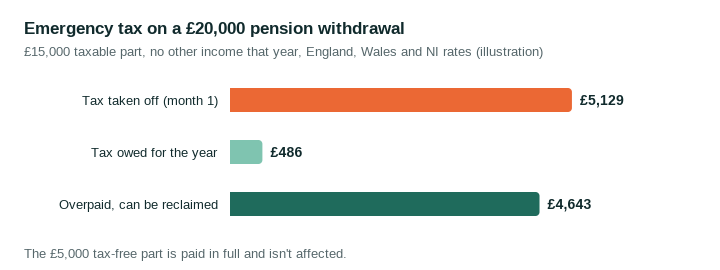
The table shows how the gap grows with the size of the taxable part, for someone with no other income that year.
| Taxable part of withdrawal | Deducted on month 1 | Tax owed for the year | Overpaid |
|---|---|---|---|
| £3,000 | £391 | £0 | £391 |
| £7,500 | £1,953 | £0 | £1,953 |
| £15,000 | £5,129 | £486 | £4,643 |
| £30,000 | £11,879 | £3,486 | £8,393 |
| £60,000 | £25,379 | £11,432 | £13,947 |
If the person also has a salary or another pension, more of the withdrawal is taxed at the higher rates, so the overpayment is smaller. It can occasionally go the other way: a withdrawal by someone with high other income can be under-taxed. Our take-home pay calculator shows the yearly tax on any level of income.
How do you claim the money back during the tax year?
You can claim online or by post, and the right form depends on whether you’ve emptied the pot and whether you have other income. GOV.UK asks people to check whether they can claim online first, and warns that using the wrong form may delay a refund. To claim you’ll need your National Insurance number, the amount paid and the tax taken off, and details of any other taxable income you expect that year.
There are three forms for flexible withdrawals:
- P55: you’ve taken some of your pension but not emptied it, you won’t take any more regular or flexible payments before the end of the tax year, and the pension provider can’t make the refund itself.
- P53Z: you’ve flexibly accessed all of your pension and you have other income, such as earnings or another pension.
- P50Z: you’ve flexibly accessed all of your pension, have a P45 from your provider, have stopped work and don’t expect to go back, and have no other income. GOV.UK says to send it only after 4 weeks have passed since you stopped work or finished taking your pension.
GOV.UK also says not to use P50Z if you’re claiming Jobseeker’s Allowance, taxable Incapacity Benefit, contribution-based Employment and Support Allowance or Carer’s Allowance. A separate form, P53, is for small pension lump sums and trivial commutation, which are taxed differently from flexible withdrawals.
HMRC pays refunds by Faster Payments into a bank account in your name or a nominee’s name. After the tax year ends, it checks the refund was right and contacts you if it wasn’t.
Can you just wait until the end of the tax year?
Yes. Claiming is optional. HMRC’s PAYE manual says that if you don’t ask for a repayment, HMRC reviews your position after the tax year ends and sends you a tax calculation showing whether you’ve paid too much or too little. Any overpayment is then repaid.
The trade-off is time. A withdrawal taken in May could leave money with HMRC for a year or more, while a claim during the year usually returns it sooner. Some people don’t mind the wait, especially for small amounts. Others prefer to claim straight away, particularly when the overpayment runs to thousands of pounds.
Waiting can also make sense if you’re unsure what your total income for the year will be. Taking more withdrawals, starting a job or starting the State Pension later in the year all change the final bill. A year-end review uses your actual income for the whole year rather than an estimate.
If you’ll take further payments from the same pension in the same tax year, the P55 conditions above mean that form doesn’t apply. In that case the pension provider handles tax on later payments using the code HMRC sends, and any remaining difference is settled after the year ends.
How is the tax code corrected afterwards?
After the first payment, HMRC issues a tax code to your pension provider for future payments. Your provider reports each payment to HMRC through the PAYE system, and HMRC uses that, together with what it knows about your other income, to work out a code. The emergency code is meant to apply only until then.
What happens next depends on how you take your pension:
- Regular drawdown income: later payments use the code HMRC issues, so the problem usually affects only the first one.
- The whole pot in one payment: the provider issues a P45 once the fund is used up, which you need for a P50Z or P53Z claim.
- The whole pot in instalments: HMRC’s manual says the P45 is issued only after the final payment.
It’s worth checking that the new code looks right. You can see your tax codes in your HMRC personal tax account or the HMRC app. If a pension is missing or the estimated income is wrong, GOV.UK says to update your details online or contact HMRC. The State Pension is paid without tax taken off, so tax on it is usually collected through the code on a workplace or private pension.
Can you avoid emergency tax in the first place?
Not entirely, but its effect depends on the size of the first payment. Some people choose to make a small first withdrawal so that the emergency code applies to only a small sum. Once HMRC has issued a proper tax code, larger withdrawals follow on that code instead.
For example, a £400 UFPLS has a taxable part of £300. That’s below the roughly £1,047.50 monthly allowance on a month 1 basis, so no tax would be deducted. Later withdrawals would then use the code HMRC sends.
There are trade-offs to weigh:
- Timing: the larger withdrawal has to wait until HMRC’s code reaches the provider, which isn’t instant.
- The money purchase annual allowance: HMRC lists the first UFPLS and the first drawdown income payment as events that trigger it. Even a small taxable withdrawal usually triggers it: defined contribution saving above £10,000 a year, rather than the standard £60,000, then faces an annual allowance tax charge. Taking only tax-free cash doesn’t trigger it.
- Provider rules: some schemes set minimum withdrawals or charge for each payment, so it’s worth checking the scheme’s terms.
Taking only tax-free cash, without any taxable income, doesn’t go through PAYE at all. Our guide to the tax-free lump sum explains the options.
Does emergency tax apply to every type of pension payment?
No. It’s mainly a problem for flexible withdrawals from defined contribution pensions, because they’re often one-off or irregular. HMRC’s manual on flexibly accessed pensions sets out the month 1 rule for these payments.
Payments that aren’t taxable at all, such as the tax-free part of a UFPLS or a pension commencement lump sum on its own, aren’t affected. Regular income from an annuity or a defined benefit scheme is taxed through PAYE too, and a new pension can start on an emergency code. Because it’s paid in equal amounts each month, any error is usually much smaller and is corrected once HMRC issues a code.
GOV.UK’s emergency tax code page also says you may be put on an emergency code when company benefits or the State Pension start. A code ending in W1, M1 or X, or showing NONCUM on a payslip, is an emergency code. Without one of those endings, you’re not on one.
Small pension lump sums and trivial commutation payments follow different rules and use form P53 to reclaim. Our pension drawdown guide explains how different withdrawals are taxed.
Common questions about emergency tax on pensions
How long does a pension tax refund take?
GOV.UK doesn’t give a fixed time for P55, P53Z or P50Z claims. It links to HMRC’s “check when you can expect a reply” tool for anyone who has already claimed. Refunds are paid by Faster Payments once a claim is processed. Claiming online, where possible, avoids postal delays.
Will the provider refund the tax itself?
Sometimes. If you take more payments from the same pension in the same tax year, the provider applies the code HMRC sends to those later payments. P55 is for cases where you won’t take further payments that year and the provider can’t make the refund. If the pot is emptied, a P45 lets you claim directly.
Does emergency tax affect the tax-free 25%?
No. Only the taxable part of a payment goes through PAYE, so the tax-free part is paid in full. On a £20,000 UFPLS, £5,000 is tax-free whatever code is used. The emergency code affects only the £15,000 taxable part.
Can you be under-taxed instead?
Yes, though it’s less common. On a month 1 basis the provider ignores your other income, so someone with a high salary can have too little deducted from a smallish withdrawal. HMRC then collects the shortfall, usually through a later tax code or a calculation after the tax year ends.
Do you need to fill in a Self Assessment tax return?
Not just because of emergency tax. Overpayments on pension withdrawals are reclaimed with P55, P53Z or P50Z, or settled by HMRC after the year ends. If you already complete a Self Assessment return for other reasons, the pension payment and the tax deducted go on it.
Where to get help
Pension Wise from MoneyHelper offers free, impartial guidance on how pension withdrawals are taxed for people aged 50 or over with a defined contribution pension. For questions about a specific tax code or refund, HMRC deals with individual cases. Our pension drawdown calculator shows how withdrawals and tax could play out over time, and the glossary explains any unfamiliar terms.
Sources
- HMRC Pensions Tax Manual PTM056520: money purchase annual allowance trigger events
- HMRC PAYE Manual PAYE94055: flexibly accessed pension rights
- HMRC PAYE Manual PAYE11090: ways an employer can apply a tax code
- GOV.UK: Emergency tax codes
- GOV.UK: Claim a tax refund on your pension by post
- GOV.UK: Claim back tax on a flexibly accessed pension overpayment (P55)
- GOV.UK: Claim a tax refund when you've flexibly accessed all of your pension (P53Z)
- GOV.UK: Claim a tax refund if you've stopped work and flexibly accessed all of your pension (P50Z)
- GOV.UK: Claim a tax refund on a pension
- GOV.UK: Tax when you get a pension, how your tax is paid
- GOV.UK: Income Tax rates and Personal Allowances
- HMRC Pensions Tax Manual PTM056520: money purchase annual allowance trigger events
- MoneyHelper: Pension Wise
Our guides are general information and education, not personal financial advice. If you are unsure whether an investment is right for you, speak to a regulated financial adviser. Capital at risk. Investments can fall as well as rise, and you may get back less than you put in.