How Much Pension Should I Have at My Age?
TL;DR
- Pensions UK's Retirement Living Standards put yearly costs for one person at £13,900 (minimum), £32,700 (moderate) and £45,400 (comfortable).
- The full new State Pension, £241.30 a week, covers most of the minimum standard on its own, but much less of the others.
- In our illustration, a moderate retirement from 67 for one person needs a pension pot of about £519,000 to £531,000, plus the State Pension.
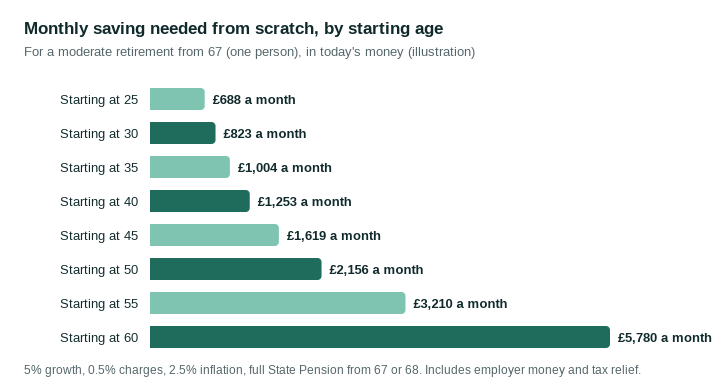
- Starting from nothing, that's about £690 a month from 25, £1,250 from 40 or £3,210 from 55, including employer money and tax relief.
- These are illustrations, not targets. Housing, other pensions, couples and investment returns all change the answer a lot.
Quick answers
- CostHow much does a moderate retirement cost? Pensions UK puts it at £32,700 a year for one person and £45,400 for two, owning their home.
- NoDoes the State Pension cover it? Not on its own. The full rate is about £12,548 a year, close to the £13,900 minimum.
- NoIs there an official target by age? No. The government doesn't set one. Age figures here are our illustrations, using stated assumptions.
- YesDoes starting earlier make a difference? A lot. In our example, starting at 25 needs about half the monthly amount of starting at 40.
- DateWhen can I take my pension? Usually from 55, rising to 57 on 6 April 2028, unless your scheme gives a protected age.
- Yearly cost of a moderate retirement, one person (Pensions UK)
- £32,700
- Full new State Pension, a week, 2026/27
- £241.30
- Minimum auto-enrolment contribution, at least 3% from the employer
- 8%
- Minimum pension age rises on 6 April 2028
- 55 to 57
On this page
- How much does retirement cost in the UK?
- How much of that does the State Pension cover?
- How big a pension pot does each lifestyle need?
- How much pension should I have at my age?
- Why does starting earlier make such a difference?
- What does the auto-enrolment minimum build?
- How much do you need to retire early?
- What changes the numbers most?
- Common questions
- Where to get help
- What to do next
- Related guides
- Sources
“How much pension should I have at my age?” is one of the most common money questions, and there’s no official answer. The government doesn’t publish a target pot for each age, and the right figure depends on the life you want, where you live, whether you own your home and what other income you’ll have. What we can do is show how the sums work. This guide uses the Retirement Living Standards from Pensions UK, the full new State Pension and the same model as our retirement calculator to show how big a pot each lifestyle needs, and what that means at different ages.
Everything here is in today’s money, meaning prices are adjusted for inflation so the figures feel like what money buys now. The figures are illustrations, not advice or targets.
How much does retirement cost in the UK?
The best-known yardstick is the Retirement Living Standards from Pensions UK, the trade body for workplace pension schemes. They describe three levels of retirement lifestyle and estimate what each costs a year, assuming you own your home outright with no rent or mortgage:
| Lifestyle | One person | Two people |
|---|---|---|
| Minimum | £13,900 | £22,500 |
| Moderate | £32,700 | £45,400 |
| Comfortable | £45,400 | £62,700 |
For one person, Pensions UK’s examples give a sense of what each level means. The minimum covers around £57 a week on groceries, a week’s holiday in the UK and no car. The moderate level includes a fortnight’s all-inclusive holiday in the Mediterranean and a three-year-old small car replaced every seven years. The comfortable level adds more spending on food, a pricier fortnight in the Mediterranean and a car replaced every five years.
These are spending figures, not income. Pensions UK points out that you may need a higher income to cover them, because pension income can be taxed. People who rent in retirement face higher costs. People who’ll still have a mortgage do too, until it’s paid off.
How much of that does the State Pension cover?
The full new State Pension is £241.30 a week in 2026/27, which is about £12,547.60 a year. That’s just below the £12,570 Personal Allowance, so on its own it’s usually free of income tax. To get the full amount, most people need 35 qualifying years of National Insurance. Your State Pension forecast shows what you’re on track for.
For one person, the full State Pension covers about 90% of the minimum standard, 38% of the moderate one and 28% of the comfortable one. For a couple who both get the full rate, two State Pensions of about £25,095 more than cover the £22,500 minimum.
The rest has to come from other savings: a workplace pension, a SIPP, ISAs, a defined benefit pension or other income. That gap is what the pot sizes below are built to fill.
The State Pension only starts at State Pension age. That age is currently rising from 66 to 67 between 2026 and 2028, and under current law it rises to 68 between 2044 and 2046. The government launched a third review of State Pension age in July 2025, so the later timetable could change. GOV.UK’s State Pension age checker gives your own date.
How big a pension pot does each lifestyle need?
Using our retirement calculator’s model, here’s roughly the pot one person would need on the day they retire at 67, with the full State Pension starting at 67, to fund each lifestyle until age 95:
| Lifestyle | Pot needed, one person | Pot needed, a couple (combined) |
|---|---|---|
| Minimum | £34,726 | None: two full State Pensions cover it |
| Moderate | £519,066 | £522,877 |
| Comfortable | £846,254 | £968,573 |
The assumptions are: 5% investment growth a year before 0.5% charges, 2.5% inflation, a quarter of each withdrawal taken tax-free and the rest taxed under today’s income tax rules, and income needed to age 95. After charges and inflation, that’s a real return of about 1.9% a year. Under those assumptions, a moderate retirement for one person means taking about £23,703 a year from the pot, before tax.
A couple needs much less than twice the single figure, because two people share many costs and two State Pensions come in. Planning to age 95 is a cautious choice; many people won’t need income for that long, but some will need it for longer.
How much pension should I have at my age?
There’s no official figure for each age, so here’s a simple way to think about it. Take the moderate lifestyle for one person, retiring at 67, and ask two questions at each age:
- If you had no pension yet, how much would you need to pay in each month from now on to build it?
- If you stopped paying in, how big would your pot need to be today to grow to it on its own?
| Your age now | Monthly saving from scratch | Pot today that would need no more saving |
|---|---|---|
| 25 | £688 | £238,164 |
| 30 | £823 | £262,010 |
| 35 | £1,004 | £288,244 |
| 40 | £1,253 | £317,105 |
| 45 | £1,619 | £348,856 |
| 50 | £2,156 | £375,248 |
| 55 | £3,210 | £412,820 |
| 60 | £5,780 | £454,154 |
For people aged 45 or under today, current law puts State Pension age at 68, so those rows assume the State Pension starts a year after retiring, and the pot needed rises to £530,876. For older rows it’s £519,066, with the State Pension at 67.
Most people sit somewhere between the two: they have some savings and are still paying in. The monthly amounts include everything going in, so employer contributions and tax relief count, not just what comes out of your pay. Our retirement calculator works out the gap for your own pot, payments and retirement age.
Why does starting earlier make such a difference?
Two things work in an early starter’s favour. First, there are more years of payments. Second, money paid in early has longer to grow, and growth is earned on earlier growth, which is compound interest at work.
In our example, someone starting from nothing at 25 needs about £688 a month to reach a moderate pot by 67. Wait until 40 and it’s about £1,253, nearly twice as much. From 55 it’s about £3,210, more than four and a half times the age-25 figure.
That doesn’t mean it’s too late at 50 or 55. Many people pay in more in their later working years, when their pay is often higher and costs like childcare have ended. Others work a little longer, take part-time work in early retirement, or plan around the minimum or a level between minimum and moderate. Each of those changes the numbers a lot.
What does the auto-enrolment minimum build?
Most employees are automatically enrolled into a workplace pension. The legal minimum is 8% of qualifying earnings, with at least 3% from the employer. Qualifying earnings are pay between £6,240 and £50,270 a year.
On a £30,000 salary, qualifying earnings are £23,760, so the minimum is £1,900.80 a year, or about £158 a month. That includes £712.80 from the employer and £237.60 of tax relief. If pay and payments rise in line with prices, the same assumptions as above give a pot at 67 of roughly:
- £135,382 if paid from age 22
- £102,121 from age 30
- £67,088 from age 40
Even from 22, that’s well short of the moderate pots above, though it would more than cover the £34,726 minimum pot. That’s why many people pay in more than the minimum, often where an employer matches extra contributions. Our guide to workplace pensions explains how auto-enrolment works and how employer matching is often set up.
How much do you need to retire early?
Retiring before State Pension age means the pot has to pay for everything until the State Pension starts, and for longer overall. In our model, with the State Pension starting at 67, a moderate retirement for one person needs about:
- £519,066 retiring at 67
- £689,083 retiring at 60, with about £35,513 a year taken before tax until the State Pension starts
- £797,344 retiring at 55
There’s also a legal floor. You can usually take money from a personal or workplace pension from 55, rising to 57 on 6 April 2028, unless your scheme gives you a protected pension age. Many people who retire early bridge the gap with ISAs, which can be taken at any age. Our guide to ISA or pension compares the two.
What changes the numbers most?
The figures above are a starting point. These things move them most:
- Housing. The standards assume no rent or mortgage. Renting in retirement adds a large yearly cost.
- Other pensions. A defined benefit pension from an old job pays a set income and cuts the pot you need.
- Your State Pension. Fewer than 35 qualifying years means less than the full rate, and a bigger gap to fill.
- Investment returns and charges. Lower growth or higher charges mean a bigger pot or more saving. Returns aren’t steady, and pension values can fall as well as rise.
- How long you live. Planning to 95 is cautious; living longer needs more.
- Tax rules. We use today’s rules. Tax rates, allowances and the State Pension can all change.
Common questions
Is £100,000 enough to retire on?
It depends on your other income. In our model, a £100,000 pot at 67 could pay a steady income of about £4,567 a year before tax to age 95, in today’s money. Added to the full State Pension, that’s about £16,434 a year after tax, between the minimum and moderate levels for one person. You could usually take up to 25% of the pot tax-free, which would be £25,000, but that’s part of the same money, not extra. A pot drawn down faster, or hit by early market falls, runs out sooner. Our pension drawdown calculator shows how long a pot could last at different withdrawal levels.
Can I retire at 55?
You can usually take money from a defined contribution pension at 55 today, but the minimum age rises to 57 on 6 April 2028. Whether 55 works financially depends on your savings. In our model, a moderate lifestyle for one person from 55 needs about £797,344, because the pot must pay for twelve years before the State Pension starts and last longer overall. Many people who stop work early cut their spending, work part-time for a few years or draw on ISAs first. Our retirement calculator lets you set your own retirement age and State Pension age.
How much money do I need to retire?
That depends on the lifestyle you want and your other income. Pensions UK’s standards suggest £13,900 a year for a minimum lifestyle for one person, £32,700 for moderate and £45,400 for comfortable, assuming you own your home. In our model, on top of the full State Pension, that means a pot of about £34,726, £519,066 or £846,254 at 67. A couple sharing costs needs less per person. A good first step many people take is to list their pensions and get a State Pension forecast; our pension check-up walks through it.
Does the 25% tax-free cash change these figures?
They already allow for it. Our model assumes a quarter of each withdrawal is tax-free and the rest is taxed as income. If you took all your tax-free cash at once instead, the tax on the rest would be spread differently. The most anyone can usually take tax-free in total is £268,275. Our guide to the tax-free lump sum explains the options.
Where to get help
If you’re 50 or over with a defined contribution pension, Pension Wise from MoneyHelper offers a free, impartial appointment to talk through your options. It’s free, impartial guidance backed by the government. For a personal recommendation on how much to save or how to take your pension, you’d need a regulated financial adviser. Your pension statements and your State Pension forecast are the starting point for any of these conversations.
Sources
- Pensions UK: Retirement Living Standards
- GOV.UK: The new State Pension, what you'll get
- GOV.UK: Check your State Pension age
- Government Actuary's Department: GAD and the State Pension age review (July 2025)
- DWP: Third State Pension age review
- GOV.UK: Workplace pensions, what you, your employer and the government pay
- GOV.UK: Tax when you get a pension, what's tax-free
- HMRC: Increasing normal minimum pension age
- GOV.UK: Income Tax rates and Personal Allowances
- MoneyHelper: Pension Wise
Our guides are general information and education, not personal financial advice. If you are unsure whether an investment is right for you, speak to a regulated financial adviser. Capital at risk. Investments can fall as well as rise, and you may get back less than you put in.