Diversification: How Spreading Risk Works
TL;DR
- Investment risk is the chance of ending up with less than you put in, or less than you need.
- Diversification means spreading money across many companies, countries and types of investment, so one failure does limited damage.
- It can't stop whole markets falling together. In March 2020 the FTSE All-Share fell more than 10% in one day.
- The FCA suggests investing for at least five years, and putting no more than 10% of net assets into high-risk investments.
- The FSCS covers up to £85,000 per person, per firm if an investment firm fails. It never covers market falls.
Quick answers
- NoDoes diversification remove risk? No. The FCA says it can reduce risk but can't totally eliminate it.
- LimitWhat time frame does the FCA suggest? The FCA suggests at least five years, to ride out short-term dips.
- LimitHow much in high-risk investments? The FCA suggests no more than 10% of net assets in high-risk investments such as crypto.
- DependsHow many funds does it take? No set number. One global fund can hold thousands of companies across dozens of countries.
- Watch outDoes more cash make it safer? It limits falls in pounds, but adds inflation risk over long periods.
- NoDoes the FSCS cover market falls? No. It pays up to £85,000 per person, per firm, only if a firm fails.
- Minimum time frame the FCA suggests for investing
- 5+ years
- Most of net assets the FCA suggests putting in high-risk investments
- 10%
- Risk scale on the new fund product summaries, in full from June 2027
- 1 to 10
- FSCS limit if an investment firm fails (not market falls)
- £85,000
On this page
- What does investment risk mean?
- What is diversification?
- What are the different ways to diversify?
- How do shares, bonds and cash compare on risk?
- What difference does the mix make over 20 years?
- How do people decide how much risk to take?
- What are the common ways to build a diversified portfolio?
- What can’t diversification protect against?
- Common questions about diversification and risk
- What to do next
- Related guides
- Sources
Every investment carries some risk. The FCA’s InvestSmart guidance puts it plainly: “Every investment carries some element of risk, even if it’s low in some cases.” Understanding the different kinds of risk, and how spreading money reduces some of them, is one of the most useful things a new investor can learn. It’s also the basis of choosing between shares, bonds and cash, and between the ready-made funds on any investment platform. This guide explains how it works; it isn’t advice about what anyone should do.
What does investment risk mean?
Investment risk is the chance that investments are worth less than was put in, or less than is needed when the money is needed. MoneyHelper describes investing as putting your capital at risk, “which means your balance can go up and down.” The main kinds are:
- Market risk: a whole stock market falls, taking most shares with it.
- Company risk: a single company struggles or fails, and its shares fall or become worthless.
- Concentration risk: too much money depends on one company, sector or country.
- Inflation risk: money grows more slowly than prices, so it buys less in future. This is the main risk of holding cash for a long time. The Bank of England’s inflation target is 2% a year.
- Interest rate and credit risk: bond prices fall when interest rates rise, and a borrower may fail to pay back. Our gilts and bonds guide explains both.
- Currency risk: overseas investments can rise or fall in pounds as exchange rates move.
- Liquidity risk: the FCA notes some investors may need to sell at a bad time, or be locked in for a set period.
- Firm risk: the platform or fund manager fails. This is covered below.
What is diversification?
Diversification means spreading money across many different investments, so that one going wrong does limited damage to the whole. It’s the “don’t put all your eggs in one basket” idea. The FCA says spreading money “across different types of investments, such as international shares and bonds, can reduce your risks,” and that diversification “can help to smooth out investment returns over time.”
The arithmetic is simple. If money is split equally across 10 companies and one becomes worthless, a tenth of the money is lost: 10%. Split equally across 500 companies, the same failure costs 0.2%. That’s why funds, which pool many investors’ money into one portfolio, are the usual way people diversify. The FCA describes funds as providing “a level of diversification that can help to smooth out long-term returns.”
The FCA’s own example is £1,000 in a single company’s shares, which could be “up or down by 20% a year later.” Holding many companies doesn’t stop prices moving, but it stops one piece of bad news dominating the result. Our guides to index funds and ETFs explain how these funds hold hundreds or thousands of companies.
What are the different ways to diversify?
People diversify across five main dimensions: companies, sectors, countries, asset types and time. Each protects against a different kind of bad luck, and a single broad fund can cover several at once.
| Diversify across | Example | What it protects against |
|---|---|---|
| Companies | A fund holding hundreds or thousands of shares | One company failing |
| Sectors | Technology, healthcare, banks, retailers, energy | A downturn in one industry |
| Countries | A global fund rather than just the UK | One economy or market doing badly |
| Asset types | Shares, bonds and cash | Shares falling sharply |
| Time | Investing regularly over years | Putting everything in at a bad moment |
The FCA’s guidance gives the same building blocks. It suggests spreading shares across “companies in different business sectors, like retailers and engineering companies,” and beyond one country, “such as elsewhere in Europe, the US and Japan.” MoneyHelper lists four main types of investment: cash, bonds, shares and property, and notes that some funds hold a range of these “to reduce the risk.” Spreading purchases over time is covered in our lump sum vs drip-feeding guide.
How do shares, bonds and cash compare on risk?
Shares have historically offered the highest long-term growth with the biggest falls, bonds have usually been steadier with lower returns, and cash is stable in pounds but exposed to inflation. The FCA’s rule of thumb is that “the greater the potential returns, the higher the level of risk.”
- Shares have historically produced the highest long-term growth, but with large falls along the way.
- Bonds have usually been steadier, though they can fall sharply too. In September 2022, the Bank of England reported that 30-year gilt yields rose by 130 basis points (1.3 percentage points) in three days of trading, a move it called three times larger than any previous move over a similar period. Rising yields meant sharp falls in gilt prices.
- Cash is the most stable in pounds. Bank and building society deposits are protected by the FSCS up to £120,000 per person, per bank. Over long periods, though, cash has often struggled to keep up with inflation.
Mixing them changes how bumpy the ride is. A mix of mostly bonds and cash is likely to fall less in a crash but grow less over time; mostly shares is likely to grow more but fall further. Neither is guaranteed.
What difference does the mix make over 20 years?
Small differences in yearly growth compound into large differences over long periods, which is the trade-off behind choosing a mix. This illustration uses the same calculation as our compound interest calculator. Someone invests £200 a month for 20 years, paying in £48,000, with no charges, at three steady growth rates. These are assumptions for illustration, not forecasts or expected returns for any type of investment.
| Steady growth a year | Value after 20 years | Growth on top of money paid in |
|---|---|---|
| 3% | £65,371 | £17,371 |
| 5% | £81,161 | £33,161 |
| 7% | £101,507 | £53,507 |
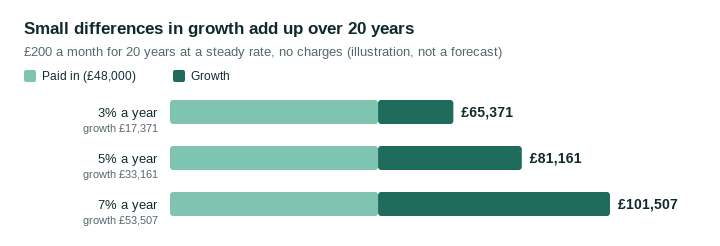
Growth of 7% rather than 3% a year roughly triples the growth in this example. But real investments don’t grow steadily. A higher-growth mix usually comes with bigger falls along the way, and falls hurt more than they look. A fall of 20% needs a rise of 25% to get back to where it started; a fall of 50% needs a rise of 100%. That’s why the size of possible falls matters as much as the average return.
How do people decide how much risk to take?
Time is usually the biggest factor: the longer until the money is needed, the more time there is to recover from falls. The FCA suggests investing over “a timeframe of at least five years” to ride out short-term dips, and MoneyHelper describes investments as usually for the long term, five years plus.
Other things people commonly weigh up:
- The goal and its date. Money for a house deposit in three years is usually treated differently from a pension to be drawn in 30.
- How they’d react to a fall. Someone who would sell after a drop of a third may find a lower-risk mix easier to stick with.
- What else they have. MoneyHelper suggests an emergency fund of three to six months’ essential outgoings in instant-access savings, so investments don’t have to be sold at a bad time. A secure income or a defined benefit pension can also change how much risk someone can bear.
- High-risk investments. The FCA suggests putting no more than 10% of total net assets into high-risk investments such as crypto, and says anyone who does “must be prepared to lose all your investment.”
Fund documents give each fund a risk score. Under the FCA’s new rules for consumer composite investments, a category that includes funds, an optional transition began on 6 April 2026 and the rules apply in full from 8 June 2027. The new product summary uses a risk indicator from 1 (lower risk) to 10 (higher risk), replacing the 1 to 7 scale used before. Our guide to reading a fund factsheet explains it.
What are the common ways to build a diversified portfolio?
Most people diversify through funds rather than picking individual shares, because one fund can hold thousands of companies. The main approaches are:
- One global index fund or ETF for the shares part, sometimes alongside a bond fund to lower the overall risk.
- A ready-made, multi-asset fund that holds shares and bonds in a set mix and rebalances automatically. Our ready-made portfolios guide explains how they work.
- A few funds chosen individually, covering different regions and asset types.
Two things are worth checking with any approach. First, overlap: two global funds often hold many of the same large companies, so owning both may add less spreading than it seems. Second, costs: the FCA warns that fees and charges “can mount up over time, eating into your investment returns.” Our platform fee calculator shows how charges add up.
What can’t diversification protect against?
Diversification reduces the damage from any single investment going wrong, but it can’t stop whole markets falling together. The FCA says it “can’t totally eliminate risks” and “there will always be individual instances when diversification does not pay off in the short term.” In March 2020, for example, the Bank of England reported that the FTSE All-Share index fell more than 10% in a single day, its largest one-day fall since 1987.
It also can’t protect against:
- Needing the money at a bad time. If a fall comes just before the money is needed, spreading it widely won’t help. Time and a cash buffer do more here.
- Inflation on cash. Diversifying across cash accounts protects against a bank failing, not against rising prices.
- Firm failure beyond the limits. If a firm fails and there’s a shortfall, the FSCS can pay up to £85,000 per person, per firm. The FSCS doesn’t cover market falls; it says it “can’t accept any claims that are for poor investment performance.”
Our investing for beginners guide puts these pieces together.
Common questions about diversification and risk
How many funds does it take to be diversified?
There’s no set number. One global fund can hold thousands of companies across dozens of countries, which already spreads company and country risk widely. More funds don’t automatically mean more diversification if they hold the same companies. What matters is how many different companies, sectors, countries and asset types the money is spread across in total.
Is a global index fund diversified enough?
A global shares fund is spread across companies, sectors and countries, but it’s still all shares, so it can fall sharply in a market crash. Some people add bonds or cash to reduce the size of falls. Our index fund guide explains how a global index is spread, and why the US usually makes up the largest share.
Is it worth spreading money across several platforms?
Spreading across platforms is about firm risk, not market risk. FSCS investment protection is up to £85,000 per person, per firm, and only applies if a firm fails and assets are missing. Some people with larger sums use more than one provider for this reason. It doesn’t reduce the risk of the investments falling.
Does holding more cash make a portfolio safer?
Holding more cash reduces how far a portfolio can fall in pounds, but it adds inflation risk over long periods. The Bank of England targets inflation of 2% a year, so cash needs to earn more than inflation just to hold its buying power. Our cash vs investing calculator and inflation calculator show the trade-off.
What does the risk number on a fund mean?
It’s a summary risk score shown in a fund’s key document, so funds can be compared on the same scale. Under the FCA’s new rules, funds are moving from a scale of 1 to 7 to a scale of 1 (lower risk) to 10 (higher risk), in full from 8 June 2027. A low score doesn’t mean no risk: every investment can fall in value.
Sources
- Bank of England: Interim Financial Stability Report, May 2020
- FCA InvestSmart: Diversification
- FCA InvestSmart: Risk and returns
- FCA InvestSmart: Golden rules of investing
- FCA InvestSmart: Understanding high-risk investments
- FCA InvestSmart: The advantages of mainstream investments
- FCA PS25/20: Supporting informed decision-making, final rules for consumer composite investments
- FCA PS25/20 (PDF): risk indicator scale of 1 to 10
- MoneyHelper: A beginner's guide to investing
- MoneyHelper: Thinking about investing? Make sure you understand the risks
- MoneyHelper: How to save for an emergency
- FSCS: Investments
- FSCS: Banks, building societies and credit unions (deposit limit)
- Bank of England Quarterly Bulletin: Financial stability buy/sell tools, a gilt market case study (2023)
- Bank of England: Inflation and the 2% target
Our guides are general information and education, not personal financial advice. If you are unsure whether an investment is right for you, speak to a regulated financial adviser. Capital at risk. Investments can fall as well as rise, and you may get back less than you put in.