Ready-Made Portfolios and Robo-Advisers
TL;DR
- A ready-made portfolio puts your money into a ready-built mix of investments matched to a risk level, and keeps it balanced.
- They come as multi-asset funds, platforms' own portfolios, or robo-advisers that choose one from your answers to questions.
- Most robo-advisers manage your money for you. A few give automated advice, usually narrower than full financial advice.
- Charges stack up: a platform fee, any management fee and the funds' own charges. The total comes out of returns each year.
- The FSCS may pay up to £85,000 per person, per firm, if a firm fails. It doesn't cover falls in value.
Quick answers
- DependsIs a robo-adviser financial advice? Usually not. Most manage your money; a few give automated advice, a regulated but narrower recommendation.
- NoAre risk labels standardised? No. One provider's 'balanced' can hold more shares than another's. The actual mix and risk score matter.
- CostWhat does it cost? Up to three layers: platform fee, any portfolio or management fee, and the funds' ongoing charges.
- YesCan I hold one in an ISA? Yes, in most cases. Multi-asset funds and many robo-advisers are available in ISAs and pensions.
- YesCan I change risk level later? Usually. In a general account switching means selling, which can create a Capital Gains Tax bill.
- LimitIs my money protected? FSCS may pay up to £85,000 per person, per firm if a firm fails, not for falls in value.
- Risk scale on new fund product summaries
- 1 to 10
- Time frame MoneyHelper links with investing
- 5+ years
- FSCS limit if an investment firm fails
- £85,000
- New product summaries fully in force
- 8 June 2027
On this page
- What is a ready-made portfolio?
- What are the main types of ready-made portfolio?
- Is a robo-adviser the same as financial advice?
- How do risk levels work?
- What do ready-made portfolios cost?
- How do the charges stack up? A worked example
- How does a ready-made portfolio compare with doing it yourself?
- What protection do you have if something goes wrong?
- What’s worth checking before choosing?
- Common questions about ready-made portfolios
- What to do next
- Related guides
- Sources
Choosing individual funds can feel overwhelming. A ready-made portfolio does that part for you: you pick a level of risk, and your money goes into a ready-built mix of investments, usually shares and bonds from around the world, that’s kept in balance over time. Many people use them to start investing without choosing individual funds. This guide explains the main types, how risk levels and charges work, what a robo-adviser does and doesn’t do, and the protections that apply.
What is a ready-made portfolio?
A ready-made portfolio is a pre-built mix of investments, chosen and managed by a professional, that you buy as a single package matched to a level of risk. Instead of picking a UK fund, a global fund and a bond fund yourself and deciding how much to put in each, you choose a risk level and the provider makes those decisions.
Most ready-made portfolios do three jobs. They spread your money across hundreds or thousands of companies and bonds, which is called diversification. They set the asset allocation: the split between shares, bonds and sometimes cash or property. And they rebalance, which means selling some of whatever has grown and buying more of whatever has shrunk, so the mix stays close to its target. Without rebalancing, a portfolio that started at 60% shares could drift to 75% shares after a strong run, and become riskier than intended.
MoneyHelper, the free government-backed guidance service, notes that some platforms let you make your own choices while others offer ready-made selections that match your attitude to risk. Both are common ways in.
What are the main types of ready-made portfolio?
There are three main types: multi-asset funds, platforms’ own ready-made portfolios, and robo-advisers. They can hold similar investments but differ in how you buy them, how they’re charged and how much help you get choosing.
Multi-asset funds
A multi-asset fund is a single fund that holds a mix of shares, bonds and sometimes other assets in set proportions, for example 60% shares and 40% bonds. Many are built from index funds and are cheap. Some keep a fixed mix. Others, often called target-date or lifestyle funds, gradually move into lower-risk investments as a target year approaches. You can buy multi-asset funds on most investment platforms, inside an ISA, pension or general account.
Platforms’ ready-made portfolios
Many investment platforms offer a small range of portfolios, typically labelled cautious, balanced and adventurous, made up of funds the platform has chosen. You pick one and the platform handles the mix and the rebalancing.
Robo-advisers
A robo-adviser asks you questions online about your goals, how long you’re investing for and how you’d feel about losses, then puts you in a matching portfolio and manages it. Some use a team of investment managers behind the scenes; the “robo” part is mainly the online process.
Is a robo-adviser the same as financial advice?
Usually not, and it’s worth checking exactly which service you’re getting. Most robo-advisers offer online discretionary management: you hand the firm responsibility for investing your money within the risk level you’ve chosen. A few give automated advice, a recommendation produced by software rather than a person. Neither is the same as full financial advice, where a regulated adviser looks at your whole situation, including tax, debts, pensions and other savings.
The FCA reviewed these services in 2018. It found that many discretionary firms didn’t properly assess clients’ knowledge and experience, objectives and capacity for loss (how much you could lose without it affecting your standard of living). Some didn’t make clear whether their service was advised or non-advised, discretionary or not. Most firms in its small sample disclosed fees unclearly, and some compared them with rivals in a potentially misleading way.
The FCA was clear that its suitability rules apply whatever the medium, so an online service has the same duty to recommend or manage a suitable portfolio as a human adviser would. A separate option since 6 April 2026 is targeted support: authorised firms can make suggestions designed for groups of consumers with common characteristics. It isn’t personal advice.
How do risk levels work?
Ready-made portfolios are usually numbered or named by risk, and the main driver is how much is in shares. More shares means more potential growth over the long term, and bigger falls along the way. More bonds and cash usually means a smoother ride and lower expected growth.
| Typical label | Rough mix | Often used for |
|---|---|---|
| Cautious | More bonds and cash than shares | Shorter time frames, lower tolerance for falls |
| Balanced | Around half shares | Medium time frames |
| Adventurous | Mostly or all shares | Longer time frames, higher tolerance for falls |
Labels aren’t standardised, so one provider’s “balanced” can hold more shares than another’s. It’s the actual mix and the risk indicator that matter. Under the FCA’s new rules for consumer composite investments (CCI), funds are moving from the old KIID and KID, which scored risk from 1 to 7, to product summaries with a scale from 1 to 10. The score is based mainly on how much the fund’s returns have varied over ten years. Funds can switch from 6 April 2026, and the new rules are fully in force from 8 June 2027. Our guide to reading a fund factsheet explains the score in detail.
MoneyHelper describes investments as usually designed for the long term, five years or more, and suggests asking whether you could afford to lose some or all of your money if values fall.
What do ready-made portfolios cost?
The cost is usually two or three layers of charges added together, and the total is what comes out of your returns each year. The layers are:
- a platform fee, for holding your account, often a percentage of your money each year
- a portfolio or management fee, for choosing and rebalancing the mix, on some services; robo-advisers often combine this with the platform fee in one charge
- the fund charges of the funds inside, shown as the ongoing charges figure (OCF)
The OCF is taken from inside the fund, so it never appears as a bill. Where a fund invests in other funds, as many multi-asset funds do, the OCF methodology includes the charges of those underlying funds. The new CCI product summaries keep this “pull-through” approach for underlying funds and ETFs. Performance fees and the costs of buying and selling investments sit outside the OCF and are shown separately.
The FCA expects platforms to show the total cost before you invest, as both a cash amount and a percentage, with a breakdown available. Fund managers also have to publish a yearly assessment of value, checking whether their charges are justified. Our platform fee calculator lets you compare the cost of different set-ups on your own amount.
How do the charges stack up? A worked example
Here’s £10,000 invested for 20 years, growing 5% a year before charges, under two charging set-ups. It uses the same model as our compound interest calculator. The charges are illustrations chosen to show the effect of layering, not the prices of any particular provider, and the growth rate is an assumption, not a forecast.
- Set-up A: a multi-asset fund with a 0.20% OCF, held on a platform charging 0.25%. Total: 0.45% a year.
- Set-up B: the same funds and platform fee, plus a 0.50% portfolio management fee. Total: 0.95% a year.
| No charges | Set-up A (0.45%) | Set-up B (0.95%) | |
|---|---|---|---|
| After 10 years | £16,289 | £15,571 | £14,806 |
| After 20 years | £26,533 | £24,244 | £21,922 |
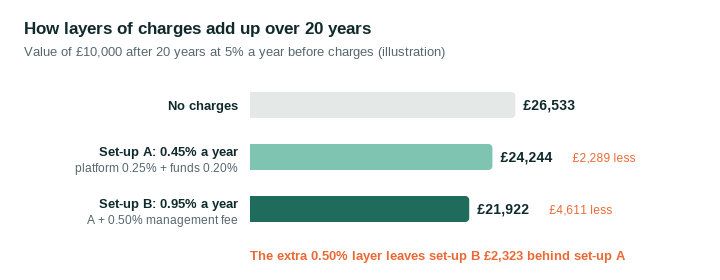
After 20 years, set-up B is worth £2,323 less than set-up A. Compared with no charges at all, set-up A costs £2,289 and set-up B costs £4,611. Whether the extra layer is worth it depends on what it adds for you, such as the rebalancing or the help choosing a risk level. Small differences compound: our fee study found 1% a year in charges takes around 30% of the growth over 30 years.
How does a ready-made portfolio compare with doing it yourself?
A ready-made portfolio trades a little extra cost, sometimes, for less work and less temptation to tinker. It tends to appeal to people who want a simple, diversified, hands-off approach and don’t want to choose or rebalance funds themselves.
Doing it yourself can be cheaper for people comfortable picking, for example, a global index fund and a bond fund, and rebalancing them once a year. It also gives more control over exactly what you hold. The trade-offs are time, the need to rebalance, and the risk of reacting to news and selling at the wrong moment.
There’s a middle route: a single low-cost multi-asset fund is itself a ready-made portfolio, often without a separate management fee. Many people compare that option with a managed portfolio or robo-adviser on total cost and service. Our platform fees guide explains how percentage and flat platform fees compare at different pot sizes.
What protection do you have if something goes wrong?
Compensation can cover a firm failing, but not markets falling. If a firm fails and there’s a shortfall in the money or assets it holds for you, the Financial Services Compensation Scheme (FSCS) may pay up to £85,000 per person, per firm, for firms that failed after 1 April 2019.
The FSCS also covers bad advice that caused you to lose money. It doesn’t cover poor investment performance, because the value of investments can go down as well as up.
Before you invest, the firm must give you key information about the product, its risks and its charges. MoneyHelper notes that cooling-off periods for investments last at least 14 or 30 calendar days, depending on the product. If the investment has fallen in value in the meantime, you might not get back the full amount.
What’s worth checking before choosing?
A handful of checks cover most of what matters. It’s worth checking:
- Authorisation. Is the firm on the FCA register with permission for the service it offers? The FCA’s Firm Checker explains how to look.
- Total cost in pounds for your amount, including platform, management and fund charges.
- The actual mix of shares and bonds, not just the label, and the risk score.
- The accounts offered, such as a stocks and shares ISA, Lifetime ISA, Junior ISA or SIPP.
- What happens in a fall. Does it rebalance automatically? How did the portfolio behave in past downturns?
- The service. Is it advice, a recommendation, discretionary management or a ready-made fund you manage yourself?
Common questions about ready-made portfolios
Can I hold a ready-made portfolio in an ISA?
Yes, in most cases. Multi-asset funds can be held in a stocks and shares ISA, a SIPP or a general account on most platforms, and many robo-advisers offer ISAs and pensions. You don’t pay tax on income or capital gains from investments in an ISA. Our ISA guide explains the rules and allowance.
How often are ready-made portfolios rebalanced?
It varies by provider. Some rebalance on a fixed timetable, such as quarterly or yearly; others rebalance when the mix drifts a set amount from its target. A multi-asset fund rebalances inside the fund. The provider’s documents describe the approach, and it’s a useful question to compare.
Can I change risk level later?
Usually, yes. Most services let you switch to a different portfolio; it’s worth checking for any switching or dealing charges. In a general investment account, switching means selling, which can create a Capital Gains Tax bill. Inside an ISA or pension there’s no tax on the switch.
Are lifestyle funds the same as ready-made portfolios?
They’re one kind. A lifestyle or target-date fund is a ready-made portfolio that changes its mix over time, gradually moving from shares into bonds and cash as a target date approaches. Some workplace pensions use them as default funds; our workplace pensions guide explains default funds.
Is a robo-adviser regulated?
The firm should be. Online investment services must be authorised by the FCA, and the FCA’s suitability rules apply whatever the medium. The FCA register shows a firm’s permissions, and the FCA’s Firm Checker explains why using a firm with the right permissions reduces the risk of harm.
Sources
- FCA: Automated investment services, our expectations (multi-firm review)
- FCA: PS25/20 Consumer Composite Investments, final rules
- FCA: PS25/22 Rules for targeted support
- FCA: Investment platforms costs and charges review, good and poor practice
- FCA: Authorised fund managers' assessments of fund value (2023)
- FCA: Financial Services Register
- FCA: Firm Checker
- CESR: Guidelines on the methodology for calculating the ongoing charges figure (CESR/10-674)
- GOV.UK: How ISAs work
- FSCS: Investments
- MoneyHelper: Investing for beginners
- MoneyHelper: Thinking about investing? Make sure you understand the risks
- MoneyHelper: Key information and cooling-off periods
Our guides are general information and education, not personal financial advice. If you are unsure whether an investment is right for you, speak to a regulated financial adviser. Capital at risk. Investments can fall as well as rise, and you may get back less than you put in.