Investing for Beginners: How to Start in the UK
In short
- MoneyHelper suggests keeping three to six months of cash for emergencies before you invest.
- Investing suits goals more than five years away, because values can fall in the short term.
- Choose the account first (an ISA, a pension or a general account), then what to hold in it.
- Funds spread your money across many companies, which is why most beginners start with them.
- Fees are taken every year and compound, and the FSCS doesn't cover investments falling in value.
- Emergency cash MoneyHelper suggests first
- 3–6 months
- Timescale investing is usually framed around
- 5+ years
- ISA allowance, 2026/27
- £20,000
- FSCS limit if an investment firm fails
- £85,000
On this page
- Before you start
- Should you pay off debt before investing?
- What’s the difference between saving and investing?
- How much money do you need to start investing?
- How investing makes money
- The main things you can invest in
- Where to hold your investments
- What investing costs
- How to choose a provider safely
- How to spot an investment scam
- Common beginner mistakes
- How to start investing, step by step
- Where to go next
- Related guides
- Sources
Investing means putting money into assets such as shares, bonds or funds, in the hope that they grow in value or pay you an income over time. Unlike money in a savings account, investments can fall in value as well as rise, and you may get back less than you put in. This guide explains what to sort out before you start, how investing works, the accounts UK investors use and what it costs.
Before you start
Investing works best with money you won’t need for a while, and as part of a wider plan. Two checks are worth making first.
Do you have an emergency fund? MoneyHelper, the free government-backed guidance service, suggests keeping enough cash to cover you for at least three to six months before you consider investing. That way, an unexpected bill or a drop in income doesn’t force you to sell investments at a bad time.
How long can you leave the money invested? MoneyHelper frames investing around goals that are more than five years away. Over shorter periods there is a greater chance that markets are down at the moment you need your money. It’s a guideline, not a rule, but the shorter your timescale, the more cash makes sense.
Should you pay off debt before investing?
Usually, expensive debt comes first. MoneyHelper’s general rule is to deal with any expensive debts and build up an emergency fund before investing, pointing out that you’ll rarely earn more on savings than you pay on borrowing. Priority debts, such as council tax, court fines and child maintenance, should always come first. Cheap, manageable borrowing such as a mortgage is a different question, and many people invest alongside it.
What’s the difference between saving and investing?
Saving usually means keeping money in cash, in a bank or building society account. Your balance doesn’t fall, it earns interest, and cash up to £120,000 per person, per bank is protected if the bank fails. The risk is that rising prices slowly reduce what it can buy.
Investing means buying assets such as shares, bonds or funds in the hope they’ll grow or pay an income. Over long periods investments have the potential to grow more than cash, but their value goes up and down, and you could get back less than you put in. MoneyHelper notes there’s no such thing as a no-risk investment, and that investing isn’t a way to get fast returns.
Most people need both: savings for emergencies and short-term plans, and investments for goals that are years away.
How much money do you need to start investing?
Less than many people expect. MoneyHelper says anyone over 18 can start investing, even if it’s only a few pounds. Many platforms let you invest small regular amounts each month, though minimums vary, so check the provider’s terms. What matters more than the starting amount is that the money can stay invested for the long term and that the charges suit a small balance. A flat yearly fee, for example, takes a much bigger share of a small pot. Our platform fees guide shows how to compare.
How investing makes money
There are two ways an investment can pay you:
- Growth. The investment becomes worth more than you paid for it, and you can sell it for a gain.
- Income. Shares can pay dividends and bonds pay interest. You can take this income or reinvest it.
Reinvested income buys more of the investment, which then earns its own returns. This is compounding, and it is why time in the market matters so much.
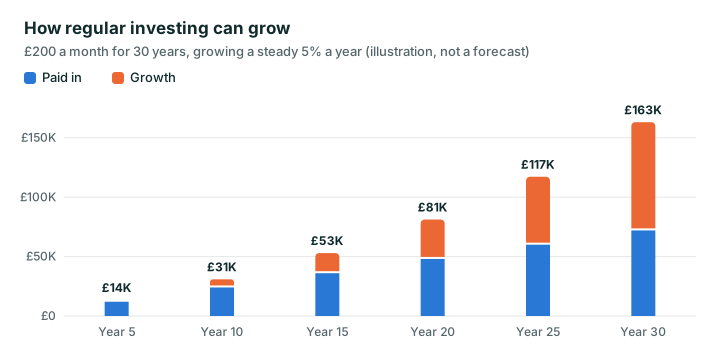
| After | Paid in | Value | Of which growth |
|---|---|---|---|
| 10 years | £24,000 | £30,873 | £6,873 |
| 20 years | £48,000 | £81,161 | £33,161 |
| 30 years | £72,000 | £163,075 | £91,075 |
Notice that growth makes up more of the pot the longer it runs. Our compound interest calculator shows the effect on your own numbers.
The main things you can invest in
Shares are small pieces of ownership in a company. Their value moves with the company’s fortunes and the wider market, and a single company can fall sharply or fail.
Bonds are loans to governments or companies that pay interest. They usually move less than shares, but they can still lose value.
Funds pool money from many investors and spread it across many shares or bonds. Spreading your money like this, called diversification, means one company doing badly has less effect on your overall investment. Most beginners start with funds rather than picking individual shares.
Index funds and ETFs are types of fund that aim to track a market index, such as the FTSE 100, rather than trying to beat it. They usually charge lower fees than actively managed funds, which employ managers to pick investments.
Where to hold your investments
Before you choose investments, you choose the account to hold them in. The account decides how they are taxed.
Stocks and shares ISA. You don’t pay tax on income or capital gains from investments in an ISA. In the 2026/27 tax year you can pay up to £20,000 into ISAs. Read our guide to how ISAs work.
Pension. Pensions get tax relief on money you pay in, but you can’t normally access the money until later in life. Many people already invest through a workplace pension without thinking of it as investing. Our guide to pension tax relief explains how the top-ups work.
General investment account. No contribution limit, but income and gains may be taxable once they exceed your tax-free allowances.
What investing costs
Costs come in several layers, and they matter because they are taken every year whether your investments rise or fall:
- Platform or account fee: what the provider charges to hold your account, either a fixed amount or a percentage of your balance.
- Fund charges: the annual cost of running a fund, shown as a percentage on the fund’s factsheet.
- Dealing charges: a fee each time you buy or sell, with some providers.
- Currency fees: charged when you buy investments priced in another currency.
A fee of 1% a year sounds small, but it is taken from your whole balance every year, and the money taken in fees also misses out on future growth. Try different fee levels in our calculator to see the difference over 20 or 30 years.
How to choose a provider safely
Before you open an account, check that the firm is authorised by the Financial Conduct Authority on the FCA Financial Services Register. Authorised investment firms are covered by the Financial Services Compensation Scheme: if an authorised firm fails and can’t return your investments, you may be able to claim up to £85,000. That investment limit is separate from, and lower than, the £120,000 limit for cash held in a bank or building society, which rose from £85,000 on 1 December 2025. The FSCS doesn’t cover losses from investments simply falling in value, and it says it can’t accept claims for poor investment performance.
How to spot an investment scam
Be wary of anyone who contacts you out of the blue about an investment, promises high or guaranteed returns, or pressures you to decide quickly. Before you invest with anyone, check the firm on the FCA’s register and use the FCA’s ScamSmart service.
Common beginner mistakes
Investing money you’ll need soon. If you might need the money within a few years, a fall in the market could force you to sell at a loss.
Reacting to short-term falls. Markets fall regularly. Selling after a fall turns a temporary drop into a permanent loss.
Putting everything in one company. A single share can fall sharply or become worthless. Funds spread that risk.
Ignoring fees. Two similar investments can produce very different results over decades if one costs more each year.
How to start investing, step by step
- Sort out the basics. Pay off expensive debt and build an emergency fund in cash.
- Decide what the money is for and when you’ll need it. Goals five or more years away suit investing better than short-term ones.
- Choose the account. A stocks and shares ISA for flexible tax-free investing, a pension for retirement with tax relief, or both. See our guides to the ISA allowance and pension tax relief.
- Choose a platform that’s on the FCA register and whose charges suit how much and how often you’ll invest.
- Choose your investments. Many beginners start with a broad, low-cost fund such as an index fund rather than individual shares.
- Invest regularly and review occasionally. Regular payments build the habit. Checking once or twice a year, rather than daily, makes it easier not to react to short-term falls.
Where to go next
- ISAs explained: the allowance, the types and the rules
- Compound interest calculator: see how regular investing and fees play out
- MoneyHelper: free, impartial guidance backed by the government
Sources
- MoneyHelper: Investing for beginners
- GOV.UK: Individual Savings Accounts (ISAs)
- GOV.UK: How ISAs work
- FSCS: Investments
- FSCS: What we cover
- FCA Financial Services Register
- FCA ScamSmart
- MoneyHelper: Pay off debt, save or invest first?
- MoneyHelper: Is investing for someone like you?
- MoneyHelper: Thinking about investing? Make sure you understand the risks
Our guides are general information and education, not personal financial advice. If you are unsure whether an investment is right for you, speak to a regulated financial adviser. Capital at risk. Investments can fall as well as rise, and you may get back less than you put in.