Flexible ISAs: Withdraw and Replace Money
TL;DR
- A flexible ISA lets you take cash out and put it back in the same tax year without using more of your £20,000 allowance.
- Cash ISAs, cash in a stocks and shares ISA, and innovative finance ISAs can be flexible. Lifetime ISAs and Junior ISAs can't.
- Offering flexibility is optional for providers, so it's worth checking the account's terms before taking money out.
- Money from earlier tax years can be put back too, but only into the same account and by 5 April.
- A planned £12,000 cash ISA limit for under-65s was cancelled at the Budget on 28 October 2026, so flexibility is unaffected.
Quick answers
- DependsDoes putting money back use allowance? Not if the ISA is flexible and it goes back by 5 April. Otherwise it counts as new money.
- NoAre all ISAs flexible? No. Each provider chooses. Lifetime ISAs and Junior ISAs can never be flexible.
- DateWhat's the deadline to put money back? 5 April, the end of the tax year you took it out.
- DependsCan it go back into another ISA? This year's money, yes. Earlier years' money, interest or growth can only go back into the same account.
- LimitCan I go over £20,000? Not with new money. Only earlier years' money put back in the same account comes on top.
- ISA allowance, 2026/27
- £20,000
- Deadline to replace money taken out this tax year
- 5 April
- Cash ISA limit in 2027/28, after the £12,000 cap was cancelled
- £20,000
- Allowance used by replacing a withdrawal in a flexible ISA
- £0
On this page
- What is a flexible ISA?
- How does a flexible ISA work? A worked example
- Which ISAs can be flexible?
- Do all providers offer flexible ISAs?
- Can you replace money from earlier tax years?
- How are mixed withdrawals counted?
- Does the 2027 cash ISA change affect flexible ISAs?
- What happens to a flexible ISA when you transfer it?
- Common questions about flexible ISAs
- What to do next
- Related guides
- Sources
A flexible ISA is an ISA that lets you take money out and put it back later in the same tax year without that money counting twice against your allowance. With an ordinary ISA, once money comes out, paying it back in counts as a new payment. This guide explains how flexibility works, which ISAs can offer it, what happens to money from earlier years, and why the cancelled 2027 cash ISA limit no longer affects it. For the basics of the yearly limit, see our ISA allowance guide.
What is a flexible ISA?
A flexible ISA is one whose terms let you replace cash you’ve withdrawn, in the same tax year, without the replacement using up more of your allowance. GOV.UK puts it simply: if your ISA is flexible, you can take out cash and put it back in during the same tax year without reducing your current year’s allowance.
The ISA allowance, also called the subscription limit, is the most you can pay into ISAs in a tax year. For 2026/27 it’s £20,000. A subscription is HMRC’s word for money you pay in. Without flexibility, a withdrawal doesn’t give any allowance back: money you take out and later pay back in is a fresh subscription.
Flexibility isn’t a separate type of ISA. It’s a feature that an ISA provider can switch on for a cash ISA, a stocks and shares ISA or an innovative finance ISA. The account works like any other ISA, except for how withdrawals and replacements are counted.
The window is the tax year, which runs from 6 April to 5 April. A withdrawal has to be replaced by 5 April in the same tax year. After that, the chance to put it back without using allowance is gone.
How does a flexible ISA work? A worked example
When you withdraw from a flexible ISA, HMRC’s rules treat the withdrawal as coming first from money you paid in this tax year. Your total paid in for the year goes down by that amount, which frees up the same amount of allowance to use again.
GOV.UK uses this example, and the numbers below are worked out from the site’s own rates file:
Example 1: you pay £10,000 into an ISA in the 2026/27 tax year, then take out £3,000.
- If the ISA is flexible, you can pay in up to £13,000 more that year: the £10,000 of allowance you hadn’t used, plus the £3,000 you took out.
- If it isn’t flexible, you can pay in only £10,000 more. The £3,000 withdrawal is simply gone from your allowance.
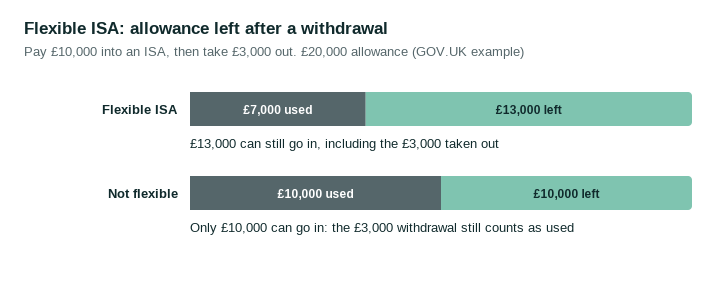
This is an illustration of how the rules count payments, not a recommendation to withdraw money.
Since April 2024, a withdrawal of money paid in this year reduces that account’s total for the year, and the freed allowance can be used in any ISA. HMRC’s guidance for providers confirms this. A withdrawal can’t take the year’s total below zero, though: anything taken out beyond what you paid in this year counts as a withdrawal of earlier money.
Which ISAs can be flexible?
Cash ISAs, cash withdrawn from a stocks and shares ISA (including sale proceeds), and innovative finance ISAs can be flexible; Lifetime ISAs and Junior ISAs can’t. HMRC’s guidance for ISA providers says flexibility can be offered in respect of cash only, and that Lifetime ISAs and Junior ISAs can’t be offered as flexible ISAs. The law sets this out in regulation 5DDB of the ISA Regulations 1998.
| ISA type | Can it be flexible? |
|---|---|
| Cash ISA | Yes, if the provider offers it |
| Stocks and shares ISA | Yes, for cash only, if the provider offers it |
| Innovative finance ISA | Yes, if the provider offers it |
| Lifetime ISA | No |
| Junior ISA | No |
“Cash only” matters for a stocks and shares ISA. Flexibility applies to cash you take out of the account. In practice that means investments are usually sold first, and it’s the cash withdrawal that can be replaced. Replacing it puts cash back into the ISA, which can then be reinvested. It doesn’t let you hand back the same shares or fund units. Our guide to stocks and shares ISAs versus cash ISAs explains how the two types differ more generally.
Do all providers offer flexible ISAs?
No: offering flexibility is optional, and each provider decides for each account. HMRC’s guidance for ISA providers says plainly that offering flexibility is optional for ISA managers. GOV.UK tells savers that their provider can tell them whether their ISA is flexible.
Because it’s a choice, two accounts of the same type can work differently. One provider may offer a flexible easy-access cash ISA and a non-flexible fixed-rate one. Another may make its stocks and shares ISA flexible but not its cash ISA. The account’s terms and conditions, or its key features document, normally say whether it’s flexible.
It’s worth checking before a withdrawal rather than after. If the account isn’t flexible, there’s no way to make an earlier withdrawal count as flexible later. The difference only matters to people who might take money out and want to put it back in the same tax year. For someone who never withdraws, a flexible ISA and an ordinary one behave the same way.
Flexibility doesn’t change the other terms. A fixed-rate cash ISA can still charge a penalty for early access, whether it’s flexible or not.
Can you replace money from earlier tax years?
Yes, if the ISA is flexible, but only in the same account and only before the end of the tax year in which you took it out. Money paid in during earlier tax years is called previous years’ subscriptions. HMRC’s guidance says withdrawals of these must be replaced in the same tax year, and can only be replaced in the account the withdrawal came from.
Replacing earlier years’ money doesn’t use any of this year’s allowance. That means a flexible ISA can let someone dip into savings built up over many years and restore them, as long as the money goes back into the same account by 5 April.
Example 2: a flexible cash ISA holds £30,000, all paid in during earlier years. Nothing has been paid in this tax year. In June the saver takes out £5,000 for a car repair.
- They can put the £5,000 back into the same account before 5 April without using any allowance.
- They can still pay in the full £20,000 of new money as well, so up to £25,000 in total could go into ISAs that year.
- If they put it into a different ISA instead, it would count as a new payment and use allowance.
The same “same account” rule covers anything you take out beyond what you paid in this year, such as interest, dividends or growth. HMRC’s guidance says those amounts can only be replaced in the ISA they came from.
How are mixed withdrawals counted?
HMRC’s rules set an order. A withdrawal is treated as coming first from this tax year’s payments into that account, then from earlier years’ money. A replacement is treated as going first to replace earlier years’ money, then this year’s.
Example 3: a flexible cash ISA holds £10,000 from earlier years. This tax year the saver pays in £4,000, then withdraws £6,000.
- The first £4,000 counts as a withdrawal of this year’s money, so the year’s total for that account falls to £0.
- The other £2,000 counts as earlier years’ money, and can only be replaced in this account.
- Altogether, up to £22,000 could go into ISAs before 5 April: the full £20,000 allowance, plus the £2,000 of earlier money replaced in this account.
- Without flexibility, only £16,000 more could go in that year.
These are illustrations of how HMRC counts payments, worked out from the current allowance. They aren’t a forecast or a suggestion to withdraw.
Does the 2027 cash ISA change affect flexible ISAs?
No longer. The government had planned a £12,000 cash ISA limit for under-65s from 6 April 2027, and the regulations would have stopped flexibility being used to push cash payments above it. The limit was cancelled at the Budget on 28 October 2026, so replacing a cash ISA withdrawal only has to fit within the usual £20,000 allowance, as it does now. The Treasury says regulations keeping the £20,000 cash limit will be laid before Parliament in November 2026; until they are, it’s worth checking with the provider if you’re relying on flexibility in 2027/28. The rest of the rules are in our ISA allowance guide.
What happens to a flexible ISA when you transfer it?
A transfer passes on what you’ve paid in, net of withdrawals, but it can limit your chance to replace money afterwards. HMRC’s guidance for providers says the old provider must tell the new one your current year’s subscriptions, less any amounts withdrawn. A transfer itself doesn’t use any allowance.
For money paid in this year, HMRC’s guidance says the old provider passes on your net payments for the year, so allowance freed up by a withdrawal carries across with the transfer. There’s one exception: if your net payments for the year are nil when the transfer happens, the chance to replace any of this year’s income or growth taken out before the transfer is lost.
Earlier years’ money is different. It can only be replaced in the account it came from, so once that account has moved, the chance to replace it may go. Bulk transfers, where a provider moves all its customers to another firm, are treated more generously.
Many people who have withdrawn money in the year ask both providers how a transfer will affect replacement before going ahead. Our guide to transferring an ISA covers the rest of the process.
Common questions about flexible ISAs
How do you know if your ISA is flexible?
Ask the provider, or check the account’s terms and conditions or key features document. GOV.UK says your provider can tell you whether your ISA is flexible. Flexibility is set account by account, so a provider can offer it on some ISAs and not others. It’s worth confirming before taking money out, not afterwards.
Can you put the money back into a different ISA?
For money you paid in this tax year, yes: since April 2024 a withdrawal reduces that account’s total for the year, and the freed allowance can be used in any ISA. Earlier years’ money, and any interest or growth you take out, can only be replaced in the account it came from. Putting it anywhere else counts as a new payment.
Is there a time limit for putting money back?
Yes. A replacement must be made in the same tax year as the withdrawal, so by 5 April. If you take money out on 1 April, you have five days. On 6 April a new tax year starts, and anything put back then counts as a new payment against the new year’s allowance.
Can a Lifetime ISA or Junior ISA be flexible?
No. HMRC’s rules say neither can be offered as a flexible ISA. Taking money out of a Lifetime ISA before 60, other than to buy a first home or in terminal illness, means a 25% charge. A Junior ISA can’t normally be withdrawn from until the child turns 18.
Does flexibility let you go over the £20,000 allowance?
Not for new money. It only stops a withdrawal from wasting allowance. The total of this year’s new payments, after taking off withdrawals, still can’t go above £20,000. The only extra is earlier years’ money put back into the same account. Our ISA allowance checker helps keep a running total.
Is a flexible ISA the same as an easy-access ISA?
No. Easy access is about whether you can withdraw without notice or penalty. Flexibility is about whether a withdrawal can be put back without using allowance. An easy-access ISA can be non-flexible, and a flexible ISA can have notice periods or penalties. Our glossary defines other ISA terms.
Sources
- HMRC: Tax-free savings newsletter 24 (October 2026): cash ISA limit retained, related rules revoked
- HM Treasury: Budget 2026 press release (28 October 2026)
- GOV.UK: Withdrawing your money from an ISA
- HMRC: Manage ISA subscriptions for your investors (guidance for ISA managers)
- HMRC: Transfer an ISA (guidance for ISA managers)
- The Individual Savings Account Regulations 1998, regulation 5DDB (flexible account)
- The Individual Savings Account (Amendment) (No. 2) Regulations 2026 (SI 2026/1018)
- HMRC: Tax-free savings newsletter 19 (November 2025)
- HMRC: Tax-free savings newsletter 23 (September 2026)
- GOV.UK: Transferring your ISA
Our guides are general information and education, not personal financial advice. If you are unsure whether an investment is right for you, speak to a regulated financial adviser. Capital at risk. Investments can fall as well as rise, and you may get back less than you put in.