Bed and ISA: Moving Investments Into an ISA
TL;DR
- Bed and ISA means selling investments held outside an ISA, then buying them back inside one. Existing shares usually can't be moved in directly.
- The sale can trigger Capital Gains Tax. In 2026/27 the first £3,000 of gains is tax-free; above that, gains are taxed at 18% or 24%.
- The 30-day 'bed and breakfast' rule doesn't get in the way, because HMRC treats ISA holdings separately from your other shares.
- Every pound paid into the ISA counts towards the £20,000 yearly allowance, so a large holding can take several tax years to move.
- Costs can include dealing charges, the spread, 0.5% stamp duty on UK shares, and a short time out of the market.
Quick answers
- NoCan I move shares straight into an ISA? Not normally. GOV.UK says shares you own can't be transferred in, except from employee share schemes.
- Watch outIs the sale taxed? It can be. Gains above £3,000 in 2026/27 are taxed at 18% or 24%.
- NoDoes the 30-day rule apply? Not when the buyback is inside an ISA. ISA holdings count as held in a different capacity.
- LimitDoes it use my ISA allowance? Yes. Every pound paid in counts towards the £20,000 allowance for 2026/27.
- CostAre there costs? There can be: dealing charges, the spread, 0.5% stamp duty on UK shares, and time out of the market.
- YesCan couples move more each year? Yes. Each partner has their own ISA allowance and their own £3,000 CGT allowance.
- ISA allowance a bed and ISA uses, 2026/27
- £20,000
- Capital Gains Tax annual exempt amount, 2026/27
- £3,000
- CGT rates on gains above the allowance
- 18% / 24%
- Bed and breakfast rule, which an ISA buyback sits outside
- 30 days
On this page
- What is bed and ISA, and why do people do it?
- Is the sale taxed?
- Worked example: how much CGT could a bed and ISA create?
- Does the 30-day “bed and breakfast” rule apply?
- How does bed and ISA use your ISA allowance?
- What are the costs, and how long are you out of the market?
- How do couples use bed and ISA?
- What about bed and SIPP?
- Common questions about bed and ISA
- What to do next
- Related guides
- Sources
“Bed and ISA” is the name for selling investments you hold outside an ISA, usually in a general investment account, and buying the same investments back inside a stocks and shares ISA. GOV.UK says you can’t normally transfer shares you already own into an ISA, unless they come from an employee share scheme, so selling and rebuying is the usual route. Once inside the ISA, future dividends, interest and gains are free of UK tax. This guide explains how it works in 2026/27, the Capital Gains Tax it can trigger, why the 30-day rule doesn’t get in the way, the costs, and how couples and pension savers use similar ideas.
What is bed and ISA, and why do people do it?
Bed and ISA is a sale in one account followed by a purchase of the same investment in an ISA, so the holding ends up inside the tax wrapper. Many platforms offer it as a single instruction, selling in the general account and buying in the ISA on the same day.
People do it for three main reasons:
- To shelter future returns. Outside an ISA, dividends above the £500 dividend allowance are taxed at 10.75%, 35.75% or 39.35% in 2026/27, and gains above £3,000 are taxed when sold. Inside an ISA they aren’t.
- To use the Capital Gains Tax allowance. Selling realises a gain. If it fits within the year’s £3,000 annual exempt amount, no tax is due, and the new ISA holding has no future CGT at all.
- To simplify tax returns. ISA income and gains don’t need reporting to HMRC, so moving holdings in reduces what a general account produces for Self Assessment.
The trade-off is that each move uses ISA allowance, can trigger tax on larger gains and has some costs.
Is the sale taxed?
Yes, the sale in the general account is a disposal for Capital Gains Tax (CGT), exactly like any other sale. Your gain is broadly the sale proceeds minus what the investment cost, including dealing costs. In 2026/27 the first £3,000 of your total gains for the year is tax-free. Above that, gains are taxed at 18% on the part that fits in your unused basic-rate band and 24% on the rest, after adding the gains to your taxable income.
If you’ve bought the same shares or fund units at different times, HMRC pools them into a “section 104 holding” and treats each one as bought at the same average cost. So when you sell part of a holding, the cost you deduct is the matching share of that average, not the price of any particular purchase.
If you make a loss instead, it can be set against gains in the same year, and any unused loss can be carried forward. GOV.UK says you must claim a loss within four years of the end of the tax year you made it. Our guide to tax on investments covers CGT in more depth, and the dividend and Capital Gains Tax calculator works out the tax on your own figures.
Worked example: how much CGT could a bed and ISA create?
This is an illustration, not a forecast. Someone holds a fund in a general investment account worth £20,000, which cost £14,000 in total. They want to move it all into an ISA in 2026/27, using the full £20,000 allowance. They have made no other gains this year.
| Sell it all this year | Sell half this year | |
|---|---|---|
| Sale proceeds | £20,000 | £10,000 |
| Share of pooled cost | £14,000 | £7,000 |
| Gain | £6,000 | £3,000 |
| Taxable after £3,000 allowance | £3,000 | £0 |
| CGT, basic-rate taxpayer (£30,000 taxable income) | £540 | £0 |
| CGT, higher-rate taxpayer (£60,000 taxable income) | £720 | £0 |
Selling everything at once creates a £6,000 gain. After the allowance, £3,000 is taxable: £540 at 18% for the basic-rate taxpayer, whose gain fits inside their remaining basic-rate band, and £720 at 24% for the higher-rate taxpayer.
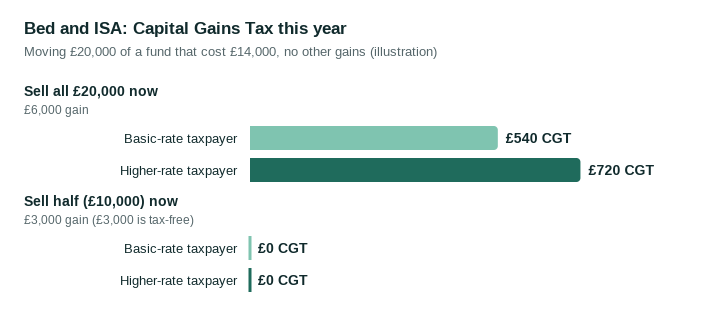
Selling half uses the section 104 average cost, so half the cost is deducted. The £3,000 gain falls within the allowance and there’s no CGT. The other half could be moved in the next tax year, using that year’s ISA and CGT allowances. The cost of spreading it out is that half the money stays outside the ISA for longer. The figures come from the same tax code as our calculators.
Does the 30-day “bed and breakfast” rule apply?
No, not when the buyback is inside an ISA. HMRC’s share identification rules normally match a sale with a purchase of the same shares made by the same person in the same capacity on the same day, then within the following 30 days. Only after that is the sale matched with the section 104 holding. This 30-day rule, often called the “bed and breakfast” rule, stops people selling and immediately buying back just to use their allowance or to reset their cost.
The ISA regulations change this for ISA holdings. Regulation 34 of the Individual Savings Account Regulations 1998 says the pooling and matching rules apply to ISA investments separately, as if the person held them in a different capacity from any other shares of the same class. So a purchase inside your ISA isn’t matched with a sale in your general account. The sale is matched with your existing holding, as normal, and the gain or loss is real for tax purposes.
The 30-day rule still applies if you sell in a general account and buy back in the same general account, or another general account in your own name, within 30 days.
How does bed and ISA use your ISA allowance?
Every pound you put into the ISA to buy the investments counts towards your allowance, which is £20,000 for 2026/27 across all your ISAs. A bed and ISA is a new subscription of cash, not a transfer, so it’s treated the same as paying in fresh money.
That limits how fast a large general account can be moved. Someone with three times the allowance outside an ISA needs at least three tax years to move it all, even if they pay nothing else into ISAs. If they also pay new savings into an ISA, that leaves less room for bed and ISA in the same year.
Growth after the money is inside the ISA doesn’t use allowance. Our ISA allowance guide explains what counts, and the ISA allowance checker shows how much is left this year. If the ISA is flexible, money withdrawn and replaced in the same tax year doesn’t use allowance, but a bed and ISA from a general account is always new money.
What are the costs, and how long are you out of the market?
The main costs are dealing charges, the spread, stamp duty on some purchases and a short period out of the market. They vary by platform and investment, so it’s worth checking the charges for both the sale and the purchase.
- Dealing charges. Some platforms charge per trade on shares, ETFs and investment trusts, and may charge less, or nothing, when the sale and purchase are done together.
- The spread. Shares and ETFs have a buying price and a lower selling price. Selling and rebuying means paying that difference once.
- Stamp duty. GOV.UK says you usually pay 0.5% Stamp Duty Reserve Tax when you buy existing shares in a UK company electronically. On a £20,000 purchase of UK shares, that’s £100. Funds bought directly from the fund manager don’t attract it, and foreign shares bought outside the UK normally don’t either.
- Time out of the market. Between the sale and the purchase, the price can move either way. Shares and ETFs trade during the day, so the gap can be minutes. Funds are usually priced once a day, so the sale and purchase may happen at different valuation points, or on different days.
Our platform fee calculator compares the ongoing cost of holding the result, and how to transfer investments covers moving accounts between platforms.
How do couples use bed and ISA?
Each person has their own ISA allowance and their own CGT annual exempt amount, so a couple can move up to twice as much each year between them. ISAs are always in one name, so if a general account is joint, each partner uses their own ISA.
GOV.UK says you don’t pay CGT on assets you give to your spouse or civil partner, as long as you lived together at some point in the tax year. When they later sell, their gain is worked out from what you originally paid. So one partner can pass investments to the other, who then sells and rebuys inside their own ISA, using their own allowances. This can help if one partner has already used their CGT allowance, or pays CGT at 24% while the other pays 18%.
HMRC’s matching rules apply to purchases “by the same person”, so a purchase by a spouse isn’t matched with your sale under the 30-day rule. Gifts to anyone else, such as an adult child, count as a disposal at market value.
What about bed and SIPP?
Bed and SIPP works the same way, but the money goes into a self-invested personal pension instead of an ISA. The investments are sold in the general account, which may create a capital gain, and the cash is paid into the SIPP, where the same investments can be bought again.
The difference is pension tax relief. The provider adds basic-rate relief, so a £8,000 contribution becomes £10,000 in the pension. Higher-rate and additional-rate taxpayers can claim more through Self Assessment. Relief is limited to 100% of your earnings for the year (or £2,880 paid in, £3,600 with relief, if you earn less than that), and total pension saving above the £60,000 annual allowance can be taxed.
The money is then locked away until the minimum pension age, normally 55 and rising to 57 from 6 April 2028, and withdrawals are taxed as income apart from the tax-free part. Our guide to ISA or pension compares the two.
Common questions about bed and ISA
Can I bed and ISA at a loss?
Yes. Because the ISA purchase isn’t matched with the sale, the loss is a real capital loss. It’s set against other gains in the same tax year, and any unused part can be carried forward, as long as it’s claimed within four years of the end of the tax year.
Do I need to report a bed and ISA to HMRC?
Only if the sale creates something reportable. If your total gains for the year are above £3,000, you must report and pay the tax, either through HMRC’s real-time CGT service by 31 December after the tax year or on a Self Assessment return. Self Assessment filers must also report disposals if total sale proceeds were over £50,000.
Can I do a bed and ISA with funds as well as shares?
Yes. Unit trusts, OEICs, ETFs and investment trusts can all be sold outside an ISA and bought back inside one, as long as the platform’s ISA can hold them. The matching rules and the separate-capacity treatment for ISAs apply to fund units in the same way as shares.
Does it matter when in the tax year I do it?
Each tax year has its own ISA allowance and its own CGT annual exempt amount. Some people move part of a holding before 5 April and the rest after 6 April, so two years’ allowances are available within a few weeks. The tax year a sale falls in is set by the date of the sale.
Can I bed and ISA into a Lifetime ISA?
A Lifetime ISA can hold stocks and shares, and cash paid in counts towards both its £4,000 yearly limit and the overall £20,000 allowance. The government bonus and withdrawal rules then apply, so the money is treated like any other Lifetime ISA payment.
Sources
- GOV.UK: How ISAs work
- GOV.UK: Individual Savings Accounts (ISAs)
- The Individual Savings Account Regulations 1998, regulation 34
- HMRC Capital Gains Manual CG51560: share identification rules
- HMRC: Shares and Capital Gains Tax (HS284, 2026)
- GOV.UK: Capital Gains Tax rates
- GOV.UK: Capital Gains Tax rates and allowances
- GOV.UK: Capital Gains Tax, gifts to your spouse or charity
- GOV.UK: Capital Gains Tax, losses
- GOV.UK: Work out if you need to pay Capital Gains Tax
- GOV.UK: Report and pay your Capital Gains Tax
- GOV.UK: Tax when you buy shares
- GOV.UK: Tax on dividends
- GOV.UK: Pension tax relief
- GOV.UK: Annual allowance
- HMRC: Increasing the normal minimum pension age
Our guides are general information and education, not personal financial advice. If you are unsure whether an investment is right for you, speak to a regulated financial adviser. Capital at risk. Investments can fall as well as rise, and you may get back less than you put in.