What Should I Do With My Money? UK Guide
TL;DR
- MoneyHelper suggests a general order: budget, priority bills, expensive debt, emergency savings, then saving, investing and pensions for goals.
- Expensive debts like credit and store cards usually cost more in interest than savings earn, so many people clear them first.
- MoneyHelper suggests an emergency fund of three to six months' essential outgoings, kept in instant-access savings.
- Employer pension payments, Help to Save and the Lifetime ISA bonus add money on top of what you pay in.
- Money needed in the next few years usually stays in cash. Longer-term money is often invested in an ISA or pension.
Quick answers
- DependsPay off debt or save first? MoneyHelper's general rule: priority bills first, then expensive debts, then build an emergency fund.
- LimitHow much emergency cash do people keep? MoneyHelper suggests three to six months' essential outgoings in an instant-access account.
- Watch outIs opting out of a workplace pension free? No. You lose your employer's payments, and the tax relief that comes with yours.
- YesSavings bonus on Universal Credit? If you had some take-home pay, Help to Save adds 50p per £1, up to £1,200.
- DependsWhen does investing come in? Usually for money you won't need for the next few years, once debts and a safety net are sorted.
- LimitIs my cash protected? Up to £120,000 per person, per banking licence, by the FSCS if a bank fails.
- Essential outgoings MoneyHelper suggests for an emergency fund
- 3 to 6 months
- Minimum employer payment into a workplace pension
- 3%
- Help to Save bonus, up to £1,200 over four years
- 50%
- ISA allowance, 2026/27
- £20,000
On this page
- What order do people usually sort their money in?
- Why start with a budget?
- Should I pay off debt or save first?
- How big an emergency fund do people keep?
- What free money do people often miss?
- Why does the workplace pension matter so much?
- How does pension tax relief work?
- What is Help to Save?
- Is a Lifetime ISA worth it?
- Where does money for goals usually go?
- Common questions
- What to do next
- Related guides
- Sources
“What should I do with my money?” usually comes up when there’s something left at the end of the month, a pay rise, a bonus or a lump sum. There’s no single right answer, because it depends on your debts, your safety net, your employer’s pension and when you’ll need the money. But there is a common order that many people work through, set out by MoneyHelper, the free government-backed guidance service. This guide walks through each step, shows the free top-ups many people miss, and works through the numbers.
It explains how things work. It isn’t personal advice, and many people do several steps at once rather than strictly one after another.
What order do people usually sort their money in?
MoneyHelper’s beginner’s guide to managing money and its “Pay off debt, save or invest first?” guidance set out a general order. Combined with the government top-ups covered below, it looks roughly like this:
- Know where your money goes. A budget shows what’s coming in, what’s going out and what’s left. MoneyHelper also suggests checking you’re getting any benefits you’re entitled to.
- Keep up essential bills and priority debts. MoneyHelper says priority debts, such as council tax, court fines and child maintenance, come before saving, because missing them can have serious consequences.
- Deal with expensive debt. Credit cards, store cards, Buy Now Pay Later and short-term loans usually charge more interest than savings earn.
- Build an emergency fund. Three to six months of essential outgoings in instant-access savings.
- Take the free money. MoneyHelper warns against missing out on employer pension contributions. Help to Save and the Lifetime ISA bonus, both GOV.UK schemes, also add money on top of yours.
- Save and invest for goals. Cash for money needed in the next few years; ISAs and pensions for longer-term goals.
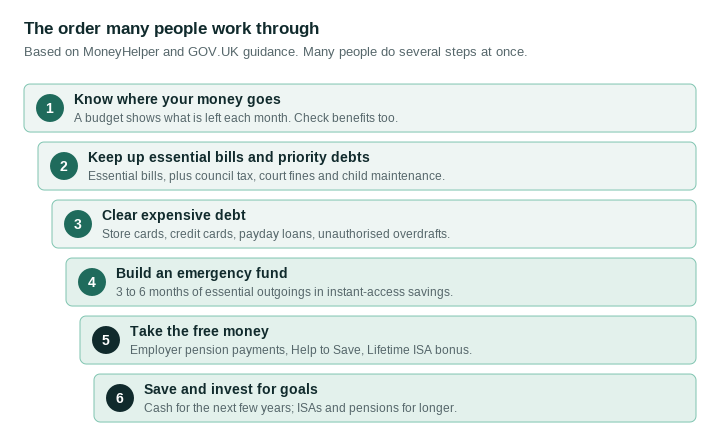
The order isn’t a rule. Someone with a generous employer pension might keep paying into it while clearing a credit card. What the order does is put the cheapest wins and the biggest risks first: an unpaid council tax bill or a 20% credit card costs more than almost any investment could reliably earn.
Why start with a budget?
Everything else depends on knowing how much is genuinely spare. MoneyHelper’s first two steps are to understand where your money goes and then create a budget. That means listing income after tax and every regular outgoing, including the irregular ones such as car insurance or birthdays, spread out as a monthly amount.
The budget answers two questions that shape every later step. First, what are your essential outgoings? These are the bills you must pay: rent or mortgage, council tax, energy, food, transport and minimum debt repayments. They set the size of your emergency fund. Second, what’s left each month? That’s the money the rest of this guide is about.
If outgoings are higher than income, MoneyHelper suggests starting with non-essential spending before cutting essentials, and getting free debt help early. Our take-home pay calculator shows what you actually receive after tax, National Insurance, pension and student loan, which is the right starting figure for a budget.
Should I pay off debt or save first?
MoneyHelper’s general rule is to deal with expensive debts and build an emergency fund first, and only then invest money you won’t need for the next few years. Within that, priority debts come first of all: MoneyHelper names council tax, court fines and child maintenance, because the consequences of missing them are more serious than for other debts.
Next come expensive debts. MoneyHelper lists store cards, credit cards, Buy Now Pay Later and short-term loans as usually having higher rates, with store cards usually the most expensive. Its emergency savings guide adds unauthorised overdrafts, payday loans, home credit and mortgage arrears to the list of debts that are cheaper in the long run to pay off first. Its beginner’s guide suggests tackling the debt with the highest interest rate, or the one charging late fees, first, while keeping up at least the minimum payments on the rest.
Here’s why. Take an illustrative £2,000 credit card balance at 20% a year. That costs about £400 a year in interest. The same £2,000 in savings at an illustrative 4% earns about £80. Paying off the card is like earning 20% with certainty, which no savings account offers. These are round illustrative rates; your own card statement shows your real one.
Many people don’t treat a mortgage in the same way. MoneyHelper notes that a mortgage could help you build a more secure future, but only if you can afford the monthly repayments and are able to sell at a good moment for house prices. Whether to overpay a mortgage or save and invest instead is one of the genuine “it depends” questions, and many people do a bit of each.
How big an emergency fund do people keep?
MoneyHelper suggests aiming for three to six months’ essential outgoings in an instant-access savings account, so the money is there the day you need it. An emergency fund pays for things like a boiler breakdown, a car repair or a gap between jobs without reaching for a credit card or selling investments after a fall.
Worked example: if your essential outgoings are £1,500 a month, three to six months is £4,500 to £9,000. MoneyHelper’s own example uses £1,000 a month, giving £3,000 to £6,000. Many people build it gradually, starting with a smaller buffer and adding to it each month.
Where you sit in that range comes down to how secure your income is and how many people rely on it.
Cash savings in a UK bank or building society are protected by the FSCS up to £120,000 per person, per authorised firm, a limit that rose from £85,000 on 1 December 2025. Brands that share a banking licence count as one bank for this limit. Interest is taxable above your Personal Savings Allowance, which is £1,000 a year for basic-rate taxpayers and £500 for higher-rate taxpayers in 2026/27. Interest inside a cash ISA is tax-free.
What free money do people often miss?
Some places add money on top of what you pay in. These top-ups are why many people keep paying into them even while working through the earlier steps:
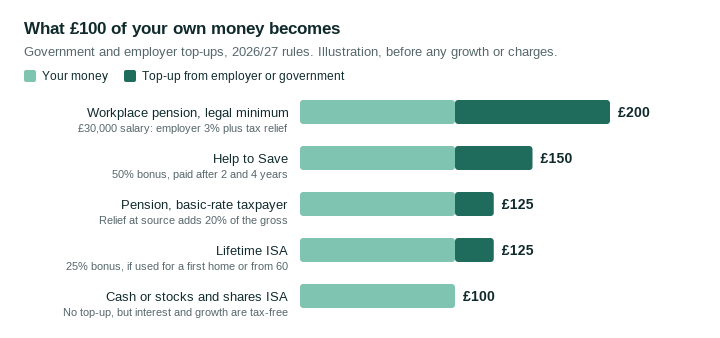
For every £100 of your own money, that’s £200 in a workplace pension at the legal minimum, £150 with Help to Save, £125 in a pension for a basic-rate taxpayer or in a Lifetime ISA, and £100 in an ordinary ISA. Each top-up comes with conditions, covered below.
Why does the workplace pension matter so much?
Under auto-enrolment, most employers must put eligible workers into a workplace pension and pay in. The legal minimum is 8% of qualifying earnings, of which at least 3% comes from the employer. Qualifying earnings are pay between £6,240 and £50,270 a year, in most schemes. Some employers pay more than the minimum.
Worked example on a £30,000 salary, with qualifying earnings of £23,760 and a relief-at-source scheme:
| Who pays | A year | A month |
|---|---|---|
| You, from take-home pay | £950.40 | £79.20 |
| Tax relief from the government | £237.60 | £19.80 |
| Your employer | £712.80 | £59.40 |
| Total into your pension | £1,900.80 | £158.40 |
So every £1 from take-home pay becomes £2.00 in the pension before any growth. You can opt out, but The Pensions Regulator says the opt-out notice warns that you lose the right to your employer’s contributions and may have a lower income in retirement. If you opt out in the one-month opt-out period, you get a full refund of what you paid in. Employers normally re-enrol you around every three years, and must not encourage you to opt out. Our workplace pensions guide covers the rules in full.
How does pension tax relief work?
Money you pay into a pension gets tax relief. In a relief-at-source scheme, you pay from take-home pay and the provider claims 20% from the government, so £100 from you becomes £125 in the pot. GOV.UK says the provider adds this even if you don’t pay income tax, on payments up to £2,880 a year if you have no earnings.
Higher-rate and additional-rate taxpayers can claim more through their Self Assessment tax return. A higher-rate taxpayer who pays in £100 gets £125 in the pot and can claim £25 back, so it costs them £75. That’s about £167 in the pot for every £100 it really costs.
The catch is access. Pension money is locked away until later life, so it suits long-term goals, not a house deposit or a rainy day. Our guide to the tax-free lump sum covers when and how it can be taken. Relief applies to contributions up to 100% of your earnings. Our pension tax relief guide and ISA or pension guide explain the trade-offs.
What is Help to Save?
Help to Save is a government savings account for people getting Universal Credit who had take-home pay of £1 or more in their last monthly assessment period. You can save between £1 and £50 each calendar month, and the government adds a 50% bonus over 4 years:
- After 2 years: a first bonus of 50% of your highest balance.
- After 4 years: a final bonus of 50% of how much your highest balance grew in years 3 and 4.
Worked example: saving the full £50 a month without withdrawing builds a highest balance of £1,200 by year 2, earning a £600 first bonus. By year 4 the highest balance reaches £2,400, so the final bonus is 50% of the extra £1,200: £600. That’s £2,400 saved plus £1,200 in bonuses, the maximum.
You can withdraw money to your bank account, and you keep any bonus already earned, but withdrawals can reduce the next bonus. The account closes after four years, and you can only ever have one. HMRC said in September 2026 that the scheme has been made permanent. Because withdrawals are allowed and the bonus is far higher than savings interest rates, it can also work as an emergency fund for people who qualify.
Is a Lifetime ISA worth it?
A Lifetime ISA lets people aged 18 to 39 open an account and pay in up to £4,000 a year until they’re 50. The government adds a 25% bonus, up to £1,000 a year. The money can go towards a first home costing £450,000 or less, or be taken from age 60.
The 25% bonus is generous, but the conditions matter. Taking money out for any other reason means a 25% withdrawal charge on the amount withdrawn, which takes back the bonus and some of your own money too. Buying a first home over the £450,000 cap now means a 20% charge instead. Lifetime ISA payments also count towards your £20,000 ISA allowance.
So it tends to suit people fairly sure they’ll buy a first home under the cap, or who want an extra pot for later life, rather than money they might need for something else. Our Lifetime ISA guide and Lifetime ISA calculator go into the details.
Where does money for goals usually go?
Once the earlier steps are covered, what’s left is usually split by when you’ll need it:
- In the next few years (a car, a wedding, a deposit): cash or a cash ISA, so a market fall can’t eat into it just before you need it.
- Longer-term goals: many people invest through a stocks and shares ISA, where up to £20,000 a year can go in 2026/27 tax-free, or top up their pension.
- Beyond the allowances: a general investment account, where tax applies above the yearly allowances.
MoneyHelper’s general rule is to invest only money you won’t need for the next few years, because values can fall as well as rise and need time to recover. Our guide Should I invest my savings? works through cash against investing over different time frames, and cash ISA vs stocks and shares ISA compares the two accounts. MoneyHelper’s list also includes protection, such as life or income protection insurance, for people whose household depends on their income.
Common questions
What do people do with spare money each month?
Many people set up a standing order on payday, so the money moves before it can be spent. Where it goes follows the order above: extra payments on the most expensive debt first, then the emergency fund until it reaches three to six months of essentials, then goals. People with a workplace pension often check their scheme’s rules, because some employers pay more than the 3% minimum. Once there’s a safety net, monthly amounts often go into a stocks and shares ISA or a pension for long-term goals. Investing monthly also spreads out the timing, which our guide to lump sums and drip-feeding explains. Our savings goal calculator shows how long a monthly amount takes to reach a target. None of this has to be perfect from day one: many people start small and increase the amount after each pay rise.
Should I stop pension payments to clear debt?
It’s a common question when money is tight. The trade-off is that stopping a workplace pension usually means losing your employer’s payments as well as the tax relief, so each £1 you stop paying can mean around £2.00 less going into your pension at the legal minimum, using our example. The Pensions Regulator says opting out means losing the right to your employer’s contributions, and that employers normally re-enrol people around every three years. Against that, very expensive debt, or priority debts like council tax arrears, can do serious damage if they’re not dealt with. MoneyHelper’s free debt advice can look at the whole picture, including whether a debt solution would leave pension saving in place. Many people choose to keep at least the minimum going while cutting other spending.
What do people do with a lump sum like £10,000?
The same order applies, just faster. A lump sum often clears expensive debt in one go and fills any gap in the emergency fund. What’s left usually goes by time frame: cash or a cash ISA for money needed in the next few years, and investing for longer-term goals. With £20,000 of ISA allowance a year, the whole £10,000 can usually go into an ISA. Some people invest a lump sum all at once; others feed it in monthly, and our guide to lump sums and drip-feeding sets out what the research shows. Our guide Should I invest my savings? works through a £10,000 example in cash and invested over 1, 5, 10 and 20 years. Remember the FSCS limit if a lump sum makes your cash balance large: it’s £120,000 per person, per authorised firm.
Where can I get free help with money decisions?
MoneyHelper gives free, impartial guidance on budgeting, debt, saving, investing and pensions, and can point you to free debt advice. Its tools include a bill prioritiser for working out which bills to pay first. For a recommendation based on your own circumstances, you need a regulated financial adviser, who will usually charge a fee. If you’re new to investing, our beginner course takes you through the basics in order, starting with how investing works.
Sources
- MoneyHelper: Managing your money, a beginner's guide
- MoneyHelper: Pay off debt, save or invest first?
- MoneyHelper: Emergency savings, how much is enough?
- GOV.UK: Get help with savings if you're on a low income (Help to Save)
- GOV.UK: Help to Save, what you'll get
- GOV.UK: Help to Save, eligibility
- HMRC: More than £300 million paid out through Help to Save (21 September 2026)
- GOV.UK: Workplace pensions, what you, your employer and the government pay
- GOV.UK: Workplace pensions, what your employer can and cannot do
- The Pensions Regulator: Opting out
- GOV.UK: Tax on your private pension contributions, tax relief
- GOV.UK: Individual Savings Accounts (ISAs)
- GOV.UK: Lifetime ISA
- GOV.UK: Lifetime ISA, who can open one
- GOV.UK: Lifetime ISA, withdrawing money
- FSCS: Deposit protection limit
- GOV.UK: Tax on savings interest, how much is tax-free
Our guides are general information and education, not personal financial advice. If you are unsure whether an investment is right for you, speak to a regulated financial adviser. Capital at risk. Investments can fall as well as rise, and you may get back less than you put in.